Thinking about the management of tomorrow is probably a waste of time, and I say that as someone who gets paid to do it.
The first reason is that the concept keeps moving underneath the forecast. I now speak more often about enableship and level 6 leadership than about management, which tells you something about how fast the vocabulary turns over.

The second reason is that I am convinced the future belongs neither to employees nor to staff in the old sense. It belongs to contributors, and to organisations that build their success with those people rather than through them.
Every forecast you will read about the management of tomorrow describes the same person: empathetic, agile, digitally fluent, inclusive, sustainable and permanently learning. That composite is accurate, unobjectionable and impossible to be. It also assumes something nobody checks, which is that the job itself survives in its current shape.
The pressures behind that composite are the ones I set out in the 7 management crises, where climate, trust, meaning, psychological health, skills, social connection and engagement form a single causal chain rather than seven separate problems. I take the meaning link of that chain further in what a manager can actually fix about meaning at work.
So this article asks a different question. Once coordination becomes cheap, what is management actually for, and what is left that cannot be automated or handed to the team?
| The forecast everyone writes | What it assumes without checking | The question underneath |
|---|---|---|
| A composite nobody can bePredictions about the management of tomorrow converge on one figure: empathetic, agile, digitally fluent, inclusive, sustainable and continuously learning. Each quality is defensible on its own, and assembled together they describe a person who does not exist. | That the role survives unchangedCompetency forecasts take the management layer as a fixed feature of organisations and argue only about what fills it. Teams coordinating themselves and software handling routine coordination both compress that layer, which no skills list accounts for. | What management is forBenjamin Chaminade’s position is that the manager existed because moving information was expensive. As that cost collapses, the durable work is deciding under ambiguity, carrying consequence and answering to a person directly, and everything else is negotiable. |
Why every forecast describes the same person
Forecasts about future managers converge because they are built the same way: take current organisational complaints, invert them into virtues, and attach them to a job title. That method produces an accurate description of what is currently missing and no guidance at all about what to do on Monday.
The lists are not wrong. They are a diagnosis of the present wearing the clothes of a prediction.
The composite nobody can be
Put the standard list end to end and you are asking for someone who is emotionally attuned and decisive, technically fluent and people-centred, comfortable with ambiguity and reliable on delivery. Real managers trade these against each other every week, because time and attention are finite. A list that ignores the trade-offs is a wish rather than a specification.
The effect on the people reading it is predictable. Managers conclude they are personally deficient, when what they are is structurally overloaded.
Almost every failure I am called in to examine turns out to be a structure problem dressed as a character problem.
Who writes these lists, and why they agree
Skills forecasts are produced by organisations that sell training, software, consulting or research subscriptions. The virtues named are, with striking regularity, the ones their products develop. That does not make the observations false, and it does explain why the same six qualities appear everywhere.
I am in that trade too, which is why I would rather name the pattern than pretend I sit outside it.
Add whatever competencies the World Economic Forum is publishing when you come across this article, tomorrow or in ten years. The list will be reasonable and it will still not tell you whether your management layer should exist in its current shape.
The question the lists never ask
Every competency forecast assumes the container. It argues about what should fill the management role without asking whether that role will still be the unit organisations build around. That assumption is doing enormous work and it is never examined.
Ask it directly and the conversation changes. What is this layer for, what happens without it, and which of its tasks could be done by the team or by a system?
The answer is smaller than most managers fear and more important than most skills lists suggest.
What management is for once coordination is cheap
The management layer exists largely because moving information used to be expensive. Someone had to gather what the frontline knew, carry it upward, translate decisions back down and keep the two ends aligned. When that transmission cost falls sharply, the parts of the job built on it fall with it, and something narrower remains.
This is the argument that makes the rest of the article possible. Get it right and the competency question answers itself.
Why the role existed in the first place
Hierarchies of managers were an information technology before they were a career structure. A chief executive could not know what happened on the factory floor, so layers of people compressed and relayed that knowledge, each one summarising for the level above. Span of control was a limit on how much information one person could physically process.
Look at any organisational chart with that in mind and it stops being a picture of authority. It becomes a picture of bandwidth constraints from a period when data moved on paper.
The constraint has changed and the shape has not, which is the actual subject of most transformation programs whether or not anyone says so.
The squeeze from both directions
Pressure arrives from below and above at the same time. Teams increasingly coordinate their own work using tools their managers do not touch, and routine coordination, scheduling, reporting and status tracking are being absorbed by software. The layer is thinned from underneath and hollowed from above.
Organisations respond by widening spans of control, which is a cost decision presented as a philosophy of empowerment.
The Australian Public Service Commission is unusually direct about the trade-offs, noting that removing layers affects backfill arrangements, succession planning, financial delegations and career pathways. Its guidance on optimal management structures is worth reading before any delayering exercise.
What the official definition already tells you
The residue is easier to identify than expected, because the statistical definition of a manager already isolates it. The Australian Bureau of Statistics defines the Managers major group by responsibility for strategic and operational direction, budgets, and the selection, appointment and dismissal of staff, and it excludes supervisors from the group entirely.
Read that list again. Direction under uncertainty, allocation of scarce resources, and decisions that change someone’s livelihood.
None of those three distributes cleanly to a self-organising team, and none automates without someone being accountable for the output. Everything else a manager currently does is arguably supervision, and the classification already says supervision is a different job.

Span of consequence, the unit worth measuring
Organisations measure managers by span of control, meaning how many people report to them. A more useful measure is span of consequence: how many decisions land on this person that nobody else in the structure can carry. The two numbers frequently move in opposite directions, and only the second one predicts whether the role is doing anything.
A manager with twenty reports and no decisions of their own is an expensive relay. One with four reports and every hard call arriving at their desk is a load-bearing wall.
Why competency lists measure the wrong thing
A competency framework describes what a person could do in principle. It says nothing about what the structure actually asks of them, which is why identical managers perform differently in different organisations. Assessing individuals against a framework while leaving the structure untouched produces development plans and no change.
This is why management training so often disappoints the people who commissioned it. The training worked and the structure returned the manager to the same constraints on Monday morning.
Measuring the role before assessing the person reverses that order, and it is considerably cheaper.
Span of control against span of consequence
Span of control counts reporting lines and is easy to extract from any system. Span of consequence counts irreducible decisions and has to be assembled by hand. The effort is the point, since the exercise itself usually reveals that several layers are carrying no consequence at all.
The table below sets the two measures side by side.
| Dimension | Span of control | Span of consequence |
|---|---|---|
| What it counts | Direct reports | Decisions only this role can carry |
| Where the data sits | The HR system | Nowhere, it has to be built |
| What a high number means | Possible overload, or a thin layer doing little | The role is genuinely load-bearing |
| What a low number means | Close supervision, or a narrow specialist team | The layer can probably be removed or merged |
| Typical use | Cost and delayering decisions | Deciding which layers should survive delayering |
A count you can run this quarter
The exercise takes a morning per management layer and needs decision records rather than opinions. You are identifying which decisions genuinely require the authority of that role, so anything that could have been made by the team or by an agreed rule does not count.
- List every decision this role made in the last quarter that changed something outside its own team.
- Strike out any decision the team could have made with information it already held.
- Strike out any decision that followed a rule, since that is a policy rather than a judgement.
- Of what remains, mark the ones that allocated scarce resources, set direction under genuine uncertainty, or affected somebody’s employment.
- Count the marked items. That number is the span of consequence for the role.
Run it across three adjacent layers and the pattern usually announces itself. One layer carries almost everything, and at least one is relaying.
Field note
The layer that made no decisions
An Australian services organisation asked me to help design a development program for a management layer its executives described as underperforming. Before designing anything I asked to see what those managers had actually decided over the previous quarter. The request caused mild confusion, because nobody had thought of the role in those terms.
We assembled the list together over two sessions. Almost everything on it turned out to be a decision the team could have made, or the application of a policy someone else had written. The genuinely irreducible calls, the ones involving money, direction or somebody’s job, sat one level above and one level below, and almost none of them stopped at this layer. These were competent, hardworking people who spent their weeks relaying, reformatting and chasing. The executives had read that as a capability gap and were about to spend a substantial budget training people to be better at a job that had stopped existing.
The operational lesson is to measure the role before assessing the person. Ask any layer you suspect of underperforming to show you the decisions only it could have made last quarter, and if the list is thin, no amount of leadership development will fix what is a structural problem.
What survives from the standard list
Read the usual competency list through the span of consequence lens and some of it holds up strongly. Technology, inclusion and sustainability all survive, though not in the form the lists describe, because each one matters through the decisions it changes rather than through the attitude it requires.
The test throughout is the same. Does this change what the manager decides, or only how they feel while deciding it?
Technology, and the part that changes the job
Managers who have not absorbed the available tools into how they work will be replaced by ones who have, and the rest will retire. What matters is narrower than digital fluency in general. It is the ability to see which parts of your own coordination work a system can now do, and to hand those over deliberately rather than defending them.
That handover is uncomfortable, because the coordination work is visible and the judgement work is not. A manager who gives away their reporting looks less busy immediately.
Leading a team through that transition, reducing resistance and keeping people steady while their work changes shape, is itself one of the irreducible tasks.
Inclusion, and the gap between policy and decision
Diversity and inclusion appear in every forecast and are usually described as an attitude. They become real at the point of decision: who gets the stretch project, whose idea is credited, who is in the room when something is settled. Those are allocation decisions, which is exactly the irreducible category.
This is why inclusion policies written centrally so often fail to change anything. The policy governs recruitment while the decisions that matter happen weekly in a manager’s head.
The practical version is unglamorous and checkable. Review who received the interesting work over the last six months and see whether the pattern matches what you would defend out loud.
Regenerative management and the three cares
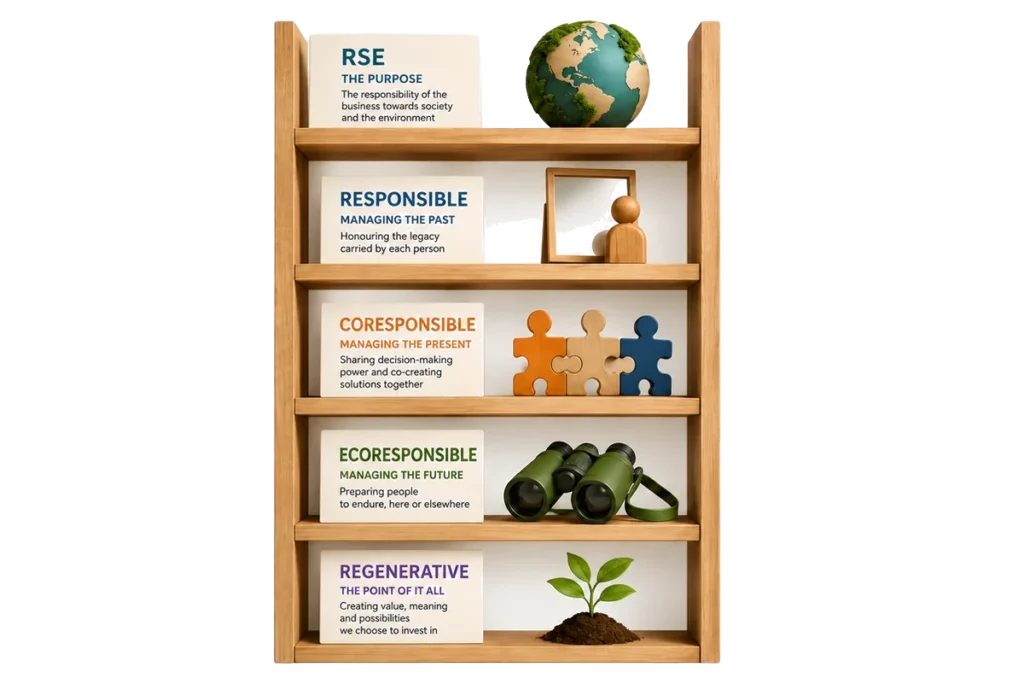
Regenerative management goes past sustainability, which aims to reduce damage, towards actively restoring the systems an organisation operates inside. When I say systems I mean the people, since a team is the system most managers actually touch. It resolves into three obligations: self care, team care and planet care.
The three sit in a deliberate order. A manager running on empty cannot restore anyone else, and a team being depleted has no capacity for anything beyond itself. Planet care reaches a manager as questions from the team rather than as strategy, and I work through those in climate anxiety is now the manager’s job description.
This connects directly to span of consequence. A role carrying every hard decision and no capacity to recover is a design failure that will present later as a resignation.
What the manager of tomorrow will actually be paid for
Three tasks remain once coordination is cheap and teams organise themselves: deciding when the information will never be sufficient, absorbing the consequence of those decisions, and answering for them to the people affected. Everything else in the job description is negotiable, and most of it is already moving.
None of the three appears prominently on a competency list, because none of them is trainable in a two day program.
Deciding when the information will never be enough
Most decisions that reach a manager arrive precisely because they cannot be resolved by gathering more data. The team escalated them for that reason. Deciding anyway, on a timeline, knowing the information is incomplete, is the part that neither distributes to a group nor delegates to a system.
Groups are good at generating options and slow at closing them. Systems are good at optimising within a defined objective and useless at choosing the objective.
The residual human task sits exactly in that gap, and it is the reason a flat organisation eventually reinvents a decision-maker under another name.
Absorbing consequence
Someone has to be answerable when the decision turns out badly, and answerability cannot be shared without disappearing. A team that collectively owns a failure owns it nowhere. This is the least discussed part of the job and the reason the role persists across every organisational fashion of the last century.
It also explains why self-managing structures keep growing informal leaders. The accountability has to land somewhere, so it finds a person whether or not the chart names one.
An organisation that removes managers without deciding where consequence lands has not flattened itself. It has made accountability harder to locate.
Enableship, and management as a condition rather than a control
Enableship is my term for the leadership of innovation: creating the conditions in which people can produce something the leader could not have specified in advance. It sits naturally in this account, since setting conditions is what remains once directing tasks has been distributed and automated.
The related idea I use, level 6 leadership, describes the point at which a leader’s contribution is measured by what the organisation produces without them present.
Both are ways of saying the same thing. The manager of tomorrow is judged on what happens when they are not in the room, which is also the hardest thing to put in a performance review.
The Australian version of this problem
Two features of the Australian workplace change how this argument lands here. Managers now carry legal duties that did not previously sit with them, and the boundaries of when they may contact their teams have been formalised. Both narrow the relay role further and add weight to the judgement role.
Neither is a competency. Both are decisions a manager makes, which is why they belong in this account rather than in a training module.
What the management of tomorrow owes under Australian duties
Australian model work health and safety law treats psychosocial hazards as risks an organisation must manage rather than monitor, and workload, job demands and job insecurity sit among them. That places a manager’s allocation decisions inside a duty rather than inside a preference. The legal effect varies by state and territory, so take proper advice on your own obligations.
Read alongside span of consequence, this is more demanding than it first appears. A manager who allocates work is now allocating exposure to a recognised hazard.
That is a judgement task by definition, since no system can decide how much pressure a specific person can carry this month.
The right to disconnect and the end of the always-on relay
Australian law now recognises an employee right to refuse unreasonable contact outside working hours. For a manager whose value came from being permanently available as a relay, that is a direct structural change. For one whose value comes from judgement, very little changes at all.
The distinction is useful as a test. If your management layer stops functioning when out-of-hours contact stops, it was carrying coordination rather than consequence.
Organisations that treated the change as a compliance problem missed the diagnostic sitting inside it.
Where the Australian evidence is thin
Australia publishes good data on who holds management occupations and very little on what those managers decide. Occupation classifications count roles, engagement surveys count feelings, and nothing routinely counts consequence. That gap is why the exercise in this article has to be run by hand inside each organisation.
It also means anyone quoting a confident national figure about management effectiveness is extrapolating from a survey of opinions.
Treat those figures as directional and build your own count, which will be more useful than any benchmark you could buy.
Deciding where to invest in your management layer
Four investments compete for the same budget: training the managers, restructuring the layers, giving managers better tools, or hiring differently. Each works under specific conditions and each fails in a predictable way. Choose by what your span of consequence count told you rather than by what your engagement survey said.
This is decision support rather than a pitch, and the first line is the one I sell.
Four investments compared
Read the failure column first. Three of these four fail for the same underlying reason, which is that they treat a structural condition as an individual deficiency.
| Investment | Works when | What it changes | How it fails |
|---|---|---|---|
| Management development | The role is real and the people are new to it | Capability and confidence within an existing structure | Trained managers return to constraints that produced the problem |
| Restructuring layers | A layer carries little consequence | Where decisions land and how fast they move | Done on cost logic alone, removing the layer that carried the load |
| Tools and automation | Managers spend their week relaying and reporting | Frees judgement time by removing coordination work | Time freed is refilled with more reporting |
| Hiring differently | The work has genuinely changed shape | Brings judgement the current group has not built | New people inherit the same role definition and behave identically |
Sequencing the four rather than choosing one
Most organisations can afford two of the four investments and attempt all four at once, which makes the result impossible to read. Sequence them instead, starting with the cheapest diagnostic step and ending with the most expensive commitment. Doing one thing properly and measuring it beats four simultaneous initiatives that cancel each other out.
A workable order begins with the span of consequence count, since it costs a morning per layer and determines everything downstream. Tools come next, because freeing relay time is quick and visible.
Development follows once the role is clear, and structural change comes last, since it is the only step that is genuinely hard to reverse.
Organisations tend to run this order backwards. They restructure first, train second, buy tools third, and never count what anybody decides.
Signals you are funding the wrong layer
Three signals show up quickly. Decisions escalate two levels past the person who was supposed to make them. Your managers describe their week in terms of chasing rather than choosing. Or the same development program has run three times and nothing measurable has moved.
The second signal is the reliable one. Chasing is relay work, and relay work is the part that is disappearing.
Where the problem sits across the whole managerial system rather than in one layer, the diagnostic frame I use is the six circles of managerial transformation.
Find out what your managers are actually for
Want the frame that replaces the competency list? Read my full explanation of enableship and learn to lead for what people produce when you are not in the room.
How I can help you rebuild your management layer
I work with executive teams on the layer itself rather than on the people occupying it, because the second question only makes sense once the first is settled. The work runs as a keynote, a facilitated design session, a leadership program or a short diagnostic across two or three layers.
The opening question is always the same. Show me the decisions this layer made last quarter that nobody else could have made.
Keynotes and design sessions
A keynote suits a leadership group heading into a restructure or a planning cycle, where the useful contribution is a frame delivered before the decisions are locked. A design session suits a smaller group ready to run the span of consequence count on their own structure and argue about the result.
Sessions run in Australian English with Australian data, including the public sector guidance on spans and layers, which travels well into private organisations.
The output is a map of where consequence currently lands, agreed in the room by the people who will live with it.
Programs and diagnostics
A leadership program suits organisations where the structure is sound and managers have never been given a method for the judgement part of the job. A diagnostic suits organisations about to spend heavily on development and unsure whether the problem is capability or design.
The diagnostic often concludes that the training budget should be spent on fewer, better-resourced roles, which costs me a program and saves the client considerably more.
Where the ambition is innovation specifically, the work connects to building an innovation culture, since a management layer designed for relay cannot host one.
Working with executive teams before a restructure
The highest value moment is the one before the org chart is drawn, when the layers are still negotiable and nobody has been told anything. At that point the span of consequence count tells you which layers to protect and which to merge, and it does so with evidence rather than with instinct.
After the announcement the same exercise becomes a justification rather than a decision, and everyone in the room knows it.
I will also say when the honest answer is that the structure is sound and the problem is a single manager nobody has given feedback to. That conversation is short and it saves a restructure.
Conclusion
It is easy to declare that the management of tomorrow rests on kindness, inclusion and sustainability, and that it needs empathetic, agile leaders open to technology. All of that is true and none of it is a decision anyone can act on.
The harder claim is that the role is being redefined by the collapsing cost of coordination, and that what remains is smaller and heavier than the lists suggest. Deciding when the information runs out, carrying the consequence, and answering to the person in front of you.
So before you buy another competency framework, count what your managers actually decide. The management of tomorrow will not be built by training people into a composite nobody can be, and it will be built by giving fewer people decisions that genuinely belong to them.
Frequently asked questions about the management of tomorrow
What skills will managers need in the future?
The published lists name empathy, agility, digital fluency, inclusion and continuous learning, and all of them are defensible. The more useful question is which decisions only a manager can make, since that determines what the role is for and therefore what it needs.
Will middle management disappear?
The relay part of the job is disappearing, since teams coordinate themselves and software handles routine reporting. The judgement part persists, because deciding under uncertainty and being accountable for the outcome cannot be distributed without dissolving.
What is span of consequence?
It is the number of decisions that land on a role and cannot be carried by anyone else. Unlike span of control, which counts direct reports, it measures whether a management layer is load-bearing or acting as a relay between two others.
Is flattening the organisation the answer?
Only where a layer carries little consequence. Removing layers on cost logic alone frequently removes the one that was doing the work, and accountability then reappears informally in someone with no authority to match it.
Why does management training so often change nothing?
Because it treats a structural condition as an individual deficiency. Managers return from a good program to the same role definition, the same spans and the same escalation habits, and the structure reasserts itself within weeks.