VUCA leadership is normally sold to you as a set of personal qualities. Be adaptive, be resilient, hold a clear vision and communicate well under pressure. I have watched that package land in Australian boardrooms and leadership offsites for twenty years, and I have watched almost nothing change in how quickly those organisations actually decide anything.
The reason sits inside the acronym’s own history, and almost nobody goes back to look at it.

VUCA was not written as a portrait of a turbulent world for its own sake. It came out of a military institution that had a very specific problem, and that institution arrived at a very specific answer. Business imported the problem statement with enthusiasm and left the answer on the shelf in Carlisle, Pennsylvania.
The answer was never to make generals more adaptable. It was to move the authority to decide closer to the people who could see what was happening. That is a structural change to who holds which right, and it is the half that never made it into the leadership seminar.
This page is the reference resource for the whole VUCA series on this site. I treat the source field first, the doctrine and the primary documents, because the transposition to business only makes sense once you have seen what the original was actually prescribing. Then I take the four letters one at a time and ask, for each of them, which decision right has to move.
And I add my own frame, the age of fragility, because an environment cannot be managed. What can be managed is how much your organisation absorbs before something in it breaks.
| The inherited reading | What it leaves out | The shift that changes the outcome |
|---|---|---|
| VUCA leadership as a set of qualitiesVUCA leadership is commonly taught as a personal repertoire of adaptability, resilience, vision and composure under pressure. The acronym stands for volatility, uncertainty, complexity and ambiguity, and it entered management vocabulary as a description of the operating environment rather than as a prescription. | The doctrine arrived with an answer attachedThe military institution that produced the acronym did not respond by asking senior commanders to become more adaptable. It responded by moving decision authority towards the people closest to the situation, which is a question of structure rather than character. That half of the doctrine rarely crossed into business practice. | Read VUCA as a condition of the organisationAn environment cannot be managed, while the exposure of an organisation to that environment can be measured, reduced and assigned to someone accountable. Naming the age of fragility puts the question on what an organisation absorbs, and each of the four letters then points to a specific decision right that has to move. |
What VUCA leadership means, and what the acronym actually describes
VUCA leadership is the practice of leading an organisation whose operating environment is volatile, uncertain, complex and ambiguous. VUCA is an acronym for those four conditions, drawn from strategic leadership work at the United States Army War College in the late 1980s. It describes what the environment does, and it says nothing on its own about what a leader should therefore do.
A diagnosis is not a treatment. VUCA tells you that your environment has certain properties, in the same way a thermometer tells you that you have a temperature. Everything that follows, including every leadership program sold under the VUCA banner, is somebody’s interpretation of what to do about it.
The four letters of VUCA, defined
Volatility is the rate of change in an environment. Uncertainty is the inability to know everything about a situation and to predict the nature and effect of change. Complexity is the difficulty of understanding the interaction of many parts and forecasting the flow-on effects of altering any of them. Ambiguity is the difficulty of interpreting meaning when the context is blurred.
Each of those four has a dedicated article in this series, because each one behaves differently and each one asks for a different response. Treating them as four synonyms for turbulence is the most common error in the field.
Order matters here too, and the sequence is not decorative. Volatility feeds uncertainty, uncertainty compounds into complexity, and complexity produces the conditions in which ambiguity becomes possible. The acronym reads in the direction the problem actually travels.
Which is why I never present the four as a checklist to tick. They form a reading grid for a disrupted environment, and a reading grid is something you use to see, never something you complete.

Where the term VUCA came from
The acronym appears in curriculum development materials at the United States Army War College in the late 1980s, and the earliest widely cited published account is a 1992 article by Herbert F. Barber in the Journal of Management Development. Attribution of the coinage itself remains genuinely contested inside the institution that produced it.
The detail is worth having, because most articles on this topic repeat a tidy origin story that the primary source does not support. The US Army Heritage and Education Center holds that documentary evidence in curriculum materials from late 1987 places VUCA in the syllabus for the following academic year, with a curriculum review ordered by the commandant as the likely trigger.
The same source records that Barber credited the underlying ideas to the leadership writing of Warren Bennis and Burt Nanus, while a separate 1992 War College study project attributes the terminology to General Maxwell Thurman instead. Two accounts, one institution, and no settled answer.
I find that uncertainty about the origin of the uncertainty framework quite fitting, and I also find it useful. A concept whose paternity is disputed is a concept nobody owns, which is exactly why it drifted so far from its original meaning once consultants got hold of it.
Where the term gets stretched past its usefulness
VUCA becomes useless the moment it is applied to everything you dislike or cannot control. Used properly it sorts your environment into four distinguishable conditions, each with a different managerial response. Used loosely it becomes a sophisticated way of saying that things are hard, which offers a leadership team nothing to act on.
You can test this in your own organisation in about ninety seconds. Ask three people to name the single most VUCA thing about your market, then ask each of them which of the four letters they mean.
In my experience you get three different letters and a short silence. That silence is diagnostic, because a team that cannot separate volatility from ambiguity will apply one generic response to four different problems.
There is a second stretch worth naming. Since 2020 the BANI framework, proposed by futurist Jamais Cascio to describe a world that is brittle, anxious, non-linear and incomprehensible, has often been presented as VUCA’s replacement. The two describe different objects, since VUCA describes the external environment and BANI describes how that environment feels from inside, so treating one as the successor to the other loses information rather than adding any.
The problem the Army was actually trying to solve
The War College was not trying to describe a mood. It was responding to a structural failure in how command worked, where senior commanders could no longer be present at the point where consequential decisions had to be made. VUCA named the conditions that broke the existing command model, and the institution then had to rebuild the model.
A command structure that stopped fitting its environment
The command model in question assumed a knowable battlefield, an identifiable adversary and enough time between assessment and action for a decision to travel up a hierarchy and back down again. Each of those three assumptions came apart in the decades that followed, and the acronym was the institution’s way of naming which assumption had failed.
Look at what changed. The adversary stopped being an army in a uniform on a map. The theatre stopped being geographic, since a cyber operation has no front line. And the population inside which forces operated stopped being reliably distinguishable from the threat.
Every one of those changes attacks the same thing, which is the distance between where information is held and where authority sits. A commander with a plan and a briefing room was now systematically further from the situation than the people executing.
That is a plumbing problem, and plumbing problems are not solved by asking the person at the top to develop a growth mindset.
What the Strategic Leadership Primer actually says about volatility
The Strategic Leadership Primer is the War College’s own teaching document on strategic leadership, and it is where the four VUCA conditions received their working definitions. Its treatment of volatility is more precise than the business literature that borrowed it, because it splits the problem into the rate of change and the adequacy of the information attached to that change.
That second half is the one that matters and the one that gets dropped. The Primer notes that even the most current information may fail to provide adequate context for a decision, which is a different and harder statement than saying things move fast.
Sit with that for a moment. It means your dashboard can be accurate, current and complete, and still leave you unable to decide well, because the frame you use to interpret it belongs to an earlier version of the environment.

The Primer also pairs volatility with the extended timelines of major acquisition programs, and that pairing is the real insight. A fast environment is survivable. A fast environment combined with slow internal commitment cycles is what actually breaks an institution, and every large organisation I work with recognises that description immediately.
I develop this split at length in the dedicated article on VUCA and the management of volatility, which also covers what it does to skills.
Why the institution reached for structure instead of character
Faced with a command model that no longer fitted, the Army had two available moves. It could try to improve the judgement, speed and adaptability of individual commanders, or it could change where the authority to decide was located. It invested seriously in the first and built its doctrine around the second.
The logic is unglamorous and hard to argue with. Individual capability has a ceiling, it walks out the door with the individual, and it does nothing about the physical distance between a decision and the information that decision needs.
Structure has none of those weaknesses. Move the authority once, write it down, and it holds when the person changes, when the situation changes and when the pressure comes on.
Notice what this implies for the business version. A market that runs an entire industry of adaptive leadership programs and almost no serious work on decision rights has copied the diagnosis and inverted the prescription.
The plan that was obsolete before it could be executed
The clearest account of the failure comes from General Stanley McChrystal, who commanded special operations in Iraq and later wrote Team of Teams with Tantum Collins, David Silverman and Chris Fussell. His observation was arithmetical. The time required to build a plan, have it approved and execute it had become longer than the time the situation stayed still.
Read that carefully, because it is not a complaint about bad planning. The plans were good. The staff work was rigorous, the intelligence was serious and the approvals were conscientious.
What had changed was the ratio between two speeds. Every organisation has a cycle time for turning an observation into an authorised action, and every environment has a cycle time for invalidating that observation. When the second becomes shorter than the first, quality of thinking stops mattering, because you are always answering a question the world has already moved past.
That single ratio is the most transferable idea in the whole of the VUCA literature, and it is almost never taught. It also explains why competent leadership teams can feel permanently behind while doing nothing obviously wrong.
The response McChrystal describes had two halves that only work together. The first was to push information sideways so that everyone could see the whole picture rather than only their slice of it. The second was to hand the authority to act on that picture to the teams holding it.
Half of that pairing has travelled into business extremely well. Transparency, shared dashboards, open channels and all-hands briefings are now standard, and organisations invest heavily in them.
The other half has barely moved at all. Giving people the full picture while leaving the authority where it was produces a workforce that can see exactly what should happen and has to watch it not happen, which is a reliable recipe for disengagement among the most capable people you employ.
I would go further, on the evidence of my own engagements. Transparency without transferred authority is more corrosive than opacity, because it converts frustration into something specific, documented and attributable to a named person upstairs.
Mission command, the prescription business left behind
Mission command is the doctrine the United States Army built for exactly the conditions VUCA describes. It combines direction set at the top with execution decided at the bottom, so that people closest to a situation hold the authority to act on what they can see. It is the operational answer that came attached to the diagnosis, and it is the half business never imported.
I want to be careful here, because this is where a business audience starts hearing military metaphor and switches off. Stay with it, because the mechanism transposes almost perfectly and the vocabulary is the only obstacle.
What mission command actually does
Army doctrine describes mission command as an approach to command and control that empowers subordinate decision making and decentralised execution appropriate to the situation. In practice it means the commander states what has to be achieved and why, then leaves how to the person in front of the problem, inside stated limits.
Three components carry the whole thing. There is intent, which is the purpose and desired end state expressed so clearly that action can continue without further orders. There is mission-type tasking, which specifies the effect required rather than the method. And there is decentralised execution, which is the actual transfer of the right to decide.
The doctrine is explicit that understanding has to travel from the bottom up as well as from the top down, and that trust is the condition on which the whole arrangement rests. Without trust the authority gets granted on paper and clawed back in practice.
Read that list again with your own organisation in mind. Most leadership teams I meet have done a version of the first component, have never touched the third, and describe the result as empowerment.
What makes a statement of intent usable
Commander’s intent is a short statement of purpose and end state precise enough that someone who has lost contact with headquarters can still decide correctly. It works because it is bounded. A statement that could justify any action at all provides no guidance, which is the failure mode of most corporate vision statements.
The test is simple and quite brutal. A useful intent tells you what you are permitted to sacrifice.
Take a real trade-off. Hold the delivery date and accept a reduced scope, or hold the scope and accept a later date. If your organisation’s stated purpose does not settle that question for a team lead at nine on a Tuesday morning, it is not intent, and the decision will travel upwards regardless of how much you have decentralised on paper.
This is why I now start engagements by asking executives to write the sacrifice into the statement. The exercise takes twenty minutes and it is the most uncomfortable twenty minutes of the day, because naming what you will give up is a decision that most leadership teams have quietly avoided making.
Even the Army struggles to apply its own doctrine
Mission command works well in operations and much less well in day-to-day garrison life, and the institution says so openly. The barriers it names are bureaucracy and risk aversion, which erode trust and quietly return authority to the top. That admission increases what the doctrine is worth to a business audience.
The Army War College’s own publication has put the problem plainly, observing that persistent execution challenges may go beyond what any doctrine can address, with bureaucracy and risk aversion hindering leaders in garrison environments.
I find that enormously encouraging, and I say so in every workshop. An institution with unambiguous hierarchy, decades of doctrine, and genuine consequences for failure still finds that decentralised authority decays back towards the centre the moment the pressure drops.
So when your own delegation quietly reverses six months after the workshop, you are not witnessing a failure of your people. You are witnessing the default behaviour of any hierarchy under bureaucratic pressure, and it needs an active mechanism to resist, never a memo.
There is one more lesson buried in that admission. Decentralisation practised only in a crisis never becomes capability, because the muscle has to exist before the crisis to be available during it.
Why VUCA leadership programs change so little in Australian organisations
Most VUCA leadership programs change individual awareness and leave the organisation’s decision architecture untouched. Participants leave with better language for their environment and the same approval thresholds, the same committee calendar and the same escalation habits. Awareness without a transfer of authority produces informed people who still have to wait.
This is the point in the article where the source field and the target field meet, so let me be concrete about the Australian version of the problem.

The diagnosis travelled and the decision rights stayed put
Business adopted VUCA as a description and built a training industry on top of it. What it did not adopt was the structural half, which asks who is allowed to decide what, at which threshold, without asking permission. Almost every VUCA program on the market sells the first and quietly avoids the second.
The avoidance is not laziness, and it is worth understanding sympathetically. Training is easy to buy, easy to schedule and easy to report on. Redrawing a delegations schedule touches finance, risk, legal and the ego of everyone who currently signs.
So the market supplies what is purchasable. Twenty years on, the vocabulary has spread beautifully and the approval thresholds in most large Australian organisations sit roughly where they sat before.
You can verify this yourself without a consultant. Find the dollar figure a team leader can approve without a second signature, then find out when that figure was last reviewed, and compare it against the change in prices over the same period.
What the Australian evidence says about management capability
Australian management capability is a documented national weakness with primary evidence behind it. The Productivity Commission has repeatedly found that managerial capability here generally lags comparable economies and that this limitation holds back productivity growth. That finding sits directly on the mechanism this article is describing.
The Commission’s five-year productivity inquiry states that managerial capability varies but generally lags other countries, in a volume specifically concerned with why innovation fails to diffuse through the economy.
Its earlier productivity insights work put the gap in physical terms that anyone can picture, noting that a typical Australian worker takes five days to produce what an American counterpart produces in four, and identifying management capability as critical to innovation while Australian businesses perform poorly on it.
Read that alongside the argument here and a specific reading emerges. A capability gap of that kind is usually treated as a training problem, and the Commission’s own framing points at diffusion, which is a question of how quickly a good idea travels through an organisation and gets acted on.
Diffusion is a decision rights question wearing an economist’s coat. An idea that has to clear four approvals to be tried is an idea that will not be tried, however well trained the person holding it.
The permission gap you can measure this quarter
The permission gap is the distance between what a person can see and what that person is allowed to decide. It is measurable, it is specific to each role, and it widens automatically over time as environments accelerate and approval thresholds stay fixed. Closing it is the operational content of VUCA leadership.
Four questions will size it for any team, and I use them in the first hour of most engagements.
- Which decisions does this team escalate that it could make on its own information?
- How long does a typical escalation take from question to answer?
- How often does the escalated answer differ from what the team would have chosen?
- What would it cost, in the worst realistic case, to be wrong at this level?
The third question is the one that does the work. When the escalated answer matches the team’s own answer most of the time, you are paying a delay for a signature that adds nothing, and you are teaching a capable team that its judgement carries no weight.
The fourth question is what makes the change safe. Moving authority without knowing the downside is recklessness, and knowing the downside turns the conversation from a philosophical debate about trust into an arithmetic one about exposure.
The age of fragility, or VUCA read as a condition rather than a climate
The age of fragility is my frame for a period in which organisational robustness has given way to exposure, where volatility is the symptom and fragility is the condition underneath it. VUCA describes weather, and weather cannot be managed. Fragility describes the building, and a building can be surveyed, reinforced and assigned to someone accountable.
This is the shift I ask leadership teams to make, and it changes what gets measured more than it changes what gets said.
An environment cannot be managed, exposure can
Every hour spent debating how volatile the market has become is an hour spent on a variable outside your control. Exposure sits inside your control entirely. It is the product of your concentration, your commitment horizons, your approval latency and the number of single points of failure you have accumulated without noticing.
The reframe has an immediate practical effect on a leadership meeting. Questions about the environment produce opinion, and opinions can be held indefinitely without anyone doing anything.
Questions about exposure produce numbers, and numbers produce owners. How many of our revenue lines depend on a single customer, how many of our critical processes depend on a single person and how long is our shortest reversible commitment.
Those questions have answers, and the answers are usually worse than the room expects. I have watched an executive team discover, in under an hour, that four separate revenue lines depended on the continued goodwill of the same two people.
What fragility looks like when you go and count it
Fragility shows up as accumulation. Organisations add capabilities, tools, processes, reporting lines and beliefs, and they almost never retire any of them. The weight is invisible on a balance sheet and completely visible in how long anything takes, which is why speed problems are usually weight problems in disguise.
Four markers give you a reading without a formal audit.
- Concentration. The share of revenue, capability or knowledge that sits with a single customer, supplier, system or person.
- Commitment length. How far ahead you have locked spending, contracts and headcount before you can change your mind.
- Approval latency. The elapsed time between a person seeing something and being allowed to act on it.
- Retirement rate. What your organisation has deliberately stopped doing, using or believing in the past twelve months.
The fourth marker is the one nobody tracks, and it is usually zero. I go into what to do about it in the article on unlearning what we know, and the short version is that an organisation with no exit process accumulates until the calendar refuses it.
Notice that all four markers are internal. None of them requires you to forecast anything about the world, which is precisely why they survive in an environment where forecasts do not.
From robustness to regeneration in VUCA leadership
Robustness is the capacity to resist a shock without changing, and it works until the shock exceeds the design assumption. Regenerative leadership, the practice I develop across this site, is the capacity of an organisation to rebuild capability faster than its environment destroys it. Under fragility, recovery rate matters more than resistance.
The distinction is not academic, because the two ask for opposite investments. Robustness spends on buffers, redundancy and contingency plans written against scenarios you have imagined.
Regeneration spends on the speed at which people can rebuild, which means decision rights held close to the work, skills that transfer across roles and the willingness to retire what no longer earns its place. It also links directly to enableship, my term for the leadership of innovation, where the leader’s job is to make other people’s ideas possible rather than to supply the ideas.
Which brings the two halves of this article together. Mission command is a regenerative structure that a military institution arrived at forty years ago, and it works for the same reason regenerative leadership works, because it shortens the distance between seeing and acting.
Field note
The one decision right I moved in my own company
When I ran my recruitment and engagement consultancy in Sydney, I had the same problem I now see in my clients. I wanted a collaborative culture and I held every lever that mattered, including the one that decided whose contribution counted. Recognition ran through me, which meant recognition ran at my speed and reflected what I happened to notice.
So I moved that single right. Each month every person on the team received five units of an internal currency we called talents, to give to colleagues for sharing knowledge, for helping someone else innovate, for lending expertise or for genuinely listening. Accumulated talents converted into training, paid days off or money. What surprised me was not the goodwill it generated. It was the map it produced. Within two months I could see who the organisation actually relied on, and the picture differed sharply from my org chart. Two people I had barely noticed were holding the place together, and one senior person I would have described as central was invisible in the flow.
Moving one decision right does two jobs at once, because it releases the decision and it reveals the real structure underneath the formal one. Start with the smallest right you personally hold on to for no defensible reason, and watch what the data tells you about your own organisation.
The four letters of VUCA and the four decision rights they move
Each letter of VUCA disables a different management instrument, and each one therefore points to a different decision right that has to move. Volatility breaks your certainties, uncertainty breaks your forecast, complexity breaks your causal model and ambiguity breaks your ability to agree on what something means. One generic response cannot repair four different failures.
This is the routing grid I use with executive teams, and it is the spine of the four satellite articles in this series. Work out which letter is actually hitting you, then move the matching right.

Volatility moves the right to retire what no longer holds
Volatility is the rate of change in an environment, including the rate at which the information about that environment goes out of date. It breaks your existing certainties faster than anyone retires them. The right that has to move is the authority to declare that a method, a product line or a long-held belief has reached its end.
Almost every organisation has a process for adopting something and none for abandoning something. Anyone may propose an addition, and only the person who originally sponsored a practice can credibly end it, which means practices outlive their usefulness by years.
Two moves fix it, and neither costs anything. Give the group that watches your environment an explicit mandate to name what should stop, and put that recommendation in front of the same executive who signs off the new spending.
The dedicated article goes further into what volatility does to the shelf life of skills, and into the commoditisation and obsolescence it produces.
Uncertainty moves the right to commit on partial information
Uncertainty is the inability to know everything about a situation and to predict the nature, scale and duration of change. It breaks the forecast, and with it every process that requires a single point estimate before anyone may act. The right that has to move is the authority to commit resources while information is still incomplete.
Watch what happens when this right stays at the top. Planning and budgeting cycles demand precise numbers, so leaders bury the uncertainty inside the cash flow to make the strategy defensible, and the organisation ends up systematically understating its own exposure.
Moving the right means authorising small, bounded, reversible commitments at a level where being wrong is survivable. Many small bets, each with a stated hypothesis and a kill threshold, beat one large bet defended by a forecast nobody believes.
The dedicated article develops the reversibility ledger in full, with the twin traps of underestimating and overestimating what cannot be known.
Complexity moves the right to convene
Complexity is the difficulty of understanding interactions between many interdependent parts and of predicting the flow-on effects of changing any of them. It breaks the causal model, so no individual can hold the whole picture. The right that has to move is the authority to pull together the people needed to see it collectively.
This is the least discussed of the four and the cheapest to fix. In most organisations, convening people from three different functions requires someone senior enough to compel three diaries, which means complex problems wait for a sponsor.
The answer to complexity is collective, and it never lies in simplification. Simplify a genuinely complex system and you have not reduced the complexity, you have hidden part of it and made the surprise arrive later.
The dedicated article covers the distinction between clear, complicated, complex and chaotic situations, and the gap between the complexity executives describe and the complexity their teams live with.
Ambiguity moves the right to interpret
Ambiguity is the difficulty of interpreting meaning when the context supports several legitimate readings at once. It breaks shared understanding, so people act on incompatible interpretations of the same instruction. The right that has to move is the authority to settle what something means locally, without waiting for the centre to clarify.
Ambiguity is the hardest of the four for managers, because it brings the two things any administrator detests, which are confusion and contradiction. An uncertain event might happen. An ambiguous situation is one where the event and its opposite are both true at the same time.
You can have a tight labour market and high underemployment together. You can have a colleague who loves the job, respects the manager and is actively looking elsewhere. Neither of those is a contradiction to be resolved, and both are conclusions to be worked with.
The dedicated article covers the world of AND, the four sources of ambiguity, and the audacity it takes to decide while two opposite readings are both defensible.
How to move one decision right without losing control
Moving a decision right safely takes six steps and about a fortnight of elapsed effort. The sequence matters, because most attempts fail by announcing the delegation before defining the boundary, which produces either paralysis or an expensive surprise. Start with one right, in one team, with a stated review date.
- Name the specific decision. Not a category such as spending, but a decision such as approving a supplier substitution under a stated value.
- Size the worst realistic downside if the decision is made badly, in dollars, in days or in reputational terms.
- Write the intent, including what the team is permitted to sacrifice when two objectives collide.
- Set the boundary and the trip wire, meaning the threshold above which the decision returns to the previous holder automatically.
- Remove the old approval from the process, in writing, so the previous holder cannot be asked and cannot volunteer.
- Review after one quarter on two measures only, elapsed decision time and the rate of decisions that breached the boundary.
Step five is where nearly every attempt dies. Leaving the old approval available as an optional safety net means it will be used under pressure, and a delegation that can be bypassed was never transferred.
Moving one decision right down a level is also one of the three moves I recommend for a single quarter in leading through disruption, alongside three dated commitments and a stop list that creates the room to use them.
Start with the letter that is actually hitting you
Wondering which of the four conditions is really slowing your organisation down? Read my full method for spotting change early and retiring what no longer holds in the dedicated article on managing VUCA volatility, then work through the remaining three letters in order.
How to choose a VUCA leadership approach against your own criteria
Four approaches get sold under the VUCA banner, and they are not interchangeable. Adaptive leadership training builds individual capability, an agile operating model changes how work flows, a decision rights redesign changes who may act, and resilience programs change what people can absorb. Choose by the failure you actually have, never by the brochure.
What follows is deliberately neutral. Three of these four are things I do not sell, and I would rather you bought the right one from someone else than the wrong one from me.
Comparing the four approaches on explicit criteria
Read the table by starting from the symptom you recognise in your own organisation rather than from the approach you already favour. Then check the last column, because what an approach leaves unfixed usually matters more than what it promises. Most leadership teams buy on the second column and get bitten by the fifth.
| Approach | What it actually changes | Symptom it fits | Managerial maturity required | What it leaves unfixed |
|---|---|---|---|---|
| Adaptive leadership training | Individual awareness, vocabulary and personal repertoire | Leaders misread their environment or freeze when it shifts | Low, it can be scheduled and delivered without structural change | Informed people still wait for the same approvals |
| Agile operating model | How work is sequenced, sized and reviewed | Delivery cycles are long and priorities change slowly | Medium, it needs discipline and protected team time | Fast delivery of decisions that were made too far from the work |
| Decision rights redesign | Who may act, at what threshold, without asking | Escalated answers usually match what the team would have chosen | High, it needs an executive willing to give something up | Nothing about capability, so it exposes weak judgement quickly |
| Resilience and wellbeing programs | Individual capacity to absorb pressure and recover | Fatigue, turnover and sustained pressure with no end date | Low to medium, mostly a matter of investment and consistency | The structural load that produced the pressure in the first place |
One warning about the fourth row, because it matters in the Australian context where psychosocial hazards now sit inside work health and safety duties. A resilience program offered to people whose real problem is an unmanageable structural load reads as an instruction to cope better, and it can worsen trust rather than repair it.
The signals that tell you which one to fund first
Three signals settle the choice quickly. If your people did not see the change coming, fund awareness. If they saw it and could not move the work, fund the operating model. And if they saw it, could have acted and had to wait for a signature that changed nothing, fund the decision rights redesign first.
Most organisations I work with need the third and buy the first, for a reason that has nothing to do with ignorance. Training is a purchase, and moving decision rights is a concession.
There is a fourth signal worth adding, and it cuts across the others. Ask who in your organisation is allowed to end something, and if the honest answer is that nobody below the executive can, none of the approaches on that list will produce speed.
Whichever you choose, buy it against a written symptom. An approach purchased against a symptom can be evaluated, and an approach purchased against a mood can only be renewed.
How I can help you build VUCA leadership in your organisation
I work with executive teams, boards and manager communities on leading through volatility, uncertainty, complexity and ambiguity, in English and in French. Three formats cover most situations. Each one is built to finish with decisions written down and owners named, rather than with a feeling of momentum that fades by Friday.
Keynotes on leading in a VUCA world
I speak on VUCA leadership at conferences, leadership offsites and industry summits, and I use the origin story deliberately, because an audience that has heard the four letters twenty times has usually never heard what the doctrine actually prescribed. The talk lands best when it closes with each table naming one decision right they would move.
Sessions run from a forty-five minute keynote to a half day with facilitated work between segments. Details and booking sit on my page on managing in a VUCA world.
Workshops on decision rights and managerial curiosity
Over a half day or two days, we size your permission gap, run the six-step sequence on one real decision, and set up the trend groups that keep your reading of the environment current. Teams leave with one right moved, a boundary written and a review date in the calendar.
The curiosity work usually runs alongside it, since a team allowed to decide still needs to see early enough to decide well. That thread continues in my work on curiosity in management.
Fragility diagnostics and manager communities
For organisations already inside a transformation, I run a shorter diagnostic across the four fragility markers, concentration, commitment length, approval latency and retirement rate. The output is a short written picture of where your exposure actually sits, with an owner against each item.
I then support manager communities through the change itself, because the people asked to hold new authority are the people most likely to hand it back. Developing cross-functional range helps here, which is the argument behind the T-shaped expert generalist.
Conclusion: VUCA leadership is a question of where decisions are made
The four letters have been in circulation for nearly forty years, and the industry built on top of them has spent almost all of that time on the character of the leader. The institution that produced the acronym reached a different conclusion, and it reached that conclusion first.
It concluded that when the environment moves faster than information can travel up a hierarchy and back down, the answer is to shorten the trip. Making the person at the top quicker at reading the map does not shorten it, and neither does writing a better plan.
So here is what I would take from this page if I read nothing else on the topic this year. Stop debating how volatile your market has become, because that is weather and you do not control it. Measure your own exposure instead, across concentration, commitment length, approval latency and what you have retired.
Then pick one decision that a capable person on your team could make with the information they already hold, and move it. Write the intent, name what may be sacrificed, set the trip wire and take the old approval out of the process.
One right, one team, one quarter. That is the entire practice, and it is worth more than a year of workshops, because VUCA leadership is settled by where the decisions are made rather than by how the people at the top describe the weather.
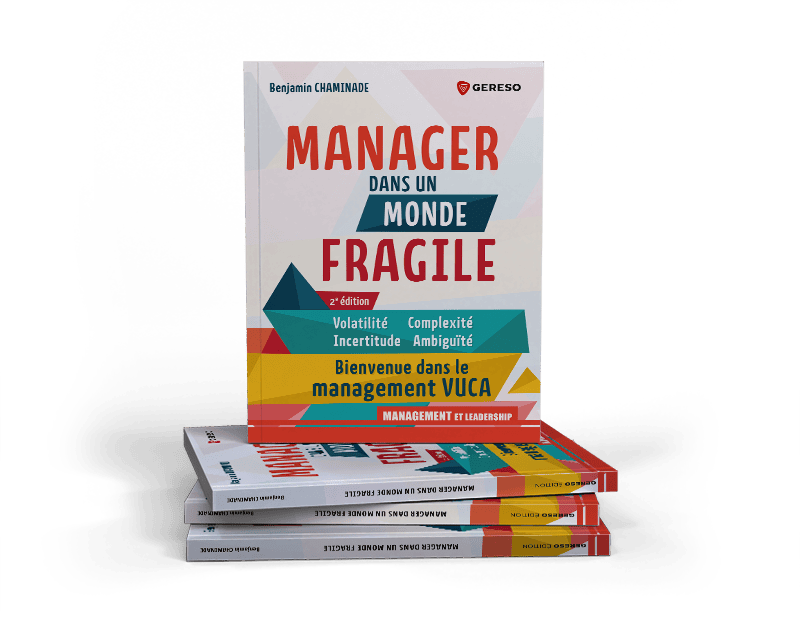
The complete version of my work on managing VUCA is available in book form, published in French by GERESO. Click the image to order a copy.
The four letters, one article each.
Frequently asked questions about VUCA leadership
What does VUCA stand for?
VUCA stands for volatility, uncertainty, complexity and ambiguity. The acronym entered the curriculum of the United States Army War College in the late 1980s to describe a strategic environment that no longer suited existing command models. It describes conditions in an environment rather than qualities in a leader.
What skills does VUCA leadership require?
Curiosity to see change early, the willingness to retire methods that no longer hold, and the confidence to commit while information is incomplete. Skills alone will not produce speed, though, because a capable person who must wait for an approval that changes nothing is still slow.
Who invented the VUCA acronym?
Authorship is genuinely contested. Documentary evidence places VUCA in the United States Army War College curriculum from late 1987, the earliest widely cited publication is a 1992 article by Herbert Barber, and a separate War College study project credits General Thurman instead. Barber himself pointed to the leadership writing of Warren Bennis and Burt Nanus.
How do you lead a team in a VUCA environment?
Write an intent that states what may be sacrificed when objectives collide, then move one decision right down to the people closest to the work with a clear boundary. Review after a quarter on elapsed decision time and boundary breaches, and expand from there.
What is the difference between VUCA leadership and agile leadership?
Agile leadership changes how work is sequenced and reviewed, so an organisation delivers faster once a direction is set. VUCA leadership asks the earlier question of where decisions are made at all. Agility without moved decision rights produces fast delivery of choices made too far from the work.