

As a business leader, I have often had to turn chaos into opportunity. The VUCA world, marked by volatility, uncertainty, complexity and ambiguity, sets a permanent challenge to the way we operate, and that challenge never shows up as a single dramatic event. Day-to-day VUCA management is what actually happens between the crises, the small calls and adjustments a leader makes every week that either shorten or lengthen the gap between a signal and a decision.

I have devoted ten articles to this subject on this blog, each exploring one facet of VUCA management. This article brings them together and gives you the full picture, before pointing you towards each deep dive through dedicated links woven through the text.
My angle is simple to state and demanding to hold. In an unstable environment, what separates the organisations that thrive from those that disappear comes down to their capacity to see change early and act before being forced to, and size and resources matter far less. Everything else in this article flows from that central idea, and from its corollary: the real variable to manage is your organisation’s decision latency, the time that passes between a signal and a decision.
| The acronym | Its origin | The conviction |
|---|---|---|
| Four forces to tameDay-to-day VUCA management answers four forces, volatility, uncertainty, complexity and ambiguity. Each force calls for a distinct response, and confusing them leads to poorly adapted decisions. | Leadership theory before the militaryThe acronym rests on the leadership work of Warren Bennis and Burt Nanus, later adopted by the US Army War College to describe the multipolar world that followed the Cold War. | Anticipate rather than endureBenjamin Chaminade’s conviction is that VUCA management consists of seeing change early and acting before being forced to. The turbulence of the environment matters less than the decision latency of the organisation facing it. |
Understanding the VUCA world before talking about management
Before talking about VUCA management, I want to set the scene. The acronym describes an environment rather than a method, and mistaking it for a ready-made recipe leads to serious misreadings. Understanding each force is the condition for responding to it accurately.
The four forces of the VUCA acronym
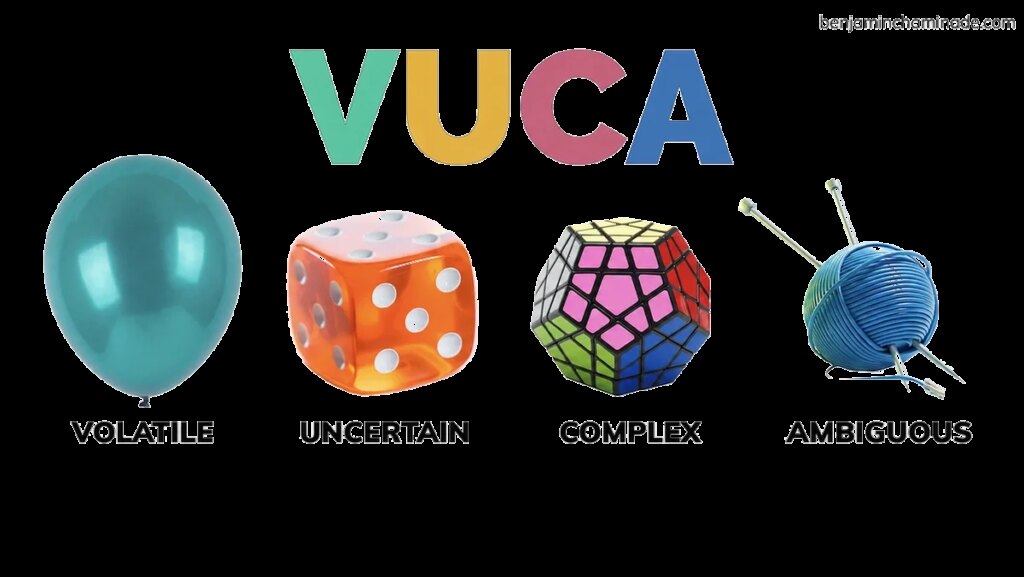
The VUCA acronym brings together four distinct realities that I see at work every day inside organisations: volatility, uncertainty, complexity and ambiguity. Volatility concerns the speed of change, uncertainty our lack of visibility, complexity the number of variables at play, and ambiguity the difficulty of interpreting what we see. Each force demands its own response:
- volatility, meaning the speed and scale of market shifts, which demand constant vigilance,
- uncertainty, the inability to predict with precision, which forces flexibility into planning,
- complexity, born of many interconnected forces whose links often stay obscure, and
- ambiguity, which grows out of unclear situations and the contradictory information of daily business.
Breaking these elements apart goes well beyond a theoretical exercise. It is the condition for grasping their impact on our decisions, because an effective response to volatility differs from an effective response to ambiguity. I have watched this awareness transform a leader’s capacity to act with accuracy.
One frequent confusion deserves clearing up from the start. Volatility and uncertainty are two different things, and so are complexity and ambiguity. Volatility concerns the speed of change, uncertainty our lack of visibility, complexity the number of variables in play, and ambiguity the difficulty of interpreting what we observe.
Why yesterday’s playbook no longer works
The main lesson of VUCA management fits in one sentence. What worked yesterday guarantees nothing about tomorrow’s success, because the context that made a recipe effective has itself changed.
This idea has concrete consequences for the way we lead. It invites us to stay agile, to question our certainties and to treat every past success as a hypothesis to re-examine rather than a permanent asset. My own quest to understand VUCA never ends, and I treat it as continuous learning.
The danger stalks successful organisations most of all. The longer a recipe has worked, the more untouchable it seems, and the longer we take to question it when the context tips. Yesterday’s success then becomes a trap, because it stretches decision latency at the very moment VUCA demands that vigilance stays constant.
I never argue for changing everything all the time, which would be exhausting and counterproductive. I argue for knowing how to separate what deserves preserving from what must evolve, and for re-running that sorting exercise regularly. This lucidity about your own achievements ranks among the hardest skills of leadership.
Definition and origin of the term VUCA
I approach the concept of VUCA with a mix of vigilance and opportunism. To handle it well, you need to know its real history, which is often summarised inaccurately. You will find a complete definition of VUCA in my dedicated article.
An origin between leadership theory and the military world
Contrary to a widespread belief, the American military never invented the acronym out of thin air. It rests on the leadership theories of Warren Bennis and Burt Nanus, two American professors whose book Leaders, published in 1985, already described the challenges a changing world posed to those who lead.
The US Army War College, the senior officer school of the American army, then placed VUCA in its curriculum from 1987 to characterise the multipolar world born of the end of the Cold War. The concept therefore travelled from leadership thinking into military strategic vocabulary, before the business world picked it up.
This double lineage is far more than an anecdote. It reminds us that VUCA began as a leadership lens, designed to help leaders act through turbulence. Reading it as a defeatist verdict on the instability of the world misses its whole purpose.
Volatility, navigating instability
Volatility names the moment when instability becomes the norm rather than the exception. Market swings are fast and large, and their underlying cause rarely lasts. Proactive management then absorbs these shocks and turns them into footholds rather than blows to endure.
Uncertainty, confronting unpredictability
Uncertainty stems from the unpredictability of events, where every decision is taken without full visibility of its effects. This facet of VUCA mixes risk and opportunity, because the unexpected opens as many doors as it closes. Innovation and anticipation are what sharpen decision-making in the face of emerging challenges. I unpack this force in the article dedicated to uncertainty in VUCA management.
Complexity, managing entangled stakes
Complexity grows out of an interconnected, multipolar world where international markets, regulation and geopolitics tangle together. Navigating this labyrinth rules out simple answers and single causes. It demands a systemic approach and sharp collective intelligence, able to hold several threads at once. I go deeper in the article dedicated to complexity in VUCA management.
Ambiguity, decoding contradictory signals
Ambiguity blurs the trail by multiplying contradictory signals. It demands a particular sagacity to interpret diverse and sometimes opposed information. This is where the need reveals itself for leadership capable of forging a clear vision out of confused material. I develop this force in the article dedicated to ambiguity in VUCA management.
Distinguishing these four forces has allowed me to embrace the changes that impose themselves and to turn each challenge into a growth lever for my company and my teams. The rest of this article details how to respond concretely to each of these forces.
The core principles of VUCA management
Facing an unpredictable environment, I have learnt to lean on a few stable principles that hold when everything moves. They work as postures that guide action through uncertainty rather than as fixed recipes. Agile leadership forms their core.
Agile leadership as the foundation
Agile leadership lets me build a flexible working dynamic, able to adapt to all four forces of VUCA. Adjusting fast, and changing direction without rebuilding everything, has become a central capability. This suppleness rests on discipline and clear reference points, and it has nothing to do with improvisation.
Like a captain in rough waters, I steer my team through unpredictable waves while staying ready to adjust the trajectory. The destination endures, and the path towards it keeps reinventing itself. That combination of constancy and adaptation defines successful VUCA management.
The agility I defend goes far beyond a project management method. It is a mindset that irrigates the whole organisation, from the way decisions are made to the way mistakes are acknowledged. Reducing agility to a tool means missing its essence.
Four principles for four forces
To each force of VUCA, I match a concrete principle of action:
- face volatility with suppleness, keeping room to manoeuvre rather than optimising to the extreme,
- anticipate rather than react, because uncertainty frightens less when you have prepared for it,
- decipher complexity through collaboration, crossing perspectives to clarify what looks nebulous, and
- master ambiguity through clear, communicative leadership that gives a readable direction.
The table below sums up this diagnosis force by force, so you can check that your response matches the problem you actually face:
| Force | What it describes | The right response | The trap to avoid |
|---|---|---|---|
| Volatility | Fast, large market swings | Keep slack and room to manoeuvre | Optimising every margin away |
| Uncertainty | Weak visibility on outcomes | Prepare several scenarios early | Waiting for certainty before acting |
| Complexity | Many interconnected variables | Distribute the reading across the team | Hunting for a single cause |
| Ambiguity | Contradictory, unclear signals | Communicate a shared, explicit vision | Staying silent and feeding rumours |
Across my journey as a leader, I have understood that success rests on a plural approach. Being at ease with risk management, daring to adopt new technologies and nurturing a culture that values change form an indivisible whole. None of these pillars is enough on its own.
The frequent mistakes of VUCA management
I regularly observe the same mistakes among otherwise competent leaders. The first consists of using VUCA as an excuse, concluding that planning is pointless since everything changes. That is a misreading, because the frame invites you to plan differently rather than to abandon planning.
The second mistake applies a single response to all four forces, when each calls for its own treatment. The tools of volatility achieve nothing against ambiguity, and confusing the two produces poorly adapted decisions. The precision of the diagnosis conditions the accuracy of the response.
The third mistake, the most human one, is giving in to alarmism. Presenting the VUCA world as a permanent catastrophe paralyses teams instead of mobilising them. I prefer to present it for what it is, a demanding environment that rewards anticipation and punishes standing still.
Agile leadership as the answer to volatility
Facing a context dominated by volatility, I have understood that agile leadership goes beyond a response, and works as a strategy turned towards the future. Adopting agility answers a necessity, the need to guarantee real flexibility through turbulent periods, and owes nothing to fashion.
Strengthening organisational flexibility
In my own company, strengthening organisational flexibility has proven a key factor of endurance. Working in short cycles lets us evaluate and adjust strategies in real time, instead of locking ourselves into an annual plan that ages fast. This regular cadence maximises adaptive capacity without sacrificing coherence.
The image that guides me is the sailing boat. On the ocean of business, it must ride the most unpredictable waves, with supple, resistant sails ready to adjust to the gusts. Rigidity breaks at the first strong blow of wind.
Cultivating resilience to manage change
Resilience has proven indispensable for crossing crises without breaking. It is cultivated through learning, through encouraging creativity and through backing new initiatives. I have put in place approaches centred on the engagement of team members, which feed a collective capacity to manage change with calm.
Three practices concretely support that resilience:
- encouraging transparent communication so challenges are understood rather than masked,
- establishing an environment where failure is treated as a stage of learning, and
- strengthening the capacity to innovate through regular exploration time.
One precision matters on the word resilience. It lets you return to the pre-shock state, which no longer suffices when shocks come in chains. This is why I prefer to aim for antifragility, the capacity to come out of disturbances stronger, a notion coined by the essayist Nassim Nicholas Taleb, which I connect to the age of fragility, the frame I describe in my book.
The difference goes deeper than wordplay. A resilient organisation absorbs the crisis and restarts as before, while an antifragile organisation uses the crisis to become better. In a VUCA environment where disturbance is the norm, aiming for a simple return to balance amounts to stagnating.
Concretely, this changes how a crisis is approached. Beyond limiting the damage, I ask my teams what the ordeal teaches us and how it can make us more solid. That question turns a shock we endure into a lever for progress.
Mastering uncertainty in decision-making
Facing a market in constant evolution, mastering uncertainty is a decisive asset. The question I share with other leaders is simple, how do you decide when the future stays veiled. Solid methods exist to turn that fog into clear-sighted choices.
Techniques for deciding without full visibility
Several techniques allow you to decide despite uncertainty, by making it objective rather than denying it:
- risk management, to identify and rank potential uncertainties,
- multiple scenarios, to project several possible futures instead of a single one,
- sensitivity analysis, to measure each variable’s impact on the outcome, and
- contingency plans, to prepare a fitted response for each scenario.
In my own experience, anticipating and simulating possible scenarios keeps my team and me calm even when the future looks blurred. We prepare for the future in several forms instead of predicting it. That preparation converts uncertainty from a handicap into ground for advantage.
Deciding fast without deciding blind
A trap lurks inside uncertainty, the paralysis of over-analysis. Trying too hard to reduce the fog delays decisions that would have gained from being taken early and corrected afterwards. I have learnt to separate reversible decisions, to take fast, from irreversible decisions, which deserve more prudence.
That distinction frees action. For reversible choices, testing and adjusting beats waiting for a certainty that will never come. Each decision then becomes an occasion to learn and to strengthen our capacity to advance through the fog. Sorting decisions by reversibility remains the fastest way I know to shrink an organisation’s decision latency.
I add an important nuance on the role of data. Predictive analytics inform the decision without ever replacing it, because no past data perfectly describes an uncertain future. I use it as a compass, never as a road map dictating every turn.
Managing complexity through managerial innovation
In my way of managing complexity, I have identified managerial innovation as a cornerstone. It feeds a collaborative culture, the only one capable of standing up to the multitude of forces in play. Leading without involving team members in the reading of that complexity no longer makes sense.
Building a collaborative culture
Building a collaborative culture has given me access to a range of perspectives that no leader holds alone. The diversity of viewpoints lights up blind spots and makes decisions more robust in the face of complexity. Hybrid work, alternating presence and distance, has reinforced both that diversity and my teams’ balance:
- including varied perspectives for better informed decisions,
- adopting hybrid ways of working to gain flexibility, and
- anchoring a social responsibility that reflects the organisation’s values.
Complexity has this particularity, it refuses to shrink and asks to be shared. No leader can hold every thread of an interconnected system alone, and claiming otherwise leads straight to error. Distributing the reading of complexity across several complementary viewpoints is the only realistic answer.
Using horizon scanning to anticipate
Facing emerging trends, horizon scanning is a tool I judge indispensable. It lets me analyse the environment continuously and spot weak signals before they become obvious to everyone. Anticipating these evolutions gives me a head start in the reading of complexity.
Scanning only serves if it leads to action. Spotting a trend and doing nothing with it amounts to ignoring it, which is why I systematically connect scanning to concrete decisions. Each weak signal then becomes an occasion for anticipation rather than a mere piece of information.
Facing ambiguity through clear communication
Over my years leading teams and projects, I have learnt that the answer to ambiguity rests on clear communication. Understanding and adapting to sometimes contradictory information requires every team member to share the same reading. I therefore put the accent on clarity of objectives and on transparency.
The challenge goes beyond recognising the grey zones, it consists of formulating a clear, shared vision that orients the team towards a common goal. That vision acts as a compass when the usual reference points go missing. Without it, ambiguity quickly turns into diverging interpretations of the priorities.
A shared vision against diverging interpretations
Several communication levers help dissipate ambiguity:
- establishing a shared vision that orients action despite the grey zones,
- adopting a common language to prevent misunderstandings,
- holding regular check-ins for continuous information sharing, and
- clarifying objectives and defining key terms to align minds.
Communication as an act of leadership
My conviction is that navigating ambiguity should never be a solitary exercise. It is a shared journey where every voice counts and every contribution shapes the route. I therefore work to build a culture where clear communication is valued and practised with rigour.
In this role, the leader becomes a producer of meaning. More than transmitting instructions, the leader helps each person understand the why behind choices in an uncertain context. That clarity of meaning turns a disoriented team into an aligned collective.
Transparency plays a decisive role here. In ambiguity, a leader’s silence gets interpreted, usually in the worst possible way, and feeds rumours more surely than any bad news. Saying what you know, and acknowledging what you still ignore, beats false reassurance.
Communicating through ambiguity also means accepting a share of discomfort. The leader lacks some of the answers, and pretending otherwise destroys credibility the moment the facts say so. Owning the uncertainty while holding a clear course is a delicate balance, and it sits at the heart of leadership in a VUCA environment.
Field note
The executive team paralysed by fog
I was working with the executive team of an industrial company facing a brutal rupture in its market. At every meeting the same scene replayed itself, hours of analysis, scenario tables of ever finer grain, and no decision at the end. The fear of being wrong had replaced the fear of doing nothing.
Digging in, I saw that the team treated every decision as irreversible, and therefore every decision as dangerous. Nobody had separated what could be tested and then corrected from what genuinely committed the company for the long term. The fog itself caused no blockage, and the team’s relationship with the fog caused all of it.
We sorted the decisions into two piles, reversible and irreversible. The first went straight into testing, the second kept the analysis time they deserved. Within a few weeks the team had regained momentum, without taking any more risk than before.
The lesson I draw is clear: in a VUCA environment, paralysis costs more than an error on a reversible decision. Sorting decisions by their reversibility works best as a standing habit inside day-to-day VUCA management, and it remains the quickest way I know to shorten decision latency.
Training managers to thrive in a VUCA world
A VUCA environment demands an adaptive capacity that no decree can produce, only deliberate building. I witness the need to train managers to prosper in the face of the unexpected, well beyond merely reacting to it. Continuous learning is the pillar of that evolution.
The key skills for day-to-day VUCA management
Flexibility, resilience and enlightened leadership rank among the essential skills for guiding a team through change. Refined by targeted development, these qualities let managers turn challenges into allies. That assumes a fine understanding of each person’s profile and the capacity to design tailored responses.
These skills are learnt rather than innate, and they build through precise mechanisms:
- agility, developed by experimenting with iterative ways of working,
- relational intelligence, refined by working on communication and emotions,
- strategic thinking, fed by the study of trends and future scenarios, and
- collaboration, strengthened by cross-functional projects and collective work.
Continuous learning as an adaptation tool
Continuous learning feeds innovation and maintains the adaptive capacity that managing in a VUCA world requires. Through regular learning, I make sure my skills and my team’s skills stay in phase with a world that moves fast. That is what keeps us a step ahead rather than chasing change.
I see this learning as a spearhead for piercing the veil of uncertainty. It hands out no ready-made answers, and it maintains the mental suppleness that lets you find them. This is how a new generation of leaders takes shape, ready to convert every obstacle into an occasion for growth.
Learning a posture before learning tools
Training in VUCA management fails when it limits itself to transmitting methods. Tools are quickly forgotten and quickly expire, while a posture anchors itself durably. I therefore look to develop in managers a way of being in the face of uncertainty, well beyond a catalogue of techniques.
That posture builds through experience rather than lectures. Putting managers in situations where they must decide in the fog, then analysing their reflexes together, beats any theoretical presentation. Learning happens in action, where the real trade-offs play out.
The leader’s role is to protect that learning time. In the permanent urgency of a VUCA environment, learning is the first thing sacrificed, and that is a mistake. Giving up on preparing your teams for change amounts to sending them into the storm without a compass.
Two case studies, two postures in the face of VUCA
Nothing illustrates VUCA management better than two companies confronted with the same technological rupture, with opposite outcomes. One saw the change early and threw itself in, the other saw it and pushed it away. Their comparison is worth every speech.
Netflix, permanent reinvention
Netflix, the entertainment company founded by Reed Hastings and Marc Randolph, started as a DVD-by-mail rental service in the late 1990s. In 2007, the company launched streaming while its DVD business was still profitable, betting that online delivery would eventually make posting discs obsolete. That choice to transform before being forced to sums up a rare posture.
The company kept moving beyond streaming. It became a producer of original content, turning a distributor into a creator, then continued reinventing itself as technologies shifted. This capacity to abandon what still works, before it stops working, is the heart of VUCA management.
The lesson I retain reaches beyond entertainment. Netflix treated each business model as a provisional stage rather than an asset to defend. That is exactly the suppleness a volatile, uncertain environment demands, where attachment to past success becomes the first factor of decline.
Kodak, the invention left in a drawer
The counter-example teaches just as much. A Kodak engineer, Steven Sasson, invented the first digital camera in 1975. The company therefore held the technology that would upend its market, years ahead of its competitors.
Yet Kodak chose to shield its high-margin film business rather than cannibalise it with digital. The company owned the invention and still lost, because its downfall came from business model choices that kept protecting film economics while the market moved on, and it filed for bankruptcy protection in 2012. Kodak had held, more than anyone, the means to see the digital wave coming.
This story perfectly illustrates the innovator’s dilemma described by Clayton Christensen, the Harvard professor who showed why dominant companies struggle to adopt disruptive technologies. A market leader hesitates to embrace a new technology for fear of destroying a profitable activity, and that very fear condemns it. Seeing the change never suffices, you still have to dare to commit to it.
What this contrast teaches leaders
Bringing these two trajectories together lights up the essence of VUCA management. Netflix and Kodak faced a comparable rupture, the shift from physical to digital, and both held the means to respond. What separated them was the decision to act on the information, since the information itself was available to both.
Kodak protected its profitable present and lost its future. Netflix sacrificed part of its present to give itself a future, launching streaming while DVDs still paid. That courage to voluntarily fragilise what works is what distinguishes antifragile organisations.
I draw from this a question I put to every leader I work with. Which profitable activity do you refuse to question today, and what would happen if a competitor questioned it in your place. That question, simple in appearance, often reveals an organisation’s true VUCA risk.
How to choose your innovation response in a VUCA environment
In a world where volatility, uncertainty, complexity and ambiguity make up the daily fabric, innovation becomes the compass that leads to plural value creation. My role as a leader consists of shaping an organisation that anticipates and moulds the future, well beyond merely adapting to it.
I have understood that waiting for opportunities to present themselves falls short. You have to flush them out through active scanning and a culture open to experimentation. Calculated risk-taking and the desire to explore new territories are the engines of that quest for value.
Identifying and seizing opportunities
Leading this quest for innovation calls for a method both structured and creative. Here are the paths that proved most fruitful in my own company:
- dedicating part of the effort to exploring new technologies,
- crossing disciplines to surface ideas that silos smother,
- building partnerships with startups and research centres to open up to external innovation, and
- maintaining a culture of continuous learning that adapts skills to what the market demands.
Technological progress and social shifts push us to question ourselves constantly. The organisations that adopt this mindset are the ones that discover openings before the others. Innovating in a VUCA environment means making uncertainty a field of opportunity rather than a threat.
Matching the innovation type to the intensity of change
All innovations differ in value when facing VUCA, and confusing them wastes enormous energy. Continuous improvement engages neither the same risks nor the same means as a radical rupture, and treating them identically leads to failure. Identifying the innovation type that fits a given context is a strategic decision in its own right.
Three criteria should guide your choice: the reversibility of the bets you place, the intensity of the disruption your market undergoes, and the managerial maturity of your teams. In a highly volatile environment, multiplying small reversible bets often proves wiser than staking everything on a single transformation. A deep market rupture, conversely, can demand a radical change of model, as Netflix did.
This logic of innovation belongs to a wider vision I develop elsewhere. Identifying the right innovation type, from continuous to radical, keeps your efforts from scattering. I detail this grid in my article on the four innovation strategies.
How I can help you master VUCA management
VUCA management amounts to far more than an acronym or a list of good practices. It demands a transformation of posture, which I support among leaders and teams who want to stop enduring uncertainty.
Keynotes on leading in the age of fragility
I deliver keynotes that give leaders a clear reading of their VUCA environment and the levers for acting on it. My talks connect the theoretical frame to real cases, so everyone leaves with a grid they can apply the very next day.
These talks draw on my book devoted to managing in a fragile world. They lay the foundations of a reflection that teams can then deepen over time, well beyond the duration of the keynote itself.
Workshops and executive team coaching
Beyond the keynote, I run workshops where executive teams train themselves to sort their decisions, build scenarios and clarify their communication. The objective is to turn the principles of VUCA management into shared reflexes.
These workshops always start from the real situations participants live through, never from generic cases. Working on their own blocked decisions makes the learning immediately useful and anchors the reflexes in their daily work. Each team leaves with a method it has already tested on its own stakes.
Prepare your teams for uncertainty
Want your teams to thrive in uncertainty instead of enduring it? Explore my publications and keynotes on managing in a fragile world and take the next step.
Conclusion
This journey through the VUCA concept has taught me a lesson I never forget. The capacity to manage a VUCA environment comes down to posture, well before resources, the posture that treats anticipation and adaptation as the engines of progress.
Netflix and Kodak proved it in their own ways, facing the same uncertainty, everything plays out in the decision to commit or to protect. VUCA management consists of choosing lucid commitment over the defence of what you have. And while we wait for the shift towards the BANI model, proposed by the futurist Jamais Cascio, and the age of fragility, that posture is what distinguishes the leaders who thrive from those who fade.
If I had to sum up this whole journey in one sentence, I would say that the measure of success lies in the quality of the decisions you take despite the uncertainty, well beyond the quantity of uncertainty you remove. That is the learning of a whole leadership life, and it is what makes day-to-day VUCA management such a demanding and fascinating discipline.
Frequently asked questions about day-to-day VUCA management
What does VUCA stand for?
VUCA is an acronym that brings together four forces, volatility, uncertainty, complexity and ambiguity. It describes an unstable, unpredictable environment that organisations must adapt to. VUCA management consists of answering each of these forces with a fitted posture rather than trying to remove them.
Where does the term VUCA come from?
The acronym rests on the leadership theories of Warren Bennis and Burt Nanus, published in their book Leaders in 1985. The US Army War College then placed it in its curriculum from 1987 to describe the post-Cold War world. VUCA is therefore a leadership frame first, adopted by business later.
What does day-to-day VUCA management actually look like?
Day-to-day VUCA management shows up as small, repeated habits rather than one dramatic response. It means sorting each decision by reversibility, preparing several scenarios ahead of need and checking regularly whether yesterday’s winning approach still fits today’s context. Anticipation practised weekly counts for more than any single crisis response.
Is VUCA still relevant compared with BANI?
The VUCA model remains a useful frame for reading the instability of an environment, even if more recent frames like BANI offer a complementary reading centred on brittleness and anxiety. Rather than opposing them, I see them as two successive grids for understanding a changing world. VUCA management keeps its full value as long as it comes with a posture of anticipation.
