Any BANI definition worth reading has to start by stepping back a little, because this acronym did not arrive in an empty room.
Over the years we have used a parade of words to describe how hard the world has become to understand and control. Dynamic, fast-moving, disruptive, turbulent, dangerous, unpredictable, and so on down the list. Then came the four-letter acronyms that bundle those words into something you can put on a slide, TUNA, RUPT, and the best known of them all, VUCA.
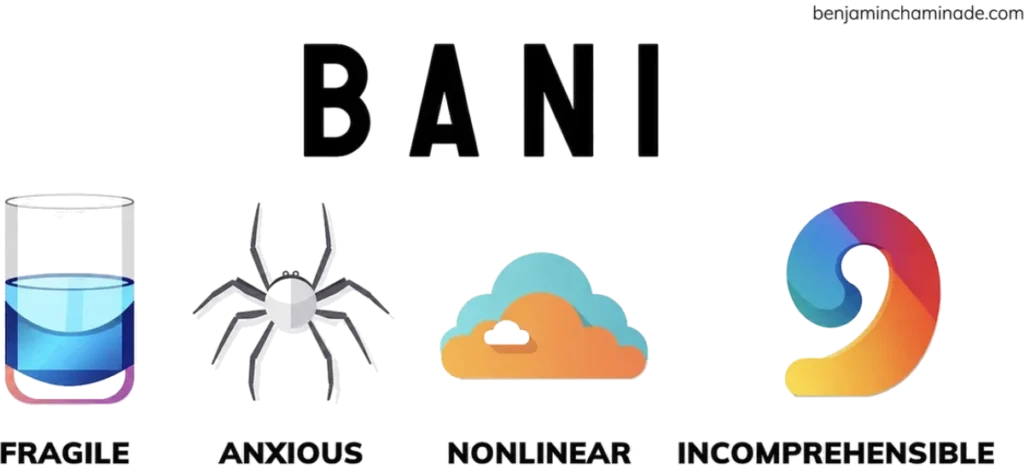
The world moves, fashions follow each other, and concepts adapt. So a newcomer arrived on the consulting scene wanting to replace VUCA, explaining that today’s world is brittle, anxious, non-linear and incomprehensible.
To be precise, BANI wants nothing. Its author wants it rather badly, and so do the many people who now sell workshops built on it.
Plausible or otherwise, the acronym does line up with how a great many people currently feel, which is more than most management vocabulary manages. That alone makes it worth taking seriously enough to define properly.
Here is the reading I want to give you, and you will not find it in the material circulating elsewhere. BANI works best as a correction rather than as a description. Each of its four letters breaks one comfortable illusion that we have been carrying for a very long time, about strength, about control, about predictability and about knowledge.
Read that way, the framework stops announcing that the world has changed and starts admitting what the world was always like. That distinction runs through everything below, and it is where this article ends up: it is time to put the easy acronyms away and talk plainly about a fragile world.
| The acronym | The usual reading | The reading that holds up |
|---|---|---|
| The BANI definition in one lineThe BANI definition covers four conditions, brittle, anxious, non-linear and incomprehensible, proposed by futurist Jamais Cascio to describe a world he judged beyond what earlier vocabulary could capture. It sets out a state of affairs and leaves the operating response to whoever picks it up. | A newer, better acronymThe framework is generally presented as the model that supersedes VUCA, on the grounds that conditions have worsened since the earlier acronym was written. That framing sells an upgrade and it discards the environmental analysis VUCA supplied, without putting anything comparable in its place. | Four broken illusionsEach letter corrects a comfortable belief rather than describing a new condition, breaking the illusion of strength, the illusion of control, the illusion of predictability and the illusion of knowledge in turn. On that reading the acronym reports a change in what we are willing to admit, and the world it describes is a fragile one that was always there. |
The BANI definition, letter by letter
BANI stands for brittle, anxious, non-linear and incomprehensible. Brittle describes something that holds until it shatters without an intermediate warning stage. Anxious describes a standing apprehension rather than a reaction to an event. Non-linear describes outcomes disconnected in size and timing from their causes, and incomprehensible describes situations that resist explanation even afterwards.
The four words in plain terms
Take them one at a time, because the compressed version above is accurate and does very little work. Each word carries a specific claim, and three of the four sound more scientific than they are.
Brittle borrows from materials science, where it has a precise meaning about how a substance fails. A brittle material gives no ductile warning, no bending, no visible deformation before failure. Applied to an organisation, the word claims that apparent solidity tells you nothing about the breaking point.
Anxious is the odd one, and I say so plainly because everyone else glosses over it. A market cannot be anxious. A supply chain cannot be anxious. Only a person can, which means one letter in four describes the observer rather than the observed.
Non-linear has a clean mathematical definition, describing relationships where output is not proportional to input. In management use it means something looser and more honest, that the results of an action arrive at a scale and a moment nobody expected.
Incomprehensible is the most exposed of the four, since comprehension needs somebody doing the comprehending. It describes a relationship between a situation and a mind, in the same way illegible describes a relationship between a page and a reader.
Where the framework came from
Futurist Jamais Cascio proposed BANI in 2020, working through the Institute for the Future, as a way of naming a state of chaos he judged beyond VUCA’s reach. His background sits in foresight rather than in management, which shows in the framework. He offered vocabulary and deliberately left the response open.
That is worth holding on to, because it explains the shape of everything written about BANI since. Cascio wrote about human responses to a BANI world, and the word human sits in his own title.
The German consultant and author Stephan Grabmeier did most of the work of carrying the acronym into management circles from 2020 onwards. A foresight concept was popularised by people who sell management programs, which is neither sinister nor accidental, and it does explain why the material you find tends to end in a training offer.
Cascio’s own framing was that existing concepts had stopped helping people make sense of the crises stacking up around them, climate, pandemic, inequality and global instability among them. A new vocabulary was needed, and BANI was his answer.
What BANI answers that VUCA does not
VUCA answers a question about forces. What large movements are at work, and what social, economic and technological effects do they produce. BANI answers a different question about experience. What does living inside those forces feel like, and what does it do to the people trying to work.
That is the honest division of labour between the two, and it is why I keep both rather than picking a winner. Understanding VUCA still matters and it stops short of telling you how to prepare people for what is coming.
Notice what the acronym contest costs an organisation that plays it. Replacing an environmental analysis with an emotional vocabulary means you have stopped studying your exposure and started describing your mood.
The environmental half of the work sits in my pillar on VUCA leadership and where decisions are made, and the human half is what follows here, letter by letter and illusion by illusion.
Brittle, and the illusion of strength
Brittleness says that solidity is an illusory strength, in the same family as the belief that everything will work out. A brittle system runs perfectly well on the surface while sitting close to a breaking point nobody can locate in advance. You cannot rely on anything brittle, and what makes it dangerous is that it looks entirely reliable until it does not.
Where organisational fragility comes from
Two habits manufacture most of it, and both are respectable. The relentless pursuit of profit and the drive to maximise efficiency are ordinary business goals, and prioritising them above everything else creates vulnerabilities that nobody chose. Neglecting relationships and the wellbeing of staff produces a shortage of skilled, motivated people, which weakens an organisation from inside.
The second habit is quieter. Every organisation carries known gaps in its system, and those gaps go unaddressed through a lack of skill, a lack of attention or a lack of resources rather than through any decision.
Reluctance to confront a known weakness is the most reliable predictor of fragility I have found in twenty years of engagements. The organisations that break are rarely the ones that did not know, and they are usually the ones where naming the problem carried a cost nobody wanted to pay.
The same pattern runs through economies. Monoculture agriculture exhausts the soil and leaves a crop defenceless against a single pest, and resource dependency traps whole regions in an arrangement that works until a technology makes it obsolete. History is generous with examples, and every one of them has a critical failure point that was visible beforehand to somebody.
What it looks like in Australian numbers
Corporate failure is the cleanest available measure of brittleness, because a company entering administration was, by definition, operating until it was not. Australia has been running a visible increase, and the way to read it responsibly is to look at the raw count and the ratio together, since they tell different stories.
The raw count is striking. ASIC reported that 13,413 companies entered external administration in the financial year to 31 May 2025, up 34.2 per cent on the same period the year before.
The ratio complicates it, and I include that deliberately. ASIC also notes that with more than 3.5 million registered companies, the proportion entering administration sits at 0.41 per cent, which remains below the levels recorded in the 2011 to 2013 period when far fewer companies existed.
Both readings are true and the second one is the interesting one for a BANI definition. Brittleness is not primarily a story about volume. It is a story about how the failures arrive, suddenly and from a position that looked sound, which is exactly what a director-driven voluntary appointment usually represents.
The surprise is the expensive part
A brittle system does its real damage through timing rather than through magnitude. It appears stable, it becomes porous over time, and it breaks unexpectedly, which leaves no window to react or adapt. The same shock arriving with two years of visible warning would cost a fraction as much.
Health systems are the example everyone now recognises. Hospitals were showing signs of growing fragility long before a global health emergency arrived, with stretched capacity and exhausted staff.
The pandemic did not create that fragility, and it revealed it in a matter of weeks. What had looked solid turned out to be porous under an external shock, which is the definition of the word doing its work in public.
Two responses follow, and neither is glamorous. Build genuine internal resilience by treating the wellbeing and capability of your people as a structural matter rather than a benefit, and confront the systemic gaps you already know about before something else finds them for you.
What brittleness ultimately exposes is a collective realisation about how delicate our arrangements always were, whether in nature, in an economy or in a peace. The illusion of strength was the comforting story, and it was never the structure.
What this letter does to an individual career is a separate subject, and I treat it in full in the dedicated article.
Anxious, and the illusion of control
Anxiety in the BANI definition means a sense of powerlessness, of being overtaken by events. It arrives with stress, worry and the fear of being unable to meet what the world is asking, combined with not knowing what is coming, which makes any good decision hard to identify. Like brittleness, this says more about people than about the world.
Anxiety as a by-product of information
Anxiety is largely manufactured by information supply. The more bad news people see and hear, the more anxious they become, because there is so little any individual can do about most of it. With real-time information arriving from everywhere at every hour, the result is unsurprising.
Notice the mechanism, because it matters for what you can actually change. The volume of information has not made anyone less capable, and it has continuously demonstrated the limits of their control.
That demonstration is the active ingredient. A person who reads about ten crises before breakfast has been shown ten times that they can do nothing, which is a training programme in helplessness delivered daily and free of charge.
Inside an organisation the same effect runs on internal information. Broadcasting the full scale of a problem to people who hold no authority over any part of it produces exactly this response, which is why transparency without transferred authority does more harm than opacity.
The gap between expected and actual control
Anxiety is a subjective feeling produced by the distance between what people expect and what they experience. People expect to be in control, and for a long stretch they held on to that expectation comfortably. Recent decades were relatively calm in parts of the world, and unrest, war and crisis have always been part of life on this planet.
So the honest statement is uncomfortable. People were never at the controls, and the change is that they are finally noticing again.
This is why the letter belongs in a list of broken illusions rather than in a list of new conditions. The illusion of control was the thing that broke, and control itself was never available to break.
Managers feel this most sharply, because the job description assumes control that the role does not confer. Being accountable for outcomes you cannot determine is the standing condition of middle management, and BANI simply named it.
Passivity, paralysed decisions and the Australian cost
Anxiety makes people and organisations less willing to take risks and to act, which leads to inaction. Decisions become excessively cautious, the safest option gets chosen by default, and more innovative answers that would pay off over a longer horizon never get considered. Caution avoids immediate risk and prevents meaningful progress at the same time.
The cost of leaving this unmanaged is now measured in Australia, and the measurement is blunt. Safe Work Australia reports that mental health conditions account for 12 per cent of all serious workers’ compensation claims, a rise of 161 per cent over ten years, with median time off work almost five times longer than for other injuries.
Australian work health and safety law has moved with that data. The model code of practice names high job demands, low job control, poor support and low role clarity among the psychosocial hazards a business must identify and control, which places most of what BANI calls anxious inside a regulated duty rather than inside a mood.
Two responses work, and the order matters. Adopt a pragmatic optimism that keeps motivation alive without denying the situation, and build a culture that treats intelligent risk-taking and failure as part of learning rather than as evidence against someone.
If any of this describes your own current state rather than an abstract organisational problem, treat that as worth acting on. Speaking to your general practitioner or contacting an Australian support service is a reasonable first step, and I would rather say so plainly than leave it implied.
The specific load this places on the manager layer is a subject in its own right.
Non-linear, and the illusion of predictability
Non-linearity is a well established idea, particularly in innovation, where it means there is no direct path from A to B and instead a network of detours and unexpected results. It is the basis of disruption. In statistics it describes a relationship between variables that does not follow a straight line, and in an organisation it means consequences arrive at a scale nobody sized.
When cause and effect come apart
In an interconnected world, even tiny decisions can produce enormous repercussions. They can bear unexpected fruit or trigger disastrous consequences, and the non-linear nature of those consequences means results are rarely visible straight away. They can surface after a long delay or become apparent only gradually.
The reverse also holds, and it is the part people forget. An abundance of resources or effort does not reliably produce success, and results can evaporate as quickly as they appeared.
The traditional model where A leads to B leads to C is not wrong so much as insufficient. Effects are influenced by a web of interdependent factors, so a small change in one part of a system can produce large and disproportionate consequences somewhere else entirely.
None of this is new. It is the butterfly effect, described decades ago, and the increase in conversation about non-linearity has changed nothing about the underlying nature of the world.
Why results stop making sense
Non-linear outcomes often appear to lack logic or purpose, which makes them feel incomprehensible as well as unpredictable. The difficulty of grasping the cause comes from the cause being distant, terrible or simply absurd. Investigation starts to look futile, and the meaning of events slips out of reach.
Watch how the letters chain together there. Non-linearity produces the raw material that the fourth letter then names, which is why the acronym reads in that order rather than in any other.
Systems also hide their own non-linearity behind apparent stability. Everything looks orderly and proportionate right up until a sudden break exposes the interconnected mess that was always underneath.
That combination of hidden interconnection and delayed consequence is what makes forecasting so unreliable, and it explains why organisations that forecast well still get caught. The forecast was not badly built. The relationship it assumed had stopped being proportionate.
The risk aversion it breeds
Non-linearity follows individuals and organisations like a shadow, pushing them to withdraw rather than engage. It encourages excessive caution and the avoidance of all risk, which can look wise in the short term and is usually damaging over any longer horizon. It becomes a direct obstacle to innovation.
Decision-making picks up the same fog. Leaders start choosing the safest available route and avoiding any strategy that might fail, which produces creative stagnation where the new is read as a threat rather than as an opening.
The organisation ends up making decisions from a survival posture rather than a growth one, and the two produce very different portfolios. Every choice is individually defensible and the aggregate is a slow retreat.
Two responses hold up. Build a culture of continuous learning that treats every situation, expected or not, as material to learn from, and make decision-making genuinely collaborative so that the cascade effects of an action get anticipated by more than one head.
What non-linearity does to the shape of a working life is the subject of its own article.
Field note
The acronym that arrived before the problem
An executive team asked me to run a session on BANI. They had read about it, the chief executive had heard it at a conference, and they wanted their managers brought up to speed. Standard request, and I asked the question I always ask before agreeing to anything. Which of the four letters describes your actual problem this year.
Silence, then four different answers from five people, then a slightly irritated observation that surely it was all of them. So we spent the first hour of the session on that disagreement instead of on the framework. It turned out that two of them were describing a single customer concentration nobody had put on paper, one was describing a manager population running on empty, and the other two were describing the general mood of the news. Three completely different problems, one acronym, and a training brief that would have addressed none of them.
Never buy an intervention against an acronym, because an acronym will absorb any problem you point at it and return nothing. Make the room name the specific letter and the specific evidence first, and you will often find you no longer need the session you asked for.
Incomprehensible, and the illusion of knowledge
Incomprehensibility describes the experience of not understanding what is happening. People cannot oversee it, cannot grasp it, cannot interpret events or the reasons behind them. They cannot find the answers they are looking for, and where answers do arrive, they cannot make sense of those either.
Systemic complexity
Most incomprehensibility comes from the complexity and interdependence of the systems around us. Modern systems, whether technological, ecological or social, are built from many layers of interaction that do not behave linearly, which creates dynamics beyond what conventional analytical tools can handle.
Ecology shows the pattern cleanly. The impact of a single environmental factor produces cascading effects that appear unpredictably and resist being traced back to their original cause.
Software offers the version every technical team recognises. A codebase can depend on a line that looks insignificant and follows no obvious logic, and removing it brings the whole thing down. The paradox is well known among developers and it quietly undermines our confidence about causation in complex logical systems.
Genetics runs the same way, and so does any organisation past a certain size. Somewhere in your business there is a process nobody can justify that would break four things if it were removed, and nobody knows which four.
Our own cognitive limits
The second cause sits inside us. Human brains are wired to perceive and interpret the world through simplified models, which helps enormously in most situations and fails when the interactions are too complex to be reduced to a simple line.
Financial modelling shows the limitation at scale. Economic models that leave out irrational behaviour or extreme events lead directly to a failure to understand the crises that follow.
So the capacity to process and understand large volumes of information is itself a limiting factor, and it does not improve with seniority. A more experienced person carries more and better models, and the models are still models.
Which brings the honest position. We may have believed we understood the world, and our understanding was always partial. Experts and scientists say this most readily, since the more they learn the more clearly they see the extent of their own ignorance.
What incomprehensibility blocks inside a business
The first casualty is innovation. When people and leaders do not fully understand the systems they work inside, they become reluctant to explore new ideas out of fear of the unknown, and the risks attached to innovation start to look too high or too unpredictable to justify.
The result is a workplace where caution beats creativity as a matter of routine, and the organisation loses the ability to adapt to its own market. Fear of failure becomes the main obstacle, and opportunities pass by because nobody understood the trend well enough to act.
The second casualty is strategic planning. An inability to read complex data correctly or anticipate market movement produces plans built on incorrect or incomplete assumptions, which shows up later as misdirected investment, badly allocated resources and products that answer nobody’s need.
Two responses help. Adopt systems thinking so that people can see whole pictures and anticipate indirect effects, and open your innovation outwards through partnerships with other businesses, universities and startups who see your environment from angles you do not have.
There is also a case for finding this bearable rather than alarming. A world that resists complete explanation is a world with something left in it, and the alternative would be considerably duller.
The contradictions this produces for a manager, where two opposite instructions are both legitimate, have their own article.
Find out what the acronym is actually scoring
Wondering why swapping frameworks never changes anything in your organisation? Read my full argument on what the four letters are really measuring, in the pillar article on BANI leadership, and run the reading on your own leadership team.
BANI, VUCA or the fragile world, which frame should you brief your team on
Three frames are available and they answer different questions, so the choice depends on what your organisation currently cannot describe. VUCA analyses the forces acting on you, BANI names what those forces do to people, and the age of fragility measures your own exposure. Brief the one that matches the gap you can evidence.
Comparing the three frames on explicit criteria
Read across from the middle column, since the question a frame answers matters more than how current it sounds. The last column is the one that decides whether the briefing produces anything, because each frame has a specific blind spot and choosing well means choosing the blind spot you can afford.
| Frame | Question it answers | Brief it when | What it produces | What it cannot see |
|---|---|---|---|---|
| VUCA | What forces are acting on us and how do they behave | Your team argues about the environment with no shared vocabulary | A structured reading of external conditions | Anything about the state of the people inside the organisation |
| BANI | What is this environment doing to the people in it | Your people are visibly affected and nobody names it out loud | Permission to discuss the human cost as a management topic | Your actual exposure, since it describes sensation rather than structure |
| The age of fragility | How much are we exposed and to what | You need a number rather than a conversation | A count of concentration, commitment length and approval latency | The emotional reality, which it deliberately sets aside |
One caution about the second row, since it is the one most organisations reach for. A BANI briefing delivered to people who then hold no authority to change anything converts a vague unease into a specific and documented grievance, which is worse than where you started.
The signals that tell you which to use
Three signals settle it quickly. If your leadership team disagrees about what is happening outside, brief VUCA. If they agree about the outside and nobody will discuss what it is doing to the manager population, brief BANI. And if they can describe both fluently and still cannot tell you what the business depends on, skip the acronyms and count your exposure.
The third case is the most common one I meet, and it is the least well served by the material available. Fluency in frameworks correlates poorly with knowing your own dependencies.
There is a fourth signal worth adding. If somebody in the room can already recite all four letters and cannot name one decision that changed because of them, no further briefing on any framework will help.
Whichever you choose, brief it against a written question rather than as general awareness. A frame introduced to answer a question can be evaluated, and a frame introduced as context can only be repeated.
How I can help you work with the BANI definition
I work with executive teams, boards and manager communities on leading in the age of fragility, in English and in French. Each format is built to finish with a specific decision written down, rather than with a room that now knows four more words than it did that morning.
Keynotes on BANI and the fragile world
I deliver a keynote on BANI leadership and the age of fragility that gives an audience the four letters and then takes them apart, which is a more interesting hour than the version where somebody reads the acronym out.
It works best when it closes with each table naming the single letter that describes their real problem, along with the evidence for it.
Workshops on managerial transformation
Over a half day or two days we work through your own exposure rather than through the framework, counting concentration, commitment length and approval latency, then testing how your managers behave under live pressure. My managerial transformation workshop is where that sits.
Teams leave with a written exposure picture and one structural change identified, with an owner and a date against it.
A diagnostic before you commit budget
I run a short diagnostic built from my own tools, including the exercise where a leadership team scores the four letters privately and then compares the spread, which reliably surfaces disagreements nobody knew they had.
It is the fastest way to find out whether you need a keynote, a workshop or a conversation about structure, and it usually saves more budget than it costs.
Conclusion: enough acronyms, welcome to a fragile world
Every word we use to describe the world around us says something about us. That was true of dynamic, of turbulent, of VUCA and of every other concept we have reached for while struggling to grasp and control what is happening.
BANI takes that to a new level. Before it says anything about the world, it says something about how we personally perceive it. The world did not become more brittle, more anxious, more non-linear or more incomprehensible.
We are the ones who finally have to let go of the illusion that it was ever otherwise. That is the whole content of any BANI definition worth the reading.
So I would leave the four-letter acronyms behind. There is a tidiness to the number four, a sense of order and balance, and that tidiness is exactly what makes these frames comforting and slightly useless. It is time to stop reducing and start naming what this actually means for leadership and for a career.
What I propose instead is the age of fragility, a world where a qualification, an experience, a background or a uniform no longer protects anybody. I describe it through four characteristics rather than four letters, and each one has its own article.
- Stable precarity. Faced with volatility, do not let internal insecurity lock you into ever narrower expertise, and stay curious about what other functions and other fields are doing.
- Permanent anxiety. Stop trying to reduce the uncertainty of your future alone, since a future is prepared collectively, so take charge of your own learning and trade knowledge with the people around you.
- Non-linear fragmentation. Do not resign yourself to work that has lost its meaning through sheer complexity, widen what interests you, and find the nerve to abandon something that works in order to try something unproven.
- Extreme paradoxes. Stop trying to define ambiguity away or to choose between two valid options, change your relationship to risk, and learn to decide without having understood everything, guided by your values and your judgement.
Whatever fears you carry about your own future, there are no simple answers and we are all in the same boat across every generation. The future does not belong to the people who watch the change from the side of the road.
Start with the letter that actually describes your year.
Frequently asked questions about the BANI definition
What is the BANI definition in simple terms?
BANI stands for brittle, anxious, non-linear and incomprehensible, and it describes conditions rather than prescribing a response. Read more usefully, each letter corrects a comfortable belief, breaking the illusion of strength, of control, of predictability and of knowledge in turn.
Who created BANI and when?
Futurist Jamais Cascio proposed BANI in 2020 through the Institute for the Future, from a foresight background rather than a management one. The German consultant Stephan Grabmeier did most of the work of carrying it into management circles from that year onwards.
Does BANI replace VUCA?
The two answer different questions, so neither replaces the other. VUCA asks what forces are acting on an organisation, while BANI asks what those forces do to the people inside it. Dropping one means either losing your environmental analysis or losing sight of your people.
Why is BANI criticised as just another acronym?
Because adopting it changes vocabulary without changing behaviour, and a four-letter frame absorbs any problem pointed at it. The useful test is whether anyone in your organisation can name a decision that changed as a result of the framework, rather than a description they can now recite.
What comes after BANI?
I would put the acronyms down and name the condition directly, which I call the age of fragility, a period where a qualification, an experience or a title no longer protects anybody. It replaces four letters with four characteristics that can each be measured and acted on.