


Conflicting priorities at work are usually treated as a communication failure. Somebody upstairs was unclear, two departments briefed you differently, and a conversation will sort it out. Sometimes that is exactly what happened. Increasingly it is not, because both instructions are correct, both are binding, and no conversation will make one of them go away.
An extreme paradox is a situation where two contradictory things are simultaneously true. I use the term for the fourth of the characteristics that make up the age of fragility, and it names what happens to your experience when the situation in front of you has no correct answer.
Australia has done something no other country has done quite so explicitly. It has written one of these paradoxes into legislation.
Since August 2024, section 333M of the Fair Work Act has given employees a right to refuse to monitor, read or respond to contact outside their working hours unless the refusal is unreasonable. A manager has to respect that right for their team and remains accountable for outcomes that do not observe office hours.
Then comes the detail almost nobody has noticed. Among the factors that determine whether a refusal is unreasonable, the Act includes the nature of the employee’s role and their level of responsibility.
Read that carefully. The manager who must protect their team’s right to disconnect has a weaker version of the same right themselves, precisely because they are the manager. That is a double bind with a section number attached, and it is the cleanest illustration of this whole subject I have ever been handed.
So this article takes the paradox seriously rather than treating it as a communication problem. What an extreme paradox actually is, why your experience stops helping, the ten of them every manager carries, and how to hold a pair instead of trying to resolve it.
| The condition | The Australian case | The move that works |
|---|---|---|
| Extreme paradoxes, definedAn extreme paradox is a situation where two contradictory statements are both true and both binding. Conflicting priorities at work stop being a communication failure at that point, and past experience stops functioning as a guide, because experience teaches which answer is correct and there is no correct answer available. | A double bind written into statuteAustralian law gives employees a right to refuse work contact outside their hours unless the refusal is unreasonable, and it lists the nature of the role and level of responsibility among the factors deciding reasonableness. Managers must uphold that right for their teams while holding a weaker version of it themselves. | Hold the pair instead of resolving itA paradox handled as a problem produces an oscillation between two positions, with each correction creating the next. Naming both halves as legitimate, setting an explicit ratio between them, and putting a review date on that ratio converts an unwinnable argument into a managed position. |
What an extreme paradox actually is
An extreme paradox is a situation where two things are true and contradictory at the same time. It disturbs the reference points we use to navigate, since those reference points were built on the assumption that contradiction signals an error somewhere. When contradiction stops signalling error, the fragility of our experience becomes visible.
A paradox and a dilemma are different problems
The distinction decides everything that follows, and most managers have never had it explained. A dilemma offers two options and asks you to pick the better one, which is difficult and finite. A paradox offers two options that are both required, which means picking one is the mistake rather than the solution.
Watch what happens when a paradox gets treated as a dilemma. The manager picks a side, the consequences of neglecting the other side accumulate, and within two quarters they swing back.
That oscillation is the signature. If your organisation has centralised and decentralised twice in ten years, or tightened and loosened its approval thresholds repeatedly, you have watched a paradox being managed as a series of dilemmas.
Nobody involved was wrong on either occasion. Each correction was a reasonable response to the problems created by the previous correction, which is exactly how a paradox behaves when you insist on solving it.
Why experience stops helping
Experience works by pattern matching. You have seen something resembling this before, you remember what worked, and you apply it faster than a novice could reason it out. That mechanism depends entirely on there having been a right answer last time, which is the thing a paradox removes.
So the experienced manager arrives with a confident answer that resolves one half of the tension. Their confidence is real, their answer is competent, and it addresses half the situation.
This is what I mean by the fragility of our experience. The asset that made you valuable becomes an active liability in the exact situations where the stakes are highest, and it does so without any signal that it has stopped working.
Notice how this connects to the rest of the series. Deep experience is what produces stable precarity, and it is also what makes paradox hardest to handle, which means the same asset is generating two of the four fragilities at once.
Three paradoxes outside work that make the pattern obvious
The pattern is easier to see away from the office, where nobody has a stake in denying it. Three examples cover most of the shape, and each one describes a situation where more of something good produced less of what it was supposed to deliver.
The paradox of abundance comes first. Goods, services and information have never been more available or more varied, and personal satisfaction has not moved in proportion and by some measures has gone backwards.
The paradox of communication is the second. Tools for connecting have become universal and effectively free, while the capacity to communicate well and build relationships of quality has visibly eroded.
The paradox of freedom completes it. We hold unprecedented freedom to express opinions, travel and choose how to live, alongside a dependence on technologies and systems that constrains real autonomy in ways the previous generation never faced.
Australia legislated one of these, which changes the conversation
Most managerial paradoxes are unspoken, which is what makes them corrosive. Australia has taken one of them and written it into the Fair Work Act, complete with a test for reasonableness and a dispute process. That single act converts a private double bind into a public, discussable, adjudicable one, and the effect is better than it sounds.
The right to disconnect, and what it asks of a manager
Section 333M of the Fair Work Act gives employees the right to refuse to monitor, read or respond to work contact outside their working hours, unless that refusal is unreasonable. It came into effect in August 2024 for larger employers and a year later for small business, and it covers contact from employers, colleagues and third parties.
The provision does something more interesting than banning after-hours contact, and it is worth being precise about this because a great deal of commentary got it wrong. Contact remains lawful, and what changed is the employee’s protected ability to decline to engage with it.
Reasonableness is assessed case by case against factors set out in the Act, including the reason for the contact, the disruption it causes, whether the employee is compensated for availability, the nature of their role and their personal circumstances.
So a manager now operates inside a legal framework that protects their team’s disengagement while their own accountability for outcomes remains continuous. Both halves are legitimate and both are binding, which is the definition this article opened with.
The reasonableness factor that catches managers
Here is the part I have not seen discussed anywhere, and it turns the provision into a genuine paradox rather than a simple protection. Among the factors determining whether a refusal is unreasonable, the Act includes the nature of the employee’s role and their level of responsibility.
Follow the logic to its conclusion. The more senior and responsible the person, the more likely it becomes that a refusal to respond would be judged unreasonable.
Which means the manager charged with protecting the right holds a weaker version of it, by operation of the same section that created it. Not through anybody’s bad faith, and as a direct consequence of a sensible drafting decision about what reasonableness should account for.
I want to be careful about the legal reach of that observation, since reasonableness is fact-specific and decided case by case rather than by any general rule. The structural point stands regardless of how any individual dispute resolves.
Why a named paradox beats an unspoken one
An organisation with an unspoken paradox produces private suffering and public confusion, because everybody is failing at something nobody has admitted is impossible. Naming it changes the failure into a trade-off, and a trade-off can be discussed, sized and allocated. That is why the Australian position is an improvement despite the discomfort it creates.
Before the provision, a manager receiving a message at nine on a Sunday evening made a private judgement with no framework behind it. Answer and set an expectation, or leave it and carry the anxiety until Monday.
Now the same manager has a public standard, a list of factors and a dispute process. The tension did not disappear and it stopped being personal.
That is the general principle worth taking from the Australian case, well beyond after-hours contact. A paradox that has been named, with an explicit position on how the two halves are balanced, costs an organisation far less than the same paradox left for each individual to resolve alone every week.
The ten paradoxes every manager carries
Ten pairs describe almost all of the conflicting priorities at work that managers actually face. Each pair contains two legitimate demands, each arrives as an instruction rather than as an acknowledged tension, and the damage comes from the pretence that a correct answer exists. Naming them is the first useful act.
Autonomy and control, innovation and stability, delegation and involvement
The first three pairs concern how much a manager holds. Give people autonomy and maintain enough control to answer for the results, encourage innovation and protect operational stability, delegate genuinely and stay close enough to be accountable for what happens.
Autonomy against control is the pair most often faked. Organisations announce empowerment, leave the approval thresholds where they were, and describe the result as trust.
Innovation against stability produces the clearest oscillation. A period of encouraged experimentation is followed by an incident, then by a tightening, then by a complaint that nobody innovates any more.
Delegation against involvement is the one managers feel most personally, because both failure modes are visible. Step back and you are absent, stay close and you are micromanaging, and the same behaviour gets both labels depending on the outcome.
Proximity and distance, change and continuity, transparency and confidentiality
The next three concern position rather than authority. Build genuine relationships with your team and hold the professional distance the role requires, drive change and preserve the continuity that keeps operations running, communicate openly and protect information you are not permitted to share.
Proximity against distance has become harder rather than easier as workplaces informalised. The expectation of authenticity sits directly against the requirement to make decisions about the people you are being authentic with.
Transparency against confidentiality is the pair that produces the most damage per incident. A manager who knows something they cannot share is asked a direct question, and every available answer costs them credibility or compliance.
The only workable position is to say plainly that you know something you cannot yet share, and to name when you will be able to. Most cultures treat that answer as evasive, which is why so few managers use it.
Flexibility and consistency, intrinsic and extrinsic motivation
These two concern fairness, which is where paradox becomes legally sensitive. Adapt to individual circumstances and apply rules consistently across the team, cultivate motivation that comes from the work itself and use the rewards and recognition the organisation actually runs on.
Flexibility against consistency has no stable resolution, and it produces the complaint that runs through every engagement survey. Accommodate one person’s circumstances and you have created a precedent, refuse the next and you have created an inequity.
The useful move is to be flexible about method and consistent about standard, which at least locates the flexibility somewhere defensible. It resolves nothing and it gives a manager a line they can explain out loud.
Intrinsic against extrinsic motivation is quieter and more corrosive. A manager is told that purpose and mastery drive performance, inside a system that allocates pay and promotion on measurable output, and both statements describe something real.
Collective and authoritative decisions, objective and subjective evaluation
The last two concern judgement. Involve the team in decisions and be capable of deciding alone when the situation requires it, evaluate performance against measurable criteria and account for context, effort and circumstances that no measure captures.
The decision pair is where most managers get caught publicly. Consult and then decide against the consultation, and you are accused of theatre. Consult and follow the group, and you have abdicated a judgement you were paid to make.
Saying in advance which kind of conversation this is removes most of the damage. Announcing that you are gathering input and will decide yourself is a different meeting from announcing that the group will decide, and the words cost nothing.
Evaluation is the final pair and the least escapable. Pure objectivity ignores everything that made the year difficult, pure subjectivity is indefensible when challenged, and every performance system in existence pretends this tension has been solved.
Field note
The executives who had issued both instructions
I ran a session for a manager community where the exercise was simple. Each person wrote down two instructions they had received in the past quarter that they could not obey simultaneously. Twenty minutes, no discussion, index cards on a wall. The executive team was in the room, which they had asked for and which I had agreed to with some hesitation.
Forty cards went up. What silenced the room was not the volume. It was that the executives recognised their own words on both sides of almost every pair. Move faster and reduce risk. Give your people more autonomy and get closer to the detail. Be transparent and hold the restructure confidential. Nobody had been careless, and the two halves had simply been issued in different meetings, weeks apart, each time as a single clear priority. The managers had spent the quarter believing they were failing at something everybody else had worked out.
Run the two-instruction exercise before you commission anything else on managerial capability, and have the executives in the room when you do it. Most contradictory instructions are not badly written, they are well written and issued separately, and the only cure is seeing both halves on the same wall at the same time.
How to hold a pair rather than resolve it
Holding a paradox takes three moves and they work in order. Name both halves as legitimate, set an explicit ratio between them for a defined period, and decide who carries the tension when the ratio is tested. Each move converts something private and unwinnable into something public and manageable.
Name both halves of the conflicting priorities out loud
Naming is not a soft opening move, it is the load-bearing one. A team that has heard both demands acknowledged as real stops interpreting the tension as managerial incompetence, which removes most of the credibility cost a manager currently pays for a situation they did not create.
The sentence is short and most managers have never been given permission to say it. We are being asked to do two things that pull against each other, both of them matter, and here is how we are going to hold them this quarter.
What that sentence buys is disproportionate to its length. It ends the private theory each person had been building about why the instructions kept changing.
It also protects the manager. A tension that has been named belongs to the organisation, and an unnamed one belongs to whoever is standing in front of the team when it surfaces.
Set the ratio and put a date on it
A paradox cannot be solved and it can be weighted. Deciding that this quarter runs seventy per cent towards delivery and thirty per cent towards experimentation gives everyone a usable instruction, and stating the period stops the weighting from hardening into a permanent position nobody chose.
The numbers matter less than their existence. What a team needs is a defensible answer to the question of what to sacrifice when the two demands collide on a Tuesday.
This is the same discipline I set out for writing an intent in my pillar on VUCA leadership and where decisions are made, and the test is identical. A statement that does not tell you what may be given up provides no guidance at all.
The review date is what distinguishes this from a decision. Revisiting the ratio each quarter builds the oscillation into the design deliberately, at a controlled amplitude, instead of letting it happen violently every two years.
Decide who carries the tension
Somebody absorbs every paradox in an organisation, and in the absence of a decision it defaults to the manager layer. Making the allocation explicit is the third move, and it usually means an executive taking back a tension they had unknowingly pushed downwards.
The right to disconnect is a good worked example. A business that tells its managers to sort out after-hours contact themselves has allocated the paradox to the layer with the least room.
A business that writes a standard, states which situations justify contact and backs the manager who declines the others has taken the tension back to where the authority sits. The same law, the same pressure, and a completely different experience for the person in the middle.
Ask the question directly at your next executive meeting. For each of the ten pairs above, name who currently carries the tension, and notice how often the honest answer is the same layer.
There is a fourth move that only works once the first three are in place, and it is the one that changes a culture rather than a quarter. Reward a manager publicly for holding a pair well instead of resolving it decisively.
Organisations promote decisiveness because it is legible, and legibility is exactly what a paradox denies. A manager who kept two demands alive for six months without collapsing either has done something considerably harder than a manager who picked a side, and almost no promotion vocabulary exists to describe it.
Write that behaviour into your criteria in plain language, then promote somebody on it and say so. Managers read promotions far more accurately than they read training, and a single visible case will do more than a year of workshops on managing complexity.
Get the conceptual half of this
Want to understand why two opposite readings can both be correct rather than one being an error? Read my full treatment of contradiction as a conclusion in the article on dealing with ambiguity, then come back and run the two-instruction exercise.
What replaces experience when experience stops working
If experience cannot settle a paradox, something has to. Three instruments remain available, and all three are treated as unserious in most organisations. Intuition built from wide exposure, creativity applied to the structure of the problem, and an explicit set of values that decides which half wins when the ratio is tested.
Intuition is a legitimate instrument here
Intuition gets dismissed as the opposite of rigour, and under paradox it is the only form of rapid judgement left, because analysis requires a correct answer to converge on. The useful version is built rather than innate, and it comes from exposure to a wide range of situations rather than from depth in one.
That origin matters, because it tells you how to develop it. Range produces better intuition than depth does, which is the same conclusion the rest of this series keeps arriving at from different directions.
It also tells you whose intuition to trust in a room. The person with fifteen years in one function has excellent instincts about that function and no particular advantage on a paradox that spans three.
Say the word out loud when you use it. A decision described as intuition invites challenge, and the same decision dressed up as analysis cannot be argued with because the analysis was never real.
Creativity applied to the structure rather than the answer
Creativity in a paradox works on the shape of the situation rather than on the choice inside it. A pair that cannot be resolved in one place can sometimes be separated in time, in space or by population, which produces a workable arrangement without pretending the tension went away.
Separating in time is the most common. Run the experimentation in a defined window and the stability discipline outside it, so both demands get an uncontested period rather than competing continuously.
Separating by population works where the pair is genuinely about different work. One team carries the stability obligation and another carries the innovation obligation, with the tension moved to the interface where somebody senior can manage it deliberately.
None of these dissolves the paradox and each of them makes it survivable. That is the realistic objective, and any consultant promising you the other thing is selling a dilemma.
Values are what decide when both answers are defensible
When two options are equally defensible on the evidence, something outside the evidence has to break the tie, and values are what that something is. This is the practical reason for an organisation to state its values in operational terms rather than aspirational ones. A value that cannot settle a real trade-off is decoration.
Test your own set against a live pair. If safety and speed collide on a Thursday afternoon, do your stated values tell a team leader which one gives way.
Most published value statements fail that test completely, because they were written to describe an aspiration rather than to arbitrate a conflict. Integrity, excellence and collaboration settle nothing.
Two things must therefore stay unambiguous whatever else is contradictory. Your values translated into managerial behaviour, and each person’s immediate objectives and priorities, which is where I always start when an organisation tells me its managers are confused.
Clarify, arbitrate or redesign, which response fits your paradoxes
Three responses get proposed when conflicting priorities at work reach an executive agenda, and they address different layers. Clarification removes the contradictions you created yourself, arbitration decides the ratio on the genuine ones, and structural redesign moves the tension to where somebody can hold it. Most organisations need the third and buy the first.
Comparing the three responses on explicit criteria
Read from the second column and be honest about which line your managers would choose anonymously. The last column decides the outcome, since each response fails in a specific way and choosing well means knowing which failure you are accepting.
| Response | Fits when | What it changes | Maturity required | How it fails |
|---|---|---|---|---|
| Clarification of priorities | Instructions genuinely contradict through poor coordination | Removes manufactured contradictions between functions | Low, mostly a coordination discipline | Applied to a real paradox, it produces a clearer version of an impossible instruction |
| Explicit arbitration and ratios | Both demands are legitimate and neither can be dropped | Gives managers a defensible answer about what gives way | Medium, needs executives willing to state a trade-off in writing | The ratio hardens into permanent policy and the review never happens |
| Structural redesign | The same layer absorbs every tension in the organisation | Moves the paradox to where the authority to hold it sits | High, since somebody senior takes back work they had pushed down | Relocates the tension onto a layer with no more capacity than the last one |
One caution about the first row, because it is the most popular and the most misapplied. Clarification is genuinely valuable on manufactured contradictions and actively harmful on real ones, since a clearer statement of two incompatible demands tells a manager that somebody senior has looked at the problem and confirmed it.
The signals that tell you which one applies
One test separates the manufactured contradictions from the real ones, and it takes a single meeting. Put both instructions in front of the two people who issued them and ask which one gives way. If they can answer, you had a coordination problem. If they cannot, you have a paradox and clarification will achieve nothing.
A second signal tells you whether redesign is needed rather than arbitration. Count how many of your ten pairs land on the same layer.
Where the answer is most of them, no amount of arbitration will help, because you have designed an organisation that resolves its contradictions by delegating them downwards until somebody has no one left to delegate to.
Whichever you choose, write the reasoning down. A trade-off recorded in writing can be reviewed next quarter, and one settled in a corridor gets re-litigated every week by people who were not there.
How I can help with conflicting priorities at work
I work with executive teams, boards and manager communities on managerial paradox, in English and in French. The work is built to finish with contradictions named on a wall and a written ratio against the real ones, rather than with a shared agreement that management has become complicated.
Keynotes on paradox and the fragility of experience
I speak on extreme paradoxes at conferences, leadership offsites and internal events, and the right to disconnect example does a great deal of the work because every Australian manager in the room has lived it.
The session lands best when it closes with each table naming the pair they have been trying to resolve for a year. Booking sits on my page on BANI leadership and the age of fragility.
Workshops on the two-instruction exercise
Over a half day or two days we run the exercise with the executive team present, sort the manufactured contradictions from the real ones, and set a written ratio with a review date on each pair that survives the sorting.
The output is an allocation of who carries which tension, which sits alongside my managerial transformation workshop.
Diagnostics on where the tensions land
For organisations where the manager layer is visibly strained, I run a short diagnostic mapping each of the ten pairs against the level currently absorbing it, which usually shows a single layer carrying almost all of them.
The load that produces on the people in the middle is the subject of my article on permanent anxiety and manager burnout.
Conclusion: stop resolving conflicting priorities at work and start weighting them
Extreme paradoxes are what happens when two legitimate demands arrive together and neither can be dropped. Your experience will offer a confident answer to one half, which is why the most experienced person in the room is frequently the one who resolves the situation most decisively and most incompletely.
Australia has handed managers an unusually clear example by writing one of these into the Fair Work Act. Protect your team’s right to disconnect, remain accountable around the clock, and hold a weaker version of the right yourself because of your level of responsibility.
That legislated paradox is an improvement on the unspoken kind, and it demonstrates the general principle. A tension that has been named, weighted and allocated costs an organisation a fraction of what the same tension costs when every manager resolves it privately each week.
So run the two-instruction exercise, sort what is manufactured from what is real, put a ratio and a date on the real ones, and decide out loud who carries each tension.
Nothing there resolves anything, and that is the point. Conflicting priorities at work stop being a private failure the moment somebody senior says out loud that both halves are true.
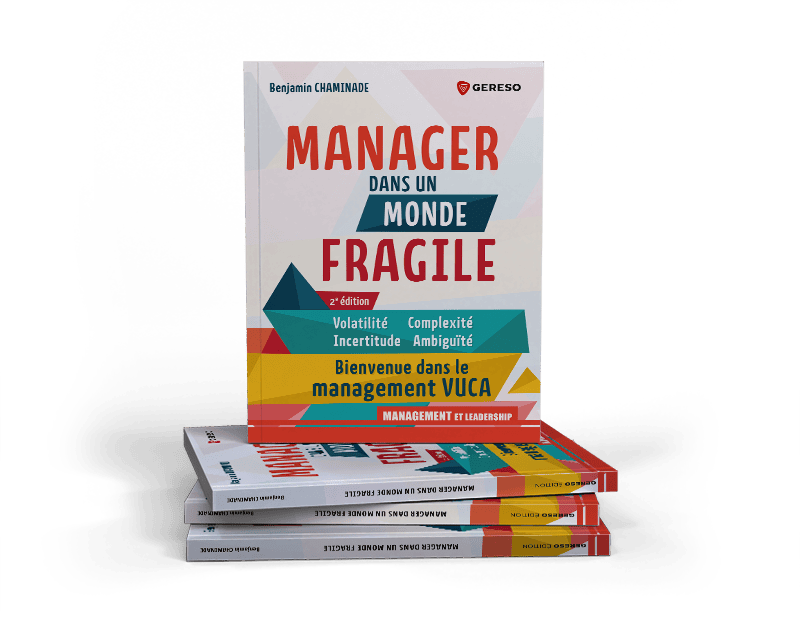
My full treatment of leading in a fragile world is available in book form, published in French by GERESO. Click the image to order a copy.
Frequently asked questions about conflicting priorities at work
How do I handle conflicting priorities at work?
First establish whether the contradiction is manufactured or real by putting both instructions in front of the two people who issued them. If they can say which gives way, it was a coordination problem. If they cannot, set an explicit ratio with a review date instead of choosing a side.
What is the difference between a paradox and a dilemma?
A dilemma offers two options and asks you to pick the better one. A paradox offers two options that are both required, so picking one is the mistake. The signature of a paradox treated as a dilemma is an organisation that swings between two positions every couple of years.
Does the right to disconnect apply to managers in Australia?
It applies to employees generally, and section 333M lists the nature of the role and level of responsibility among the factors deciding whether a refusal is unreasonable. Reasonableness is assessed case by case, and a senior manager’s refusal is more likely to be tested than a junior employee’s.
Why does experience stop helping with paradoxes?
Experience works by recognising a pattern and applying what worked before, which assumes there was a right answer last time. A paradox removes that assumption, so an experienced manager produces a confident answer that competently addresses one half of the situation.
What should a manager say when two instructions contradict?
Say both out loud and name the weighting. Telling a team that two demands pull against each other, that both matter, and that this quarter leans a stated way gives people something to act on and moves the tension from the manager to the organisation.
