A non-linear career path is one where progression stops behaving like addition. Effort and outcome come apart, a sideways move produces more than a promotion, a redundancy opens something better than the job it ended, and a sensible resignation leads to eighteen months of nothing. Cause and effect are still there and they have stopped being proportionate.
Non-linear fragmentation is my name for what that does to a working life over time, and it is the third of the four characteristics I use to describe the age of fragility.
Now the Australian problem, which took me a while to work out and which changes the whole article.
Everything written internationally about non-linear careers assumes you can see them. Job hopping, portfolio work, visible reinvention. Australian data refuses to cooperate. Of the people who changed jobs in the year to February 2025, the Australian Bureau of Statistics reports that almost two-thirds stayed inside the same occupation, and among professionals the figure passes four in five.
So Australian careers still look linear from the outside. Same occupation, tidy progression, a CV a recruiter can read in nine seconds.
The fragmentation is happening anyway, and it is happening inside the roles rather than between them. Your title stayed the same for eight years while the job underneath it was replaced twice, and nothing in your employment record records that.
That is the Australian version of this problem, and it is harder than the visible one. Invisible fragmentation cannot be seen by a recruiter, cannot be credited in a selection process, and cannot be planned for by anybody doing workforce strategy from an occupation code.
| The condition | The Australian twist | What has to change |
|---|---|---|
| Non-linear fragmentation, definedA non-linear career path is one where outcome stops being proportionate to effort, so a lateral move can produce more than a promotion and a redundancy can open more than it closes. Working lives become sequences of loosely connected episodes rather than a single ascending line. | Fragmentation that nobody can seeAustralian careers still present as linear, since most people who change jobs stay inside the same occupation and professionals do so at a much higher rate. The fragmentation happens inside roles instead, where the work is replaced while the title holds, leaving no trace in any employment record. | Read capability rather than continuitySelection processes reward legible progression, which filters out people whose histories look untidy and misses the change accumulated inside tidy ones. Reading transferable capability rather than sequence gives an employer access to both groups, and gives an individual a way to describe what actually happened. |
What non-linear fragmentation actually means
Non-linear fragmentation describes the replacement of the traditional career ladder with a sequence of loosely connected episodes. The old model divided a life into three phases, education then work then retirement, and each phase had a clear boundary. That structure has given way to something with continuous learning, interrupted work and no fixed end point.
The end of the three-phase life
The three-phase model was never a law of nature and it worked well enough for two generations. It assumed you learned once, applied that learning for four decades, then stopped. Every part of that sequence has come apart, and the pieces have not rearranged into any new standard.
Four features describe what replaced it, and most people are living at least two of them without having named any.
- Learning distributed across the whole of working life rather than concentrated at the start.
- Rest and withdrawal distributed the same way, so that periods away from work happen throughout rather than only at the end.
- Diversification of activity, with people holding more than one kind of professional identity at once.
- More frequent interruptions, voluntary and involuntary, treated as normal features rather than as failures.
Notice that none of those four is a problem in itself. What causes the difficulty is that our institutions, our selection processes and our own self-narratives were all built for the model that has gone.
Why progression stopped being addition
The mathematics of a career used to be additive. Each year of experience added to the last, seniority accumulated, and the total was the sum of the parts. Non-linearity means the relationship between input and output stopped being proportionate, so results can compound unexpectedly or evaporate entirely.
You see this most clearly in what a year of experience is now worth. In a stable field, a fifteenth year in the same role adds roughly what the fourteenth did.
In a field being reshaped, that fifteenth year can add nothing, or subtract, because it deepened a position that has stopped being where the value sits. Two people with identical effort and identical competence can end a decade in completely different places.
That is disproportionality rather than unfairness, and the distinction matters. Unfairness implies somebody rigged it, and disproportionality is simply how systems behave once enough things are connected to each other.
The linear and the non-linear career path, side by side
The two models differ on three dimensions rather than one, which is why moving between them is harder than it sounds. They differ in how the path is chosen, in how the phases sit against each other, and in the direction capability is built.
| Dimension | Linear career | Non-linear career |
|---|---|---|
| How the path is set | A predefined plan followed over time | Several trajectories tested, with the plan revised as evidence arrives |
| How phases sit | Education, then work, then retirement | Learning, work and interruption interleaved throughout |
| How capability is built | Vertically, deepening a single specialism | Horizontally and vertically at once, adding range around a core |
Read the third row carefully, since it is the one that decides the other two. A person building only vertically has no capacity to change direction, which means their path is set whether they chose it or not.
Range is what converts a career from something you follow into something you steer. Everything else in this article is a consequence of that single point.
There is a generational misreading worth clearing up while we are here, because it distorts every conversation on this subject. Younger workers get described as the ones abandoning linear careers, and the ABS records the opposite pattern for Australia.
People aged 15 to 24 are indeed the most mobile group at around 12 per cent, and mobility for younger workers has generally been trending down over the longer run rather than up. Fewer young Australians change jobs today than did so thirty years ago.
So the story about a restless generation redesigning work does not survive contact with the national data. What has actually happened is that every generation is moving less while the work underneath all of them moves more.
The Australian paradox, fragmentation you cannot see
Australian careers present as more linear than the international commentary assumes, and they are being fragmented anyway. Most people who change jobs stay inside the same occupation, so the disruption does not appear as visible movement. It appears as the content of a role changing underneath a title that stays put.
The data says careers here still look tidy
Start with what the ABS actually measures, because it contradicts almost everything written about modern careers. Of the 1.1 million Australians who changed jobs in the year to February 2025, almost two-thirds stayed within the same occupation, and among professionals the figure rose to more than four in five.
Add the direction of travel. The same release records the job mobility rate falling for a second consecutive year, and the ABS notes that mobility in Australia has generally been trending down for decades.
So the Australian professional appears remarkably stable on paper. One occupation, occasional employer changes, a career that any selection process would describe as coherent.
Every instinct says that stability should mean insulation from non-linearity. It does not, and the reason sits in the next section.
Australia had to rebuild its map of what jobs are
Here is the fact that settles the argument, and it comes from the statistical agency rather than from any commentary. Australia’s official classification of occupations had to be rebuilt because the previous one no longer described the work being done.
The Australian and New Zealand Standard Classification of Occupations described this labour market from 2006 onwards. In December 2024 the ABS published the Occupation Standard Classification for Australia, which replaces it, following a comprehensive review conducted between July 2022 and December 2024.
Think about what a statistical agency has to conclude before it rebuilds a classification. The names of the jobs stopped matching the jobs, across an entire economy, over eighteen years.
And the replacement is not treated as permanent either, since the ABS is already consulting on the next update. The instrument for measuring what jobs exist now has a maintenance cycle, which tells you how fast the underlying reality is expected to move.
Fragmentation inside the role rather than between roles
Put those two facts together and the Australian version of non-linear fragmentation comes into focus. People are not moving between occupations, and the occupations themselves are moving underneath them. The change is real, it is substantial, and it leaves no trace in any employment history.
Ask anybody who has held the same title for a decade what proportion of their current work they were doing at the start. The answer is usually somewhere between a third and none.
That person has changed career several times without changing employer once. They have retrained repeatedly, absorbed new tools, taken on functions that used to belong to other departments, and lost functions to software.
And none of it appears anywhere. Their record shows one title, one occupation code, one long unbroken line, which is exactly the shape a linear career leaves behind. The fragmentation happened and the evidence of it was never collected.
Why invisible fragmentation is the harder problem
Visible fragmentation carries a cost and it also carries a signal. Somebody with four different roles across three industries has an unusual CV, and they also have an obvious story to tell about range. Invisible fragmentation gives you all of the disruption and none of the evidence.
Three consequences follow, and each of them lands on a different party.
The individual cannot describe what happened to them. Asked at interview what they have learned, they reach for the title rather than for the four transitions inside it, because nobody taught them to see those as transitions.
The employer cannot credit it. A selection process reading occupation and tenure sees continuity where there was constant adaptation, and it therefore rates a person who has changed enormously as somebody who has not changed at all.
And the workforce planner cannot see it either. A plan built from occupation codes assumes those codes describe stable content, which is precisely the assumption the ABS spent two and a half years correcting.
Ruptures and disproportionate effects
A career rupture is any break in continuity, whether it comes from a role change, a redundancy, a resignation or a period away from work. Non-linearity means those ruptures produce effects that bear no reliable relationship to their apparent severity. The same event lands differently on two people, and the difference is not luck.
The four kinds of rupture
Ruptures arrive in four recognisable forms, and it is worth naming them because people tend to treat only one of the four as a real event.
- A role change, whether inside the same organisation or across to another one.
- Redundancy or dismissal, where the employment ends on the employer’s initiative.
- Resignation, where it ends on yours.
- Career interruption, voluntary or otherwise, for caring, health, study or any other reason.
Most people only count the second one as a rupture worth talking about, which is why the other three catch them unprepared. A voluntary role change is a genuine break in continuity and it deserves the same thought as an involuntary one.
Each of these is frequently the starting point of a reorientation rather than an end. That reframing is accurate and it is also the reason the outcomes vary so wildly.
Why the same event produces opposite outcomes
Disproportionality is the defining feature here. A redundancy can produce the opportunity to rebuild in a new field with capabilities the person never had reason to develop. A straightforward resignation, taken deliberately and with a plan, can produce an extended period of unemployment and real difficulty getting back in.
Those two outcomes come from events that look opposite in severity. The involuntary one, which everybody treats as the disaster, frequently produces the better result.
Part of that is structural, since a redundancy usually comes with money, a defensible narrative and a socially accepted reason to be looking. A resignation comes with none of the three and often with a suspicion attached.
Which produces something worth knowing before you need it. The market treats your reason for leaving as information about you, and it treats a decision you made more harshly than an event that happened to you.
The rest of the disproportionality comes from timing that nobody controls. The same skills entering the same market twelve months apart can meet completely different demand, and the person who left in the better month will attribute the outcome to their own judgement.
That attribution matters, because it produces advice. Somebody whose transition worked will confidently explain the method, and a large part of what they are describing is the month they happened to be looking.
What actually determines which way it goes
Three factors do most of the work in deciding whether a rupture opens or closes a career, and none of them is about the rupture itself. What range the person had already built, how quickly they started moving, and whether they could describe what they were carrying across.
Range built in advance is the largest of the three by some distance. Somebody with a second area of genuine competence has somewhere to go, and somebody without one has to build the option and use it simultaneously.
Speed matters more than people expect and less than urgency suggests. Starting within weeks preserves the professional network and the sense of momentum, and starting within days usually produces a decision made from fear.
The third factor is pure articulation, and it is the one most within reach. A person who can name what transfers, with evidence, converts an untidy history into a story about range, and the same history without that framing reads as drift.
What breaks in recruitment
Selection processes are built to read continuity, so they handle a linear history well and a fragmented one badly. Candidates with genuine transferable capability get filtered out because their record does not present as a sequence, which deprives employers of exactly the adaptability they say they are looking for. The cost falls on both sides.
Recruiters cannot read a fragmented history
The difficulty is real rather than lazy. Assessing an atypical career takes longer, requires judgement rather than pattern matching, and carries more risk for the person making the recommendation. A sequential history can be verified in minutes, and a fragmented one has to be understood.
Under time pressure, understanding loses to verification every time. That is not a criticism of recruiters and it is a description of what an unstructured screening process rewards.
The consequence is that many candidates with transferable capability get set aside, and organisations lose access to people who could have brought considerable value. Both parties end up worse off through a process nobody designed to produce that result.
Australia’s invisible fragmentation makes this worse rather than better. The candidate with eight years in one title has changed enormously and looks unchanged, so the process rates their adaptability at zero on the evidence available to it.
What it costs the employer
The cost lands in three places, and only the first is usually noticed. A smaller viable candidate pool in a market where shortages are documented, a workforce selected for similarity of background, and a systematic underestimate of the adaptability already sitting inside the organisation.
The third one is the expensive one. An organisation that cannot see the change its own people have absorbed will buy externally what it already has internally.
I have watched a business recruit an expensive external hire for a capability held by two existing staff who had developed it inside a role with an unrelated title. Nobody was hiding anything, and the internal record simply had no field for it.
That is a workforce planning failure rather than a recruitment one, and it starts from the same assumption. Occupation codes and titles describe stable content, which the ABS has now spent two and a half years demonstrating that they do not.
What to change in selection
Three changes cover most of the gap and none of them requires a new system. Value transferable capability explicitly, recognise diverse experience and self-directed learning as evidence rather than noise, and assess the ability to solve unfamiliar problems rather than the record of having solved familiar ones.
The practical version is a single added question, asked of every candidate regardless of how their record looks.
Ask what proportion of their current work they were doing when they started the role, and what they had to learn to close the difference. A candidate with a linear history will often produce a far more impressive answer than their CV suggested, and a candidate with a fragmented one finally gets to explain the thread.
The T-shaped profile is the shape worth selecting for, pairing depth in one area with the lateral range to work across others. I develop it fully in my article on the T-shaped expert generalist.
Field note
Explaining the motorsport years
My own record is the least tidy thing I own. A recruitment and engagement consultancy in Sydney, then a competition vehicle business in France building and supporting cars for desert rally events, then consulting and speaking on management. Written down in that order it reads like somebody who could not settle, and for a while I presented it apologetically because that is how it kept being received.
What changed was giving up the chronology. The motorsport years were where I learned what happens to a business when four unrelated pressures arrive at once and none of them is the one you prepared for. The recruitment years were where I learned that organisations select for what somebody has already done while claiming to want people who will do something new. Neither lesson is visible in a job title, and both of them are the reason clients hire me now. The sequence explained nothing and the transferable content explained everything.
Stop presenting your history as a sequence and start presenting it as a set of capabilities with evidence attached. The chronology is what makes a fragmented career look like drift, and it is also the part nobody actually needs.
What to build instead of a ladder
A non-linear career path needs a different object of construction. A ladder assumes the wall stays put, so the useful thing to build instead is a portfolio of transferable capability that keeps working regardless of which field it gets applied in. That means changing what you accumulate and how you record it.
Transferable capability, and which ones actually transfer
Transferable capabilities are the ones that keep their value across different contexts, which makes them the load-bearing part of any non-linear career. They are worth listing plainly, because most people underestimate how many they hold and overestimate how well they can evidence them.
- Communicating effectively, in writing and in a room, including with people who do not share your background.
- Working with others across boundaries, which is different from working well inside a familiar team.
- Organising work, your own and other people’s, under conditions where the requirements keep moving.
- Solving problems and making decisions with incomplete information.
- Learning something unfamiliar quickly enough to be useful before you are comfortable.
The fifth one predicts the other four over a long enough horizon. Somebody who has demonstrably learned three unfamiliar things will learn a fourth, and that is a better signal than any specific competence they currently hold.
Evidence is the part people skip, and it is the difference between a claim and an asset. A capability you cannot point at with a specific instance will not survive an interview, and it will not survive your own honest review of it either.
Reading your own history properly
Most people describe their career as a list of employers and titles, which is the least informative version available. Rewriting it as a list of transitions produces something far more useful, and for anyone in the Australian invisible-fragmentation situation it is the only way to make the change visible at all.
The exercise takes an hour. Go through each role you have held and identify the moments where the work materially changed, whether or not the title did.
For each one, write down what you had to learn, what you stopped doing, and what you were able to do afterwards that you could not do before. Most people find between four and ten of these inside what they had been describing as two jobs.
That list is your actual professional record. It is what an employer wants to know, it is what you will need in any rupture, and it does not exist anywhere until you write it down.
Building range on purpose rather than by accident
Range built by accident is the most common kind and the least reliable. Waiting for a restructure to hand you a new function means your capability portfolio is designed by whoever is running the restructure, which is a poor arrangement for a career you intend to keep for thirty years.
Building it on purpose takes three habits, none of which requires leaving your employer.
Take one piece of work each year that sits outside your defined role and slightly beyond your competence. Cross-functional projects, secondments and volunteering for the awkward problem all qualify, and comfort is the signal you have chosen wrongly.
Learn something with no obvious application to your current job, since anything that serves the role you already have is deepening the specialism rather than widening the base. And keep the transitions list current, so that the range you build is visible to you before it needs to be visible to anybody else.
Build the range before you need it
Wondering how to stop your expertise becoming the thing you cannot leave? Read my full method for replacing a monoculture career with a portfolio that survives a break, in the article on stable precarity, then take the inventory this month.
Stay, move sideways or change field, which one does your evidence support
Three moves are available when a career stops feeling like it is going anywhere, and they suit different evidence. Staying and deepening works where the field is genuinely growing, moving sideways builds range without losing income, and changing field resets the whole position. The right answer depends on what you can demonstrate rather than on how you feel.
Comparing the three moves on explicit criteria
Read from the second column and match it against something you could show another person. The final column decides most outcomes, since each move fails in a specific way and the useful question is which failure you could absorb.
| Move | Fits when | What it builds | Cost | How it fails |
|---|---|---|---|---|
| Stay and deepen | Demand in your specialism is visibly rising and you are approached from outside | Depth, reputation and pricing power inside one field | Concentration of your whole position in one place | The field shifts and you have built the wall you cannot climb |
| Move sideways | Your field is stable today and you cannot see five years out | Range around a core you keep, without losing income | Time, discomfort and a temporary drop in visible competence | Produces a shallow spread with no genuine depth anywhere |
| Change field | Your occupation is visibly contracting and you still have runway | An entirely new position, built from transferable capability | Income, seniority and professional identity together | Attempted after the runway has gone, from a position of necessity |
One caution on the middle row, which is the option most people should take and fewest do. A sideways move looks like standing still to anybody reading a CV chronologically, which is exactly why it needs to be recorded as a transition rather than as a job.
The signals that tell you which one applies
Three signals settle it. If people outside your organisation approach you unprompted, stay and deepen. If advertisements in your field have thinned noticeably across two years, change field while you still have choices. And if neither is clearly true, move sideways, because that is the option that remains correct under both futures.
A fourth signal cuts across all three and it is the Australian one. Ask what proportion of your current work you were doing three years ago.
If the answer is nearly all of it, your role has stopped changing in an economy where the classification of occupations had to be rebuilt. That stability is the least reassuring finding available, and it usually means the change is being absorbed by somebody else in the organisation.
Whichever move you choose, write down the evidence you used. A career decision made against something you could show another person can be reviewed in a year, and one made against a mood can only be regretted.
How I can help with non-linear careers
I work with executive teams, HR functions and individuals on what fragmentation does to careers and to selection, in English and in French. The work is designed to finish with a written transitions list or a changed selection question, rather than with agreement that careers have become complicated.
Keynotes on careers in the age of fragility
I speak on non-linear fragmentation at conferences, industry events and internal leadership days, and the Australian data does the heavy lifting because almost nobody in the room has seen it.
The session works best when it closes with everybody writing their own transitions list. Booking sits on my page on BANI leadership and the age of fragility.
Workshops for HR on reading fragmented histories
Over a half day or two days we rebuild your selection questions around transferable capability, test them against real candidate records, and design the internal version that surfaces the change your own people have already absorbed.
The output is a revised screening approach and an internal capability map, which sits naturally alongside my managerial transformation workshop.
Diagnostics on internal capability and drift
For organisations planning a workforce strategy, I run a short diagnostic on how far the actual content of your roles has drifted from the titles and codes describing them, which is usually further than anybody expects.
Curiosity predicts who adapts through a rupture and who stalls, which is why this work often starts with my curiosity test.
Conclusion: a non-linear career path is already yours, whether you can see it or not
Non-linear fragmentation gets described everywhere as job hopping, portfolio work and visible reinvention, and Australians reading that description reasonably conclude it does not apply to them. Job mobility here is falling, most movers stay in their occupation, and among professionals that figure passes four in five.
Meanwhile the ABS spent two and a half years rebuilding the national classification of occupations because the previous one had stopped describing the work. Both of those things are true at once, and together they describe a country where careers change constantly without appearing to change at all.
That is the Australian form of this, and it is more dangerous than the visible kind. Nobody credits change they cannot see, which leaves individuals unable to describe what they have learned and employers buying capability they already hold.
So do the one thing that fixes both ends of it. Write down the transitions inside your own history, with what you learned at each one, and stop presenting your working life as a chronology that explains nothing.
Your non-linear career path started some time ago without asking permission, and the only real choice left is whether you can describe it.
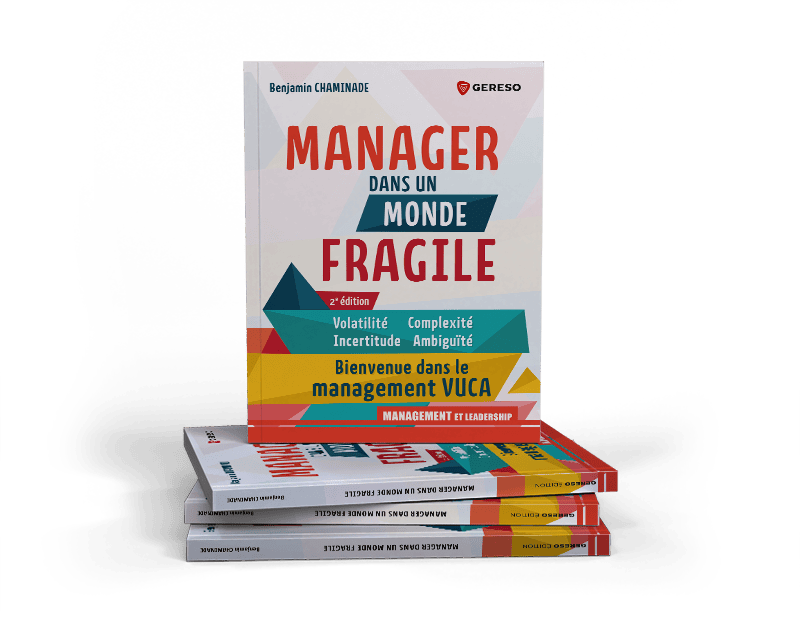
My full treatment of working and leading in a fragile world is available in book form, published in French by GERESO. Click the image to order a copy.
Frequently asked questions about non-linear career paths
What is a non-linear career path?
A non-linear career path is one where outcome stops being proportionate to effort, so a lateral move can produce more than a promotion and a redundancy can open more than it closes. Working lives become sequences of loosely connected episodes rather than a single ascending line.
Do Australians actually have non-linear careers?
Yes, and mostly invisibly. Job mobility is falling and most people who change jobs stay inside the same occupation, so the fragmentation happens inside roles rather than between them. The work changes while the title holds, leaving no trace in any employment record.
Why do recruiters struggle with fragmented careers?
Because a sequential history can be verified quickly while a fragmented one has to be understood, and screening under time pressure rewards verification. Capable candidates with transferable capability get set aside, and employers lose access to the adaptability they say they want.
How do I explain a career that looks scattered?
Stop presenting it as a chronology and present it as capabilities with evidence attached. List the transitions rather than the jobs, naming what you had to learn at each one and what you could do afterwards, since the sequence is the part that makes range look like drift.
Is it better to be made redundant or to resign?
Neither is reliably better, which is what non-linearity means in practice. A redundancy often arrives with money, a defensible narrative and a socially accepted reason to be looking, while a deliberate resignation can carry none of those, so outcomes frequently invert the apparent severity.