VUCA volatility is now common currency for spotting transformations early, whether they are technological, economic, social or societal, and whether they land on the organisation or on the people inside it.
VUCA stands for volatility, uncertainty, complexity and ambiguity, four words borrowed from military strategy to describe an operating environment nobody fully controls. Those four letters bring a little sense to what people call the new normal, a world where anything you have acquired can vanish in a matter of days, sometimes for reasons nobody was in a position to imagine.

The clearest illustration in living memory remains the worst economic shock most of us have experienced, triggered by a global health event and by the ease with which populations now move. That shock put large-scale wage subsidies in place across Australia within weeks, and it moved remote work into normal mode.
Let me take the four words of the acronym one after the other, starting with VUCA volatility. That will help you understand the concepts and their reach across business activity, and I will not forget their effects on management and on the skills all of us have to acquire quickly to stay in step with this context.
A quick way to define the new normal people keep referring to: make a list of the events that look ordinary today and would have been treated as science fiction ten years ago. The list writes itself, and it gets longer every year.
Here is the reading I want to add. Organisations track what they need to learn and almost none of them track what they need to stop believing. Volatility is measured everywhere as an inflow of new signals, and the load that actually breaks a management system is the old certainty nobody retired. I call this the age of fragility, my own frame for a period where robustness gives way to exposure, and where volatility is the symptom and fragility is the condition.
This article continues my series on the frame. Start with VUCA leadership and where decisions are made if you have not read it yet.
| The definition | What it does to management | The measure that changes everything |
|---|---|---|
| VUCA volatility, definedVUCA volatility describes the rate of change in an environment and the gap between that environment and the information available about it. It covers the speed, frequency and scale of change, and the fact that even fresh data may no longer give enough context for a decision. | Stable methods stop being stableManagement methods built as fixed sequences of steps keep working in some situations and fail in others. Skills follow the same path, moving from rare to common and then to obsolete, which turns the shelf life of expertise into a management question. | Track what gets retiredOrganisations count what they learn and rarely count what they stop believing. Measuring the rate at which old certainties, methods and skills are deliberately retired gives a sharper reading of exposure than any dashboard of incoming trends. |
The definition of VUCA volatility
Volatility relates to the rate of change of the environment. In the information age it means that even the most recent data may fail to provide adequate context for a decision, which is a harder problem than speed alone.
What the official definition actually says
Beyond the ability to assess the current environment accurately, leaders have to anticipate rapid change and forecast as best they can what may happen inside a project, a program or an operation. The Strategic Leadership Primer notes that this volatility, combined with the long timelines of modern acquisition programs, creates a particular challenge for leaders.
Read closely, that definition splits volatility into two halves that most commentary collapses into one.
- The speed, the frequency and the scale of the changes themselves.
- The information attached to those changes, which no longer allows you to understand them.
What is true today will not be true tomorrow, and what is innovative today will be obsolete faster than you think.
From incremental change to exponential change
You may find this strange, and change itself is changing. Three types of change now coexist, and they call for different management responses. Confusing them is the most common mistake I see in the room.
Start with improvement changes, which move an offer forward step by step by making it better, faster, simpler and cheaper. You take a process and improve whatever can be improved, one increment at a time. The advantage is that nobody gets rushed and everyone moves at the same speed. The danger is being overtaken by changes that reward speed and nerve instead of consolidation and safety.
Then come transition changes, which solve a problem by moving from an old system to a new one. Change management as a discipline was designed for exactly this situation. You identify the problem, you prepare a solution and you put it in place.
The trouble with that approach is its assumption that you move from one stable system to another with a period of mess in between. A VUCA world promises permanent movement with no stability, and no clearly identified departure or arrival. That is why people now talk about transformation change more than transition change.
Which brings us to the third type, transformation changes, where you adapt to a brutal shift in environment or to a disruptive technology. Changing a few things or solving a problem is no longer the job. Practices, culture and mindset all get revolutionised at once, everything moves at the same time, all the time, and all of it under uncertainty.
The exponential mindset
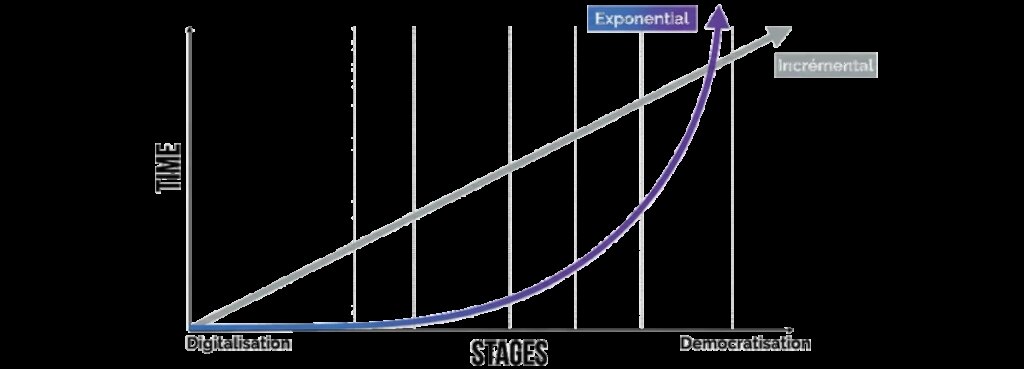
Volatility belongs to that third type of change. Mathematically, volatility describes the tendency of a variable to move away from its mean value, sometimes towards infinity, which explains why exponential has become attached to the concept.
An exponential can run in either direction. It ran positive for Uber and Airbnb as they scaled internationally. It ran negative for the small retailers and restaurants that closed in waves when trading conditions turned.
An incremental mindset concentrates on immediate continuous improvement. An exponential mindset looks for something different whose results compound over time. Put plainly, incremental settles for 10 per cent and exponential goes looking for a factor of ten, minimum.
The illustration is easy, and it holds. Last century, industrial business models were defined by their use of machines to create increasing returns to scale. Digital business models now use network effects to create what Ray Kurzweil describes as accelerating returns. Industrial models are linear, digital models are exponential, and the second kind demands the adapted mindset that Mark Bonchek sets out in his work on the exponential mindset.
The shrinking of stable periods
In earlier episodes of technological change, periods of rapid innovation and upheaval were followed by periods of relative calm that let industries settle. That rhythm is the part of volatility almost nobody manages, and it has gone.
Look at the S curve that describes the life cycle of a product, an innovation or the stages of a project. Electricity, the telephone and the internal combustion engine all produced strong bursts of innovation in the underlying technologies, then stabilised. Obvious winners appeared and stayed at or near the top for decades, from Ford to Kodak.
That calm after the storm paradigm no longer exists. The cost-performance improvement of digital technologies shows no current sign of slowing, and even the limits that looked final keep getting pushed back. Moore’s law, which predicted that transistor density on integrated circuits would double every two years, has been relaunched more than once by new chip architectures.
On that subject I like talking about Shrek’s law, my shorthand for the way each Shrek film demanded far more rendering capacity than the one before it. Intel has published its own account of the computing effort behind that studio’s animation work, in an Intel case study on high performance computing for animation, which is worth reading as a supplier account of its own customer. Quantum computing promises to go well beyond a doubling, and the pause between waves keeps getting shorter.
The volatility of information
The second half of the official definition matters more than the first. Volatility shows up as a gap between the current state of an environment and the information you hold about it, which means every fact you own has an expiry date you did not set.
This calls for detaching from the stamp collector approach to knowledge, where facts, ideas and information get accumulated once and never revisited. That approach sits at the base of the fixed mindset, the belief that ability and knowledge are set traits. In a volatile mode, all information is temporary, so facts, ideas and theories become a temporary anchor rather than a comforting collection.
No knowledge stays valid forever
This is the art of unlearning, where the job stops being the accumulation of knowledge and becomes the questioning and updating of what you already know. Unlearning is the deliberate retirement of a belief, a method or a skill that no longer holds.
Do we make decisions through logic and reflection? Behavioural economics has spent decades arguing that much of the reasoning arrives after the decision rather than before it.
Does professional success rest mainly on intelligence? David Brooks argues in The Social Animal that the social and emotional capacities matter more than the measured kind. Is charisma innate? Olivia Fox Cabane gathers a body of work in The Charisma Myth suggesting it can be built deliberately.
The list would keep growing if I added every book whose title starts with Re. Re-imagine by Tom Peters, Rework by Jason Fried and David Heinemeier Hansson, and the small library of titles called Rethink, Rewired or Reinvention. Welcome to the unlearning movement.
What looks true may no longer be
Learn to distrust your own knowledge and stay aware of confirmation bias, the habit of favouring information that corroborates and comforts what you already believe. The bias is comfortable, cheap and expensive at the same time.
Social platforms built the industrial version of it. Keeping you on the network for as long as possible, and exposed to as many advertisements as possible, works better when the content comes from people who think the way you do. Nobody gets jolted, and nobody updates anything.
Push the idea further and you get something more useful. Yesterday’s solutions can produce today’s problems, and today’s problems resist yesterday’s solutions.
Australia carries the finest example in the world of a solution that became the problem. Cane toads were released in Queensland in the 1930s to control a beetle damaging sugar cane, they made almost no difference to the beetle, and they have been spreading across the north ever since. Somebody solved the brief in front of them and created a far larger one behind it.
What looks obsolete may not be
The corollary holds just as firmly, and this is where most volatility commentary falls over. Volatility runs in both directions, so a format written off as dead can return with a market attached, and the return is as unpredictable as the collapse was.
Vinyl records are the obvious case. The format was pronounced finished for two decades, independent record shops closed accordingly, and new pressings are now a standing line item for major labels and a visible fixture in Australian retail again.
Software follows the same pattern. One-off purchase products such as Affinity by Serif have taken ground back from subscription suites, in a category everyone assumed had settled permanently into rental.
Follow the thread all the way and volatility gets stranger, because the returning product is rarely the one that left. A vinyl record now sells partly as an object to own and display, which means the thing being bought has changed even though the thing being sold looks identical.

Volatility inside the organisation
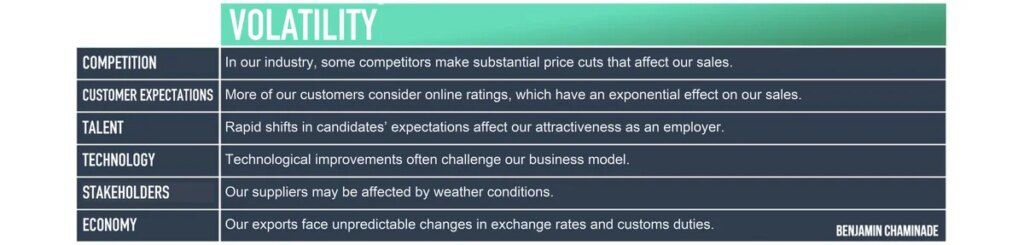
Now to the concrete effects. VUCA volatility lands on six fronts at once, competition, customer expectations, talent, technology, stakeholders and the economics of the business model, and each front moves at its own speed.
Competition
Competition keeps getting faster, to the point where startups still in development find themselves competed with. In a VUCA world the challenger is rarely another startup. It is an individual with a laptop or a very large group with a spare balance sheet.
In that setting, Michael Porter’s five forces prove insufficient on their own for reading an environment. Rivalry, supplier power, buyer power, the threat of new entrants and the threat of substitutes all still apply, and three additions now matter as much: the fickleness of demand, the accelerating depletion of resources, and the power of brand and differentiation.
Customer expectations
Customers now weigh each other’s opinions through ratings and reviews before they weigh yours, and the volatility that matters sits in that shift of source. Expectations change, and so does the place your prospects go to form them.
That second movement is the one that catches marketing teams. Your communication is no longer the main input into your reputation, so the volatility sits in a channel you do not own and cannot brief.
Talent
I will spare you another sermon on generations. Generation, values, family context, professional situation, the economic environment and the pace of technology all shape what people now expect from their organisation and their manager, and those expectations move faster than any engagement survey cycle.
A new human resources discipline is emerging around this, centred on the consumerisation of the employment relationship. HR Design applies the methods of product design, research, prototyping and iteration, to the experience of working somewhere. Platform work shows why it matters, since a workforce can be assembled and dispersed at a speed no workforce plan was ever built to absorb.
Technology
The rate of technological innovation keeps rising and its effects keep getting more visible. One of my clients, a retail network, went from a handful of store closures in one year to dozens, then to hundreds, as digital competitors took the volume out of their core category.
External shocks accelerated the trend without causing it. The asteroid gets the credit for the dinosaurs, and the dinosaurs were already heading for the exit long before it arrived.
Which brings the point most people miss. Volatility runs in both directions at once, so your successes are exactly as volatile as your failures, and the same curve that lifted you can drop you.
Stakeholders
Here we touch the interconnection of exchanges. The more partners you work with, the more even the smallest change can produce effects at scale, in the image of dominoes going down one after another.
Supply chains taught this lesson to every Australian business that discovered how much of its operation depended on a single port, a single supplier or a single piece of software. Interconnection buys efficiency and sells fragility at the same time.
The economics of the model
Volatile change explains why some business models are being abandoned. Vertical integration is hard to move when a market turns or a technology disrupts, so it gives ground to lighter models that ask for little investment, what people call asset light.
Dropshipping builds a storefront for products you do not manufacture. Intermediation rents out cars or rooms that do not belong to you. Both trade ownership for speed.
The move from ownership to usage runs the same way, with subscription models letting people use a product without owning it. That model is now a victim of volatility itself, because it became too widespread. Death by a thousand subscriptions is a real effect, and it is producing a surprising step backwards towards one-off purchases.
Managing VUCA volatility
So what managerial response keeps you from being overtaken? Start by identifying what VUCA actually changes for managers, because the honest answer is uncomfortable and the useful answer follows from it. The harder part is the everyday work between the crises, which I cover in day-to-day VUCA management.

What VUCA volatility challenges in management practice
Keep it simple. Most managerial methods taught in training ask you to follow precise steps.
Step one, restate the objectives to your team member. Step two, review past performance together. Step three, and so on. You get the idea.
Those methods deserve to keep their place, and what deserves challenging is the assumption that they hold everywhere. They stop working in some situations and with some people, so they need completing with a contextual approach, which is what situational management does.
Situational management adapts the managerial posture to the maturity and autonomy of the person in front of you. It rests on four rules.
- Adopt, at every moment, the managerial attitude suited to the context of the situation.
- Reveal the potential of each team member by developing their trade skills and their cross-functional skills, what the T-shaped profile describes.
- Assess the autonomy of individuals and teams continuously.
- Create the conditions for autonomy and accountability to develop.
The decision right volatility asks you to move
Each of the four VUCA conditions points to a specific authority that has to move closer to the work, and volatility points to the authority to retire. Someone has to be allowed to say that a method, a product line or a long-held belief about your customers has reached its end, and in most organisations nobody below the executive holds that right.
Look at how lopsided the machinery is. Every organisation has a process for adopting something, complete with a business case template, an approval path and a launch. Almost none has a process for ending something.
The consequence is arithmetic rather than cultural. When additions have a route and endings do not, the stock of practices only ever grows, and the organisation gets slower every year while every individual decision inside it looks sensible.
Two moves fix it and neither costs money. Give whoever watches your environment an explicit mandate to name what should stop, and put that recommendation in front of the same person who signs off the new spending, on the same day.
I develop the full frame behind this, letter by letter, in the pillar article on VUCA leadership and where decisions are made.
The emotional response
A manager’s first response to a change they do not understand can be purely emotional, because they realise they are out of step with what is happening. No amount of self-managing structure or holacracy makes that feeling go away, and the reassurance sits elsewhere.
What becomes obsolete is your understanding of the world, of your team’s expectations and of the managerial answers to give. In principle, that is not you.
Understand that aiming for long-term performance obliges you to participate in your own obsolescence. Being the best at what you already know how to do stops being enough. You also have to explore fields adjacent to yours and build connections between them.
You work in sales, get interested in neuroscience. You work in marketing, get interested in interface and experience design.
You work in HR, go and sell something. You sell, go and recruit. You work in the public service, go and spend a day inside a startup.
What to do first, preparedness
Before you move to situational management, prepare for acceleration. Preparedness is the readiness to act on a change you have seen coming, which is a different capability from reacting well once it arrives.
Some organisations institutionalise it. Trend groups gather volunteers who each take responsibility for following one trend, meeting the experts in that field, reading the specialist press, and building partnerships with universities and researchers. Large consumer goods companies run versions of this with external scouting networks that sit outside the research function entirely.
Those trend leads then meet to work through the effects on the organisation, on manufacturing and on distribution. The meeting matters more than the research, because a trend nobody has argued about has not been understood.
Whether you manage or not, do not let yourself get swallowed by a job that leaves you no time to think. If that is your situation, treat it as a warning, because you are disconnecting from the changes under way.
And do not let your organisation decide your development plan on its own. There is every chance it cares more about its short term than about your long term. Aim at a rising skill instead, and the World Economic Forum’s Future of Jobs work is a reasonable starting point, since employers there expect 39 per cent of core skills to change by 2030, with curiosity and lifelong learning among the skills rising fastest.
Field note
The trend group that had no permission to forget
A national services business asked me to help set up trend groups, on the model I describe above. Twelve volunteers, six trends, a quarterly forum, and a genuine appetite from the executive team. The groups worked. Within two quarters they had produced a solid reading of what was coming at the business over the following three years.
Then nothing moved. Every recommendation the groups made was an addition, a new capability to build, a new tool to trial or a new segment to test. Not one of them proposed retiring anything, because nobody in the room had the authority to say that a method, a product line or a long-held belief about their customers had reached its end. The organisation had a learning process and no forgetting process, so the new sat on top of the old until the calendar refused it.
Give your trend groups an explicit mandate to name what should stop, and put that recommendation in front of the same executive who signs off the new investment. An organisation that can learn without being able to retire gets heavier rather than faster.
The managerial skills to develop against VUCA volatility
Slowing down feels like the intuitive answer to volatility and it fails, whatever comfort the idea offers. Abandon the notion that you control anything, because you cannot answer volatility with deceleration or complexity with simplicity. Staying in constant movement is the price, and three actions carry most of it.
Build a culture of personal and organisational curiosity
Never leave a question unanswered, even when the answer is harder to find than a search result. Curiosity here means the deliberate pursuit of information you did not know you needed, and it can be prompted rather than left to chance.
Ask your team to answer questions like these.
- Which business model could be dangerous for us?
- Which alternatives to our offer already exist that we do not treat as competitors?
- Which disruption would take you by surprise?
- Do you know what customers now expect?
Some organisations run job swaps so that staff, and sometimes customers, see the work from a new angle. Retailers send head office people onto customer sites to understand how expectations are shifting. Both cost very little and both work.
Question what you know and the practices you use
That knowledge was probably state of the art when you received it. Whether it still is remains an open question, and answering it is a management task rather than a personal indulgence.
Take the management methods you actually use and go looking for articles, studies and research about them. Are they still current? If you run annual performance reviews, look for the organisations that have replaced them and read what happened next.
Then write down what you have decided to stop doing as a result. An audit that produces no retirement produced nothing.
Become more proactive and encourage proactivity
Being proactive means thinking and acting ahead of expected events. It saves work later, and more importantly it prevents problems that would otherwise arrive fully formed.
To get there, start acting, take your responsibilities and control your reactions. Anticipate your near future. Concentrating on solutions instead of problems keeps your perspective on events accurate.
Trend groups help here too, with volunteers becoming trend researchers and each one becoming the internal reference on their subject. Artificial intelligence, distributed teams, agility, emotional intelligence and psychographics all make reasonable starting points.
The skills consequences of volatility
Volatility brings two dangers to the people in your team, the commoditisation of skills and the obsolescence of skills. They look similar from a distance and they need different answers, which is why they are worth separating.
Commoditisation of skills
Commoditisation happens when a product or service that started out rare and expensive becomes so common that its high price stops being justified. Think of the car before the Model T, the taxi before ride hailing, or music before the digital store. Skills go the same way.
When a new type of skill is required, a new programming language for instance, the people who master it are the people who created it. Demand grows against a thin supply, prices run high, and buyers have no choice but to call those pioneers.
Over time more people train, supply meets demand, and the newcomers compete with the pioneers on price. Digital marketing followed exactly that arc. At that point the organisations that used consultants hire someone full time instead.
Obsolescence of skills
Obsolescence belongs to every technological development and to every professional career. If your skills remain useful while another skill takes over the job, retraining moves onto your agenda whether you like it or not.
Being an expert in your field stays valid for exactly as long as your field does. Staying curious about technological progress and about the transformations crossing your sector is the cheapest insurance available, VUCA or no VUCA.
Skill obsolescence comes in two forms. Physical obsolescence covers a decline in the capacity to learn and adapt to newly required skills, and economic obsolescence covers a skill made useless by a transformation. Employers surveyed by the World Economic Forum expect close to four in ten core skills to change within five years, which puts a number on how fast the second form now moves.
What skill volatility looks like in Australian data
Australia measures this every year, and the measurement is more useful than most people realise. Jobs and Skills Australia assesses over a thousand occupations and publishes which ones are in shortage nationally and by state, and the interesting number sits in the movement rather than the headline.
The agency separates occupations in persistent shortage from occupations that enter and leave the list from one year to the next, and it publishes the annual Occupation Shortage List with its shortage drivers so you can see which force is doing the work in each case.
Read it as a volatility instrument. An occupation that was hard to fill last year and comfortable this year has not become less valuable, and the demand around it has moved faster than the training pipeline that supplies it.
That has a direct consequence for anyone building a workforce plan. A plan anchored to this year’s shortage list is describing a position that will have shifted before the plan is halfway through delivery, which is why I ask clients to plan against capabilities rather than against job titles.
It also gives you a free early warning system. Watching which occupations adjacent to yours are moving on and off that list tells you more about your own five-year exposure than any internal capability review will.
Automation and its third age
Commoditisation and obsolescence apply to every skill, with one narrow exception. Skills protected by a guild or a professional order hold out longer, and even there competition and automation are catching up.
Until recently the equation was easy. The simpler a skill, the more automatable it was. That stopped being true when we entered the third age of automation.
- First age, mechanisation of hard and dangerous work, mining being the example.
- Second age, rationalisation of routine and repetitive tasks, industrial manufacturing being the example.
- Third age, automation of activities requiring a diagnosis or a fast decision, medicine and law being the examples.
So the question is no longer only whether you learn fast enough to stay current. It is whether you can identify which of your skills are about to be replaced by an artificial intelligence, a database or a freelancer.
The five questions of a personal skills strategy
Commoditisation and obsolescence should push you towards the right questions for your own skills strategy, across five areas. Answer them once a year, in writing, and the answers will surprise you more than any market report.
- Stay alert. Which of your skills risk being commoditised first, and how do you develop new ones the environment actually wants? While you are there, ask whether listing office software mastery on a CV still earns its line.
- Understand your value. How do your skills create value for your organisation or your clients, and is that value unique or at least differentiated from the alternatives?
- Increase your differentiation. Which capabilities are turning into commodities, which gap could you fill, and which skills are becoming important?
- Build a skills portfolio. What horizon are you working to, and which new skills will you need on it?
- Learn the way you breathe. Keep your skills current at almost any cost, and stay ready to drop any skill that looks like it is going obsolete. Do not cling to it, unless your trade is an old or artisanal one, in which case the rarity is the point.
And here we are again. Those five questions bring us back to curiosity, and four of them are questions about what to abandon.
Agility, curiosity or unlearning, which response fits your team?
Three responses to VUCA volatility get sold to leadership teams, and they are not interchangeable. Agility reacts fast, curiosity sees early, and unlearning clears the space the other two need. Choosing between them depends on where your organisation actually fails, so compare them against your own symptoms before you buy a program.
Comparing the three responses against your own criteria
Each response answers a different failure. Read the table by starting from the symptom you recognise in your own organisation, then check what the matching response costs you and what it leaves unsolved.
| Response | What it does | Symptom it fits | Managerial maturity required | What it leaves unsolved |
|---|---|---|---|---|
| Agility | Reacts quickly once the change has arrived | Decisions take too long and delivery cycles are slow | Low to medium, methods can be taught | You still find out late, so you are fast and surprised |
| Curiosity | Sees the change from a distance, before it lands | Every shift arrives as a shock nobody predicted | Medium, needs protected time and permission to explore | Insight accumulates with no mechanism to act on it |
| Unlearning | Retires the beliefs, methods and skills that no longer hold | New initiatives stack on top of old ones and nothing ever stops | High, needs an executive willing to name what ends | Painful in the short term and hard to celebrate |
The signals that tell you which one to fund
Three signals settle the choice. If your people saw the change coming and could not move, fund agility. If they moved well but only after the change hit the numbers, fund curiosity. If they saw it, moved on it, and the organisation still carries every practice it has ever adopted, fund unlearning first.
Most teams I work with need the third and buy the first, because agility is easier to sell internally. Retiring a method that somebody in the room built is the hardest political act in an organisation, which is exactly why it stays undone.
Find out how your curiosity actually works
Want to know which kind of curiosity you rely on before you build it into your team? Take my curiosity profile test and get your five dimensions scored, then use the result to choose what you explore next.
How I can help you manage VUCA volatility
I work with executive teams, boards and manager communities on volatility, in English and in French. Three formats cover most situations, and each one is built to end with decisions written down instead of a feeling of momentum.
Keynotes on managing in a volatile environment
I speak on VUCA volatility at conferences, leadership offsites and industry summits. The talk lands best when it closes with the audience naming the belief their own organisation should retire this year. You can book me through my page on managing in a VUCA world.
Workshops on curiosity and trend groups
Over half a day or two days we set up your trend groups, give them a mandate that includes retirement as well as adoption, and score your team against the five dimensions of curiosity. Teams keep the work going with the curiosity matrix.
Diagnostics and manager communities
For organisations already inside a transformation, I run a shorter diagnostic on where your certainties are ageing fastest, then support your manager community through the change. Work on managerial curiosity is usually where that begins.
Conclusion: VUCA volatility, curiosity and what you retire
You will have noticed that agility is missing from my list, even though plenty of people who follow VUCA like a modern bible put it first. The reason is that agility means reacting quickly to a change of context in order to adapt to it. Curiosity aims at something earlier, which is seeing the change from a distance before it reaches you.
Curiosity looks to me like the single most important capability available today. Without curiosity there is no creativity, no innovation and no serendipity. I will not labour the point, since you will find plenty on the subject across this blog, including professional curiosity at work.
Let me repeat it. Volatility asks you to be curious about your environment, so that nothing takes you by surprise and so that you keep several exits available if things turn. Speed on its own buys you very little, and without curiosity being agile gets difficult.
And add the entry that most VUCA volatility advice leaves out. Keep a list of what your organisation has deliberately stopped believing this year, next to the list of what it has learned, and give someone the authority to add to the first one. A team that only ever adds gets heavier, and weight is what volatility punishes.
Frequently asked questions about VUCA volatility
What does the V in VUCA stand for?
The V stands for volatility, the rate of change in an environment. VUCA volatility covers both the speed, frequency and scale of change, and the gap between what is happening and the information you hold about it. Fresh data can still leave you without enough context to decide.
What is the difference between volatility and uncertainty in VUCA?
Volatility describes how fast and how far things move, while uncertainty describes how little you can predict about what comes next. A market can be volatile and predictable, like seasonal demand, or stable and uncertain, like an industry waiting on a regulatory decision.
How do you manage volatility as a manager?
Start by treating your own methods as temporary and adapting them to each situation instead of running fixed steps. Then build curiosity into the routine through trend groups and job swaps, and give someone the authority to retire practices that no longer hold.
Which skills protect you against VUCA volatility?
Curiosity first, because it lets you see change from a distance, then the ability to unlearn what no longer holds. Employers surveyed by the World Economic Forum expect close to four in ten core skills to change by 2030, which turns retraining into a standing habit.
How do you know if a skill is becoming obsolete?
Watch supply rather than demand. A skill is commoditising when the number of people who hold it grows faster than the work available, and it is obsolescing when the task itself moves to software or to a different profession. Jobs and Skills Australia publishes an annual shortage list that shows both patterns.