Every professional ecosystem rests on tangible elements that we can observe, measure and transform. These 8 components of the professional ecosystem form the invisible infrastructure of our working day. They largely determine whether we thrive in our working environment or exhaust ourselves in it.
If your organisation were a body, where would the diseased organs be? This map of the 8 components reveals the zones where the professional ecosystem breaks down most often. Each zone can look healthy on the surface while hiding deep pathologies that contaminate the whole.
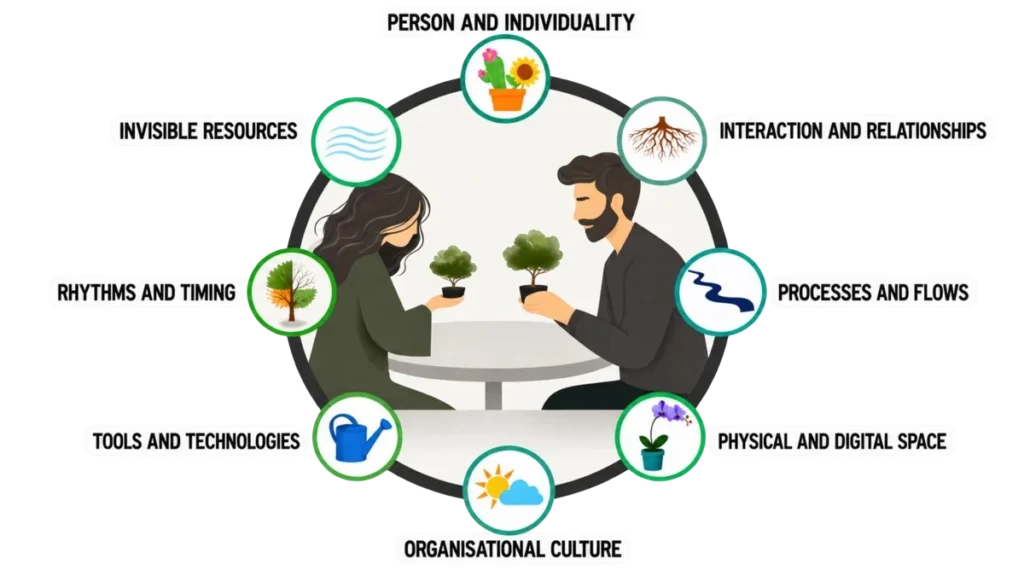
What makes the diagnosis complex is the interconnection of these zones. Relational toxicity can be born from an unsuitable physical space. Rigid processes can kill the diversity of talent. Monitoring tools can poison the culture. This systemic view is what allows us to understand why treating an isolated symptom never works. Systemic vision is also the first of the six pillars of holistic management.
Before auditing these 8 components, it is useful to identify your Manager’s Inheritance, because it shapes your reflexes, your decision criteria and the way you treat symptoms.
| The problem | The reason | The solution |
|---|---|---|
| We treat isolated symptoms as though the organisation were a series of individual cases. The result is one sticking plaster after another. | The components of the professional ecosystem are interdependent. A “sick” zone often contaminates another one. | Audit the 8 components, spot the systemic violations and then act on the conditions. |
This article comes from the regenerative management guide.

Do you know the components of the professional ecosystem?
Your professional success does not depend only on your skills or your hard work. It rests on a set of interconnected relationships, resources and environments that make up what we call your professional ecosystem. Clients, partners, mentors, network, tools and market positioning all play a part in your capacity to prosper or to stagnate.
But how do you know whether your ecosystem is really healthy? Whether it carries you towards your objectives or holds your development back without you noticing?
This is precisely what is revealed by the ecosystem audit. By putting each component of your professional environment under scrutiny, this exercise gives you a clear and objective view of your strengths, your vulnerabilities and the improvement levers to activate.
The outcome: your Ecosystem Vitality Index (EVI), a concrete indicator to measure the overall health of your ecosystem and to guide your next strategic decisions.
Ready to discover what your ecosystem really says about you?

People and their singularities
In a healthy ecosystem, diversity is a strategic asset rather than a corporate responsibility box to tick. Each profile brings its own talents, ways of working and specific needs: the creatives pollinate new ideas, the analytical ones structure and optimise, the relational ones weave the connections and the visionaries open up the horizons.
Work ecology recognises this diversity as a fundamental asset and not as a complexity to be standardised. That means adapting the environment to people instead of forcing people to fit a standard mould.
The systemic violation: some organisations replace the richness of diversity with compulsive standardisation. Profiles recruited from the same schools, methods imposed on everyone or standardised indicators. This organisational monoculture creates extreme fragility in the face of disruption, like a lettuce field infected with mildew.
The imbalance: systematic standardisation
Diversity is celebrated in theory and stifled very often in practice. Recruitment processes filter profiles on their past experience before their value. Training standardises behaviour. Appraisals punish difference. The result is an organisational monoculture that creates extreme fragility in the face of disruption.
I observed this phenomenon with a client in the banking sector. After 10 years of recruiting on the pattern of business school plus sales background, the company found itself incapable of innovating.
When I opened a seminar using the creative profile indicator Foursight, a tool I have been trained on that distinguishes 4 creative profiles, clarifier, ideator, developer or implementer, 99% of participants had the clarifier profile. These are people who always look for more data and more precision, so that they never move to action. 48 people out of 49 had the same creative blind spots and the same fears of uncertainty. The one person in the group who was not a clarifier was an implementer. That profile is known for wanting to turn ideas into reality quickly.
The problem was that the ideas never arrived, because they were blocked at the clarifier stage. When the market started using AI, nobody had the skills to pivot. Uniformity had made them collectively incapable of reinventing themselves.
The warning signal: depleted soil
When employees no longer know why they work beyond the salary, the soil of your ecosystem is exhausted. The nutrients of meaning, which are impact, contribution and belonging, have disappeared.
The symptoms are everywhere: recurring questions about the usefulness of the work (“what is this actually for?”), demotivation in the face of daily tasks, difficulty explaining your job to people outside it and the feeling of being an interchangeable number. A salesperson told me: “I sell products I no longer understand, to clients who see no use for them. I have become an automaton.”
This depleted soil can no longer feed the diversity of talent. Only the personalities most resistant to conformity survive, and they are often the least creative and the most cynical.
Interactions and relationships
Professional relationships form the invisible fabric that holds the ecosystem together. Like the mycelium that connects the roots of trees, they allow information, support and energy to circulate. In a healthy ecosystem, these relationships go beyond hierarchical links and create a rich horizontal mesh. Toxic communication, unresolved conflict or social isolation can contaminate the whole ecosystem. Healthy and constructive relationships feed engagement and collective performance.
The systemic violation: compartmentalisation. Individual objectives, individual appraisals and individual bonuses have created collections of isolated individuals instead of collectives. This denial of interdependence destroys the natural cooperation that gives living systems their strength.
When the network becomes a battlefield
Professional relationships that are meant to feed collaboration can become sources of exhaustion. Internal competition replaces cooperation, mistrust settles in between departments and information becomes a weapon of power. The relational fabric tears, turning work into solitary survival where everyone protects their own territory.
This is why, when we sense a collaboration problem, we ask these 10 questions anonymously:
- In the last 3 months, how many times have you avoided working with one or more people in your team or in the company?
- Do you sometimes avoid approaching certain people even when they hold the information or the skill you need?
- Have you ever held back important information for fear that it would be used against you?
- Have you ever kept a piece of work information to yourself for fear that it would be used without your contribution being recognised?
- In the last 3 months, have you chosen to work alone on a topic that could have been collaborative, in order to avoid tension or conflict?
- When you have the choice, do you prefer to avoid collective projects in order to keep the peace?
- In the last 3 months, have you chosen to work alone on a topic that could have been collaborative, in order to avoid tension or conflict?
- When you have the choice, do you prefer to avoid collective projects in order to keep the peace?
- I can express my ideas or concerns without fearing negative consequences.
- In my team, disagreements can be expressed openly and handled constructively.
We ran this questionnaire in companies at the end of 2025 and the start of 2026. 62% of employees avoid certain colleagues. 40% hide information for fear that it will be used against them, or worse, used without them. 54% prefer to work alone in order to avoid trouble. The cost? 30% of productivity lost in relational friction and duplicated effort.
The warning signals: stale air and desertification
First signal: the air becomes unbreathable. Relational toxins such as gossip, unhealthy competition, passive aggression or micro-aggressions poison the working atmosphere. The results are turnover that rises year after year, sick leave in cascades and a permanent cold war atmosphere. The air was so stale that new arrivals were suffocating within a few weeks.
Second signal: relational desertification. Connections break and everyone retreats into their professional bunker. I watched a 50 person start-up turn into a desert over six months of poorly supported remote work. The developers no longer spoke to the sales team, marketing ignored client feedback and the leadership was flying blind. Two managers simply disappeared. They had every communication tool imaginable and no real human connection left.

Processes and workflows
Processes are the rivers of the organisation. They should allow energy, information and decisions to circulate naturally. In nature, water always finds the most efficient path, adapting to obstacles and creating new channels when necessary. A healthy ecosystem maintains this adaptive fluidity: processes structured enough to guide yet flexible enough to adjust, cycles that respect the natural rhythms of production and recovery, and flows that nourish instead of exhausting.
The systemic violation: our organisations swing between absolute rigidity (procedures for everything) and total chaos (permanent change without vision). They have lost any capacity for dynamic balance, that faculty of living systems to navigate between order and creative disorder.
When flows become dams
Our organisations swing between two deadly extremes. On one side there is absolute rigidity: procedures for everything, cascading forms and endless approvals. Innovation at one company in the energy sector took 14 months between the idea and the experiment, with 23 documents to complete and 8 approval committees. By the time an idea passes every filter, it is no longer innovative. Our competitors have already launched.
On the other side there is permanent chaos: reorganisations every 18 months, constant changes of direction and processes modified before they have even been mastered. Employees endure the inertia of the procedures AND the instability of the structures at the same time. This organisational schizophrenia exhausts people without producing value.
The warning signal: polluted water
Information is the water that irrigates the ecosystem. When it is polluted by lies, unspoken truths, withheld information or distortion, the whole organism is poisoned.
According to the Talkspirit x Ipsos study, 12% of employees consider their company completely transparent, so imagine the quality of the informational water in circulation. Decisions are made on false premises, rumours replace facts and mistrust settles in for the long term. This informational pollution paralyses collective action.
Physical and digital space
The physical environment is an actor in the ecosystem in its own right and not simply a backdrop. The workspace directly influences our behaviour and our wellbeing. A poorly designed open plan office can generate stress and reduce concentration, while a digital environment overloaded with notifications creates constant cognitive fatigue. Work ecology treats these elements as determining factors. A living space that can be adapted and personalised feeds creativity and wellbeing.
The systemic violation: our workspaces have become hostile to the people who live in them. Instead of welcoming and supporting, they attack and exhaust. Hospitality, the capacity of a place to make its occupants feel good, has been sacrificed to densification and the optimisation of square metres, or forgotten completely during the shift to remote work.
When the habitat becomes a cage
The open plan office promised collaboration and created permanent cognitive chaos. The flex office promised freedom and generated territorial wandering and the loss of landmarks. The all-digital workplace promised efficiency and produced mental saturation and attentional exhaustion for 43% of employees according to the Leesman Index.
The warning signals: permanent stress and flight
A hostile space generates two physiological reactions: chronic stress for those who stay and flight for those who can leave. “Our open plan office has become a pressure cooker,” a manager told me. “We can feel the pressure building collectively but nobody dares lift the lid for fear it blows up in their face.”
Flight takes several forms: systematic remote work to escape the toxic office, minimal presence on site or resignations from those who can no longer stand the environment. The space that was meant to bring people together and energise them becomes the thing they avoid at all costs.
Company culture
Company culture is the climate of your ecosystem. Tropical and lush, temperate and balanced, or arctic and hostile? Culture shows up in the values actually practised, in the behaviours encouraged or sanctioned and in the stories people tell. It determines whether the ecosystem will be cooperative or competitive, innovative or conservative, and inclusive or excluding.
The systemic violation: our organisations punish error and hide failures. This refusal to learn, which is a fundamental principle of living systems that evolve through trial and error, condemns them to repeat the same dysfunctions forever.
When the climate turns toxic
The values companies display, such as kindness, innovation or collaboration, sometimes mask a toxic reality. On the programme: permanent pressure, disguised conformity or false conviviality. The values on the walls contradict the behaviour in the corridors. I think of the consulting firm that displayed collective intelligence as its cardinal value.
In practice? Bonuses were 100% individual, promotions rewarded those who guarded their clients jealously and team meetings could sometimes turn into verbal jousting. A manager told me: “We pretend to collaborate during the day and we stab each other in the appraisals. It is Game of Thrones without the courage.” This cultural hypocrisy had helped produce 35% turnover a year and made it impossible to build cross functional project teams.
The warning signal: cultural desertification
Aligning actions with values takes courage and generates extraordinary power. Culture cannot be decreed. It is lived through consistent daily behaviour, and particularly through the behaviour of management. Rest assured, we get to that in the next chapter.
Your culture has to rest on living principles before it rests on values displayed on a wall that nobody looks at any more. As proof, I ran a working group of 83 managers at a giant of the entertainment industry and NOT ONE of them could quote me a single value.

Tools and technologies
Tools are not neutral. They shape behaviour and relationships. A monitoring tool generates mistrust. A collaboration tool creates synergy. The choice and the use of tools reveal the real managerial philosophy.
This is why work ecology treats tools as extensions of our skills and not as external constraints.
The systemic violation: tools should increase our capabilities. They reduce them. Instead of amplifying human intelligence, they put it at their service. This inversion, with the human serving the tool rather than the reverse, turns professionals into system operators.
When technology enslaves
The fragmentation of tools is not simply an impression. According to the Anatomy of Work 2023, knowledge workers use an average of 10 applications a day. This dispersion comes with a layer of work about work that eats into the day, with 62% of time lost in repetitive tasks that create little value.
As for monitoring dressed up as analytics, a meta-analysis by Rudolf Siegel, Cornelius König and Veronika Lazar in Computers in Human Behavior Reports links electronic monitoring to lower job satisfaction and higher stress. What I see with clients is that it also erodes trust and puts managers in a bind, with damaging effects on engagement. In France, the CNIL is the national data protection authority. It fined a real estate company 40,000 euros in 2024 for disproportionate monitoring of employee activity. That penalty is a reminder of the legal framework and of the possible excesses of monitoring tools.
The warning signal: cognitive saturation
The human brain is not designed for this permanent fragmentation of attention. The symptoms of saturation are everywhere: an inability to concentrate for more than a few minutes, anxiety about unread notifications, a perpetual sense of being behind on your tools and mental exhaustion at the end of the day.
This chronic cognitive fatigue destroys creativity, multiplies errors and wipes out wellbeing. The tools that were supposed to increase our capabilities have reduced them. We have become the exhausted servants of our own tools.
Rhythms and time cycles
Every human activity requires alternation between tension and release, between production and recovery, and between sprint and rest. These cycles are the conditions of durable performance rather than lost time. Rest allows consolidation, breaks generate insights and celebrations create meaning. A healthy rhythm respects human biological and cognitive capacity. The three temporalities of regenerative leadership carry the same question of rhythm into the past, the present and the future of the people you manage.
The systemic violation: we have abolished the vital alternation between tension and release, sprint and recovery. This perpetual urgency violates the cycles that living systems need and it programs systemic exhaustion. Rest is no longer seen as regenerative and necessary. It is seen as a loss of productivity.
When rhythms turn to chaos
Abolishing natural cycles creates permanent urgency without breathing space. There are no design phases distinct from execution phases, no creative pauses and no celebration of achievements. Everything is a priority, so nothing really is. Organisations live in a perpetual sprint that exhausts people without producing durable value.
The warning signal: creativity extinguished
When natural rhythms are violated, innovation dies progressively. Ideas stop coming, solutions become recycled versions of the past and proposals lack boldness. “We no longer have time to let ideas steep. We produce warmed up leftovers all the time,” the disillusioned director of a logistics platform admitted to me.
The symptoms are everywhere: brainstorming meetings that run empty or that are used for team building instead of producing innovative ideas, proposals that repeat what already exists with cosmetic variations and a collective inability to think outside the frame. The creative soil is compacted by the perpetual sprint, as it would be by traffic passing over it too often, and nothing can grow there any more.
Invisible resources (intangible capital)
Beyond the tangible elements, a professional ecosystem lives on its invisible riches: the trust accumulated between colleagues, the tacit knowledge that is never documented, the informal networks that smooth the work, individual and collective reputation, and the memory of past successes and failures. These intangible resources are often the real value of an organisation. They are fragile, slow to build and quick to destroy. Work ecology treats them as decisive for the vitality of the ecosystem.
The systemic violation: our organisations alternate between an impermeable fortress (NIH syndrome, Not Invented Here*) and wide open doors with no filter (compulsive adoption of every management fashion that passes). They have lost the art of selective permeability, that capacity of living systems to exchange with the outside while preserving their identity.
* A syndrome that pushes a team to reject external ideas, technologies or methods simply because they were not created in house. This is collective ego disguised as caution rather than technical rigour.
When intangible capital evaporates
Our organisations squander this invisible capital without even noticing. Restructures destroy informal networks. Departures take undocumented tacit knowledge away. Brutal change evaporates trust. Permanent rotation erases institutional memory.
A few weeks ago, a mid-sized industrial company lost 300 years of accumulated experience in 18 months following a voluntary redundancy plan. The new recruits will take years to rebuild that knowledge capital. In the meantime, the mistakes of the past will repeat themselves and long-standing clients will feel abandoned. The very identity of the company will be diluted. For the chief executive who could only watch the decision taken by his shareholders: “We saved on the wage bill and lost our soul.”
The warning signals: organisational amnesia and loss of soul
The organisation becomes progressively amnesic. Nobody knows any more why things are the way they are. Processes exist without anyone knowing their reason for being. Traditions carry on emptied of their original meaning. This organisational amnesia paralyses evolution.
| Role | Typical violation | Warning signals | Indicators to track | Key action | |
| 1. People and singularities | Cognitive diversity that feeds creativity and resilience | Monoculture of profiles, standardisation of behaviour | Difficulty innovating, cloned profiles and loss of meaning | Diversity of career paths and spread of thinking styles | Open up recruitment and adjust the appraisal criteria |
| 2. Interactions and relationships | Circulation of information, support and energy | Compartmentalisation, internal competition and withheld information | Avoidance, duplication, mistrust and isolation | Psychological safety, cross functional cooperation | Collective objectives and collaboration rituals |
| 3. Processes and workflows | Flows that carry decisions and value | Procedural rigidity or permanent chaos | Multiple committees, frequent reorgs | Lead time from idea to test, experimentation | Fast lanes for trials and fewer approvals |
| 4. Physical and digital space | Habitat for concentration, energy and landmarks | Noisy open plan office, excessive notifications | Cognitive fatigue, errors | Satisfaction with spaces, number of interruptions per hour | Quiet zones and notification rules |
| 5. Company culture | Climate that regulates behaviour and learning | Punishment of error, values not lived and conformity | High turnover, cynicism and risk taking avoided | Number of useful post mortems and internal mobility | Learning rituals and aligned incentives |
| 6. Tools and technologies | Extensions of capability and cooperation | Stacking of tools and workflows that put people in service | Mistrust of analytics | Number of apps per day and time spent searching for information | Rationalise and frame the use of tools |
| 7. Rhythms and time cycles | Alternation of production and recovery so the pace can last | Perpetual sprint, no cooldown and no exploration | Chronic fatigue, falling quality | Production to recovery ratio and cadence of retrospectives | Planned cooldowns and exploration quotas |
| 8. Invisible resources, intangible capital | Trust, tacit knowledge, networks and memory | Organisational amnesia, loss of knowledge, NIH or following fashions | Long onboarding, long standing clients drifting away | Documentation coverage, alumni network and reuse of lessons | Communities of practice and careful offboarding |