
For several years I have looked at my incoming requests with one question in mind: almost all of them begin with a request to speak on a topic, and very few begin with my name.
A training manager wants a keynote on uncertainty. An HR director wants someone to talk about skills obsolescence in front of three hundred managers. Very few want to know what the author of this blog has to say from the angle of his own experience. That makes sense if you have read the article where I questioned the absence of a “consulting star” in Australia.

It hardly matters that I have 200 videos across my 3 YouTube channels, dozens of podcast episodes or 800 articles piled up on my (too) many blogs. People find the topic, not me.
I should not knock it, this fills my diary, but with 90 % of clients looking for a topic and a price, it also raises a deeper question about what my expertise is really worth when it is bought like a thematic slot.
Me or someone else, it makes no difference. #humility
What I need is to become a “reference”. That is the word the market uses to describe the moment when the name moves ahead of the topic. Like the day a writer’s name takes up more room on the cover than the title.
So here it is. As the new season gets under way, this piece is my attempt to work out how relevant I am in today’s world, so I can build the plan that follows from it. Not the building of my relevance, which needs no proving (at least for this month), but how to make it known, now that I am finally launching my Australian site.
To do that, I suggest we start from a model that comes from the creator economy, then extend it to draw out a unit of measurement and to found “My relevance plan”…
| The observation | What is at stake | The shift |
|---|---|---|
| The topic calls before the nameRequests sent to a consultant or a speaker arrive in the name of a theme and rarely in the name of a person. Becoming a reference means bringing the name up to the level of the topic, then keeping it there. | A topic always ends up detachingA theme that gains momentum soon travels without the person who first carried it. The one who set it up then becomes interchangeable with anyone else able to handle it competently. | Relevance is measured, notoriety is enduredThe right question is what determines the client’s agreement, the topic requested or the person who handles it. This share is recorded at every enquiry, tracked over time and reduced through concrete decisions. |
What the creator economy understood before consulting did
The creator economy measures attention with a precision that consulting has never reached. It came out with a conclusion that is useful for any expertise-based profession and not only for influencers: the volume of attention and the value of that attention are two independent quantities.
View count, a currency that says nothing about value
The view count has been the accounting unit of content creation since the early days of video and algorithmic platforms*. It measures one contact and nothing else. It says nothing about who watched, what they kept, or what the viewer will do with that contact the following week. A video with two million views whose author no one remembers produces less effect than content watched by fifty thousand people who wait for the next one.
* and no longer “social media”!
This took a long time to take hold, because the view had two unbeatable qualities. It was available in real time and it could be compared from one creator to another. The creators who built a lasting career ended up looking elsewhere.
They noticed that the time spent with them mattered more than the number of contacts. A long format, a live stream of several hours or a weekly show creates a relationship that a viral video never creates. Length of exposure builds familiarity, and familiarity builds credit.
The parallel with my own work is direct: a keynote in front of eight hundred people produces a considerable volume of contacts yet very little credit (on average 8 LinkedIn connection requests per 100 people). A three-hour workshop with twelve executives produces the opposite. Both are nonetheless invoiced along lines that completely ignore this difference.

The four levels of relevance proposed by Colin and Samir
Colin (Rosenblum) and Samir (Chaudry) host a show devoted to the creator economy and its economic mechanics. They proposed a four-level scale to describe what attention really produces, beyond volume. This scale is the starting point for everything that follows.
- The first level is ambient relevance. Your content circulates and becomes part of the landscape, without people knowing who produces it. They may recognise the type of content and tell themselves they often see these videos, without being able to name the author.
- The second level is named relevance. People can identify and name you. Your name becomes associated with a type of content, an area of expertise or a specific world. For interviews served with hot sauces, the audience knows it is Sean Evans and his show.
- The third level is appointment relevance. Your audience no longer waits to stumble on your content, it waits for it actively. You enter its habits, like an awaited weekly episode or a new season booked in advance.
- The fourth level is reference relevance. Your ideas or your name become something that others use in their own conversations. You are no longer only consumed, you are quoted, discussed and passed on. One of the two authors adds that he is still working on this fourth level, which shows that this is a working model and not a fixed taxonomy.
Worth a listen
The Viral Russian MrBeast TikTok and The True Value of Views
Colin Rosenblum and Samir Chaudry start from a high-audience MrBeast video to ask the question that opens their relevance scale: what a view is really worth. This is the episode the first four levels come from, taken up and extended in this article. You can also listen to the episode directly on Apple Podcasts.
Why the creator model does not transfer as is
This model describes a relationship with a mass, free audience. My work rests on a small, paying and prescriptive audience. Transferring it therefore requires three corrections before it can be used.
- First correction, the scale stops too soon. Being quoted in a conversation is still a social use. It says nothing about the moment when someone commits a budget, an internal reputation or an executive committee to your name.
- Second correction, volume does not play the same role. A creator has to be everywhere, because their business model rests on numbers. An expert has to become hard to avoid when a specific problem appears, which assumes a narrow, well-identified target population.
- Third correction, the progression is not a queue. You can be heavily quoted within a small professional community with almost no ambient relevance. A creator can be everywhere while never being consulted, awaited or treated as an authority. The levels coexist instead of replacing one another.
Why notoriety is no longer enough to sell expertise
The consulting market is going through a phase where expertise is verified less and compared more. Buyers have tools that produce in a few minutes what used to be the visible material of an assignment. The consequence for an independent is immediate and deserves to be faced head on.
What the consulting market actually buys today
The French consulting market is going through a phase of consolidation whose drivers I have described elsewhere. According to the most recent figures published by the sector’s professional body, activity contracted by 2 % excluding inflation over the last full financial year, with headcount down 2.6 %. Recruitment consulting takes the hardest hit, with a 15 % drop in activity.
The figure that really interests me lies elsewhere in the same study. Assignments whose impact is evaluated make up only 23 % of firms’ turnover on average. In other words, more than three quarters of the consulting sold in France is subject to no measurement of effect.
This absence of measurement has a logical consequence. When the result is not measured, the purchase is decided on something else. The same study indicates that client loyalty, the renewal of assignments and recommendation remain the indicators commonly used to assess the value created.
Recommendation therefore becomes the real market. It rewards memorability rather than proven quality. A provider whose name no one remembers cannot be recommended, whatever the quality of their work.
Automation has made the topic layer abundant
Part of what a consultant used to sell was the shaping of existing knowledge. Desk research, benchmarking, synthesis and the preparation of deliverables have largely been automated. The consulting profession’s body describes this plainly and raises a risk of the service becoming a commodity.
This shift is already embedded in everyday habits. According to the Ifop institute, 65 % of French people say they use generative artificial intelligence tools, and 39 % do so at least once a week. Your client questions a machine before questioning you, and does so with the vocabulary of your topic.
The topic becomes abundant, free and instant. What remains rare is contextualisation, judgement and the ability to commit someone in front of their own organisation. The strongest firms are in fact falling back on sector expertise, strategic interpretation and hands-on support, which amounts to leaving the position of supplier for that of orchestrator.
I draw an uncomfortable conclusion from this shift for my own activity. The part of my work that carried my name only by convention is losing its rarity. The part that carries my name because it comes from my direct experience becomes the only part that holds up.
Becoming a reference when the topic comes before the name
Becoming a reference only makes sense within a specific population and for a specific problem. The client is not looking for a person, they are looking for the solution to a problem dated in their calendar. The topic is therefore always the way in, and that is perfectly normal.
The useful question is what happens just after that door. How many names did the client consider before mine. Would they accept my handling their need from an angle other than the one they framed. How much time passes between the moment they think of the problem and the moment they think of me.
These three questions are answered by observable facts and not by an impression. They can be asked at every incoming request, in thirty seconds, and recorded in a table. This is the starting point for everything I describe next.
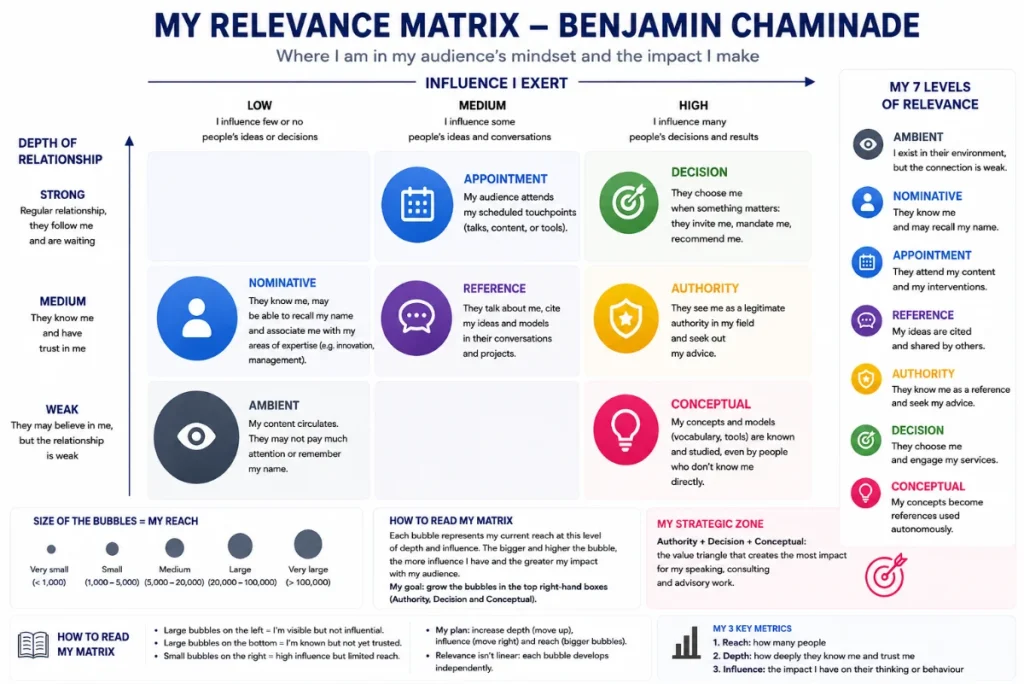
My relevance matrix, seven levels and three dimensions
The four levels from the creator economy describe forms of relationship with an audience. They are missing everything to do with the credit granted, the decision committed and intellectual property. So I add three levels, then reorganise the whole into a matrix.
The three levels I add to the original model
The fifth level is authority relevance. You become a source a professional turns to when a specific topic appears. The difference from the previous level matters a great deal. A person is quoted because they are interesting and is consulted because they are granted credit.
The sixth level is decision relevance. Your name or your ideas directly influence a purchase, an invitation, a hire, a strategy or a change of practice. This is the level where relevance becomes economically interesting.
The typical example plays out over several months. An HR director reads an article on engagement, does not reply to it and mentions it to no one. Six months later, she is looking for someone to speak in front of three hundred managers and your name comes to her immediately.
The seventh level is conceptual relevance. Your vocabulary now circulates in your place, rather than your person. When professionals use your concepts to describe their own reality, you have created something more lasting than an audience. Simon Sinek established starting with why, Clayton Christensen established disruptive innovation, and Nassim Taleb established the black swan and then antifragility.
The seven levels of relevance in one table
Each level is recognised by an observable behaviour and not by an intuition. So I have set them against the signal that lets you observe them in the reality of an independent practice. This table is the tool I use to place a professional relationship in a few seconds.
| Level of relevance | What the person opposite does | The observable signal |
|---|---|---|
| Ambient | They come across your content without retaining your identity | Traffic with no search on your name |
| Named | They can name you and link your name to a field | Searches on your own name |
| Appointment | They actively wait for your next publication | Re-subscriptions and regular opens |
| Reference | They quote you in their own conversations | Spontaneous mentions with no commercial link |
| Authority | They consult you when the topic appears | Requests for advice with no order attached |
| Decision | They commit a budget or a reputation to your name | An incoming request that names you and is not compared |
| Conceptual | They use your vocabulary without approaching you | Third parties taking up your terms |
A quick read of this table already gives a diagnosis. If your signals cluster on the first three rows, you are working an audience. If they cluster on the last three, you are working a market.
The three dimensions that give the real position
Stacking seven levels on a single scale mixes quantities that have nothing to do with each other. Notoriety, audience behaviour, influence and intellectual property are not measured in the same way. So I prefer three independent dimensions.
Reach answers a simple question. How many people are you able to reach. This is the dimension the view measures correctly and that every dashboard shows first.
Depth measures the relationship those people have with you. It ranges from the person who came across you once to the one who organises their week around your publications. It is read in regularity and in time spent, never in the number of followers.
Influence measures what your presence changes in the way people think or act. It ranges from polite interest to the reuse of your vocabulary in an internal memo you will never read. Combining the three gives a distinction I find valuable: audience is a matter of reach, community is a matter of depth and authority is a matter of influence.
A world-renowned management professor illustrates the independence of these dimensions well. You may have never watched a single one of his videos, may not await his next book and yet use one of his concepts every quarter. His conceptual relevance to you is at its highest and his appointment relevance is nil.
The substitutability rate, the unit of measurement that was missing
A matrix without a unit of measurement is just a drawing. I needed a figure that could be recorded and was credible, comparable over time and impossible to embellish. I built it from facts observable during the scoping conversation, without asking anything that could make a prospect uncomfortable.
What the substitutability rate measures
The substitutability rate measures the share of enquiries in which the topic requested determines the client’s agreement, regardless of who handles it. A high rate indicates that the theme carries the demand. A low rate indicates that your name carries it. This is an indicator I built for my own steering and that I share here exactly as I use it.
For a long time I tried to measure something else, namely the probability that another speaker would have been accepted in my place. That question describes a situation that did not take place and that no one can observe, not even the client, who always reconstructs their decision after the fact. The rate therefore rests on no declared intention and only on facts visible during the exchange.
The central test takes place in the scoping conversation and costs nothing. The client arrives with a topic, you propose a different angle on the same need. If they accept the shift, they have chosen you. If they refuse and stick to their initial theme, they have bought a slot that any competent practitioner can fill.
Three other criteria complete this test, because it does not come up in every request. Each enquiry gets a score out of eight points, and the substitutability rate is the share of requests whose score stays below four.
| Observable criterion | What scores zero | What scores one | Weight |
|---|---|---|---|
| Topic shift test | The client refuses any other angle | The client accepts the angle proposed | Three |
| Opening wording | The request names a theme | The request names you | Two |
| Declared competition | Two or more speakers in contention | No other option mentioned | Two |
| Order of negotiation | The fee is discussed before the content | The content is scoped before the fee | One |
This rate has a quality that notoriety indicators lack. It depends on no platform, no algorithm and no statistic supplied by a third party. It is recorded with a six-column table and three minutes of discipline per request.
It also carries three limits worth knowing before relying on it. The first is volume, since an independent practitioner receives a few dozen requests a year, which makes any quarterly reading very noisy. So read the rate on a rolling twelve months and compare it only from one year to the next.
The second limit is a serious selection bias. You only see the requests that reached you, whereas the organisations that chose someone else without ever contacting you measure your real substitutability far better. The only partial correction comes through agencies, which know on which assignments your name was not put forward.
The third limit is the self-reported nature. A client almost always plays down the number of speakers consulted, out of politeness more than calculation. The competition criterion is therefore the least reliable of the four, which justifies its moderate weight in the grid.
One last reading point avoids a misinterpretation. A very low substitutability rate can signal a solid position or a tiny market, so it is always read together with the volume of requests received.
The name premium, its translation into fees
The name premium is the average fee gap between requests that reach at least four points on the previous grid and those that stay below. It is measured as a percentage, over a scope of comparable services. It turns a question of ego into a question of margin.
This calculation calls for an obvious precaution. A plenary keynote and a half-day workshop are not comparable, so the premium is recorded by format, on engagements of equivalent length and preparation. Without this precaution, you mainly measure the variety of your offer.
This premium already exists in the sector’s practices, without being named. Results-based remuneration remains a minority, since 14 % of consulting and research firms offer it, while hybrid models mixing a fixed fee and success-based pay are rising from 5 % to 9 %. The market is visibly trying to charge for something other than time spent.
My reading of this movement is as follows. A buyer agrees to pay on results when they believe in the person, and refuses when they are buying a thematic slot. The name premium therefore comes before the ability to leave behind billing by the hour.
A nil or negative premium deserves to be looked at without kidding yourself. It means your name changes nothing about the price accepted, and therefore that the market is buying your availability on a theme rather than your way of handling it.
The record in six moves
The record has to take a few minutes per request, otherwise it will never get done. Here is the sequence I apply to every incoming enquiry, from the first message to the client’s decision. It produces a score per request and a usable rate after twelve months.
- Note the exact wording of the request, telling apart the one that names a topic from the one that names you.
- Systematically propose an angle different from the one requested, on the same need, then note whether the client accepts the shift.
- Ask the client how they came to you, in a single open question put at the first exchange.
- Ask how many other speakers feature in their thinking, without trying to learn their names.
- Note whether the fee or the content was raised first, which can be read without asking a question.
- At the end of each quarter, calculate the score out of eight for each request, then the share of those staying below four points over the last twelve months.
The second move is the only one that takes a bit of nerve and it is also the one that pays off most. Proposing another angle goes down well in a sales conversation, because the client sees it as a contribution rather than an objection.
The next two questions interest the client, since they force them to spell out their own need. The fifth move asks nothing, you only have to observe the order in which the conversation unfolds.
From the field
The qualification call that held up a mirror
A skills development manager in an industrial group contacts me for a session aimed at his managers. The scoping call lasts an hour and a quarter. He asks me for the running order, the main ideas, the examples, the exercises planned and the way I handle objections from the most sceptical participants. I answer everything, because the conversation is pleasant and I think it useful to show how I work.
The follow-up never comes. A few months later, I learn that the session did take place, run by someone else, on a running order very close to the one I had described. For a long time I filed this episode under the extraction of free consulting under cover of sales qualification, what I call freesulting. Reading it again several years later, I see something else. This manager had never chosen me. He had chosen a topic, then looked for the cheapest supplier of that topic, and I had myself provided the brief that made the substitution possible.
A qualification call where you detail your content without ever being asked about your personal experience is the most reliable signal that the client is buying your theme and not you. These calls are the simplest leading indicator to observe, even before calculating the score of each request.
Detachment, or why a topic ends up leaving the person who carried it
A topic that works attracts other people who take it up. Their arrival is proof that the topic is good and the start of the problem for the person who set it up. Detachment describes the moment when the theme carries on its way and leaves its original carrier at the side of the road.
The three moments of detachment
The first moment is appropriation. Other professionals take up your framework, simplify it and spread it to audiences you were not reaching. Your name disappears from the reuses within two or three changes of hand.
The second moment is standardisation. The topic enters training catalogues, tenders and job descriptions. It becomes an administrative box that any competent provider can tick.
The third moment is saturation. The market treats the topic as covered, requests slow down and fees crumble. The original carrier ends up associated with a theme the market judges dated, which is the cruellest form of professional obsolescence.
These three moments unfold over several years and can be spotted early. The leading signal is simple to observe: the number of people talking about your topic rises while the number of requests naming you stays flat.
The serious objection, being called for your topic also protects you
I have to deal honestly with the opposite objection, because it is solid. Being called for your topic rather than for your name has real economic advantages. The demand is kept up by the whole market, including by competitors working the same theme, and it does not depend on your daily presence.
A professional called for their name bears the cost of maintaining their visibility alone. They have to publish, show up and reinvent themselves constantly, or watch their diary empty when attention moves to someone else. The topic, for its part, works while you sleep.
My answer to this objection fits in one sentence. A topic has a lifespan and a person can change topics. Betting only on the topic amounts to indexing your career to the longevity of a fashion, which exposes you to exactly the obsolescence I spend my time describing in others.
The right trade-off is therefore not to pick a side. It consists in keeping a strong topic for incoming demand while building, in parallel, an ability to carry your relevance across to the next topic.
Carrying your relevance from one topic to the next
Relevance is carried by the framework and not by the content. A framework is a way of cutting up a problem, with its terms, its thresholds and its units of measurement. It survives a change of theme because it applies to several themes.
This is the difference between talking about uncertainty and offering a grid to cut it up. The first makes you interchangeable with everyone who talks about uncertainty. The second makes you quotable, including by people who have never heard you speak.
This shift from content to framework is the only one I have seen produce conceptual relevance. It requires agreeing to give the framework away instead of keeping it. A framework kept secret does not circulate and therefore builds no authority.
I can test this rule on my own frameworks, which is the only honest proof I can offer. The crossing rate was born in a network of independent leaders and applies to any executive committee. The clocks of obsolescence describe an individual career and transfer to a whole business model.
The same test applies to the others. The six circles of managerial transformation and the laws of the Shift work outside their original subject, while the TRACE method stays tied to the individual professional footprint. A framework that fails this test will die with its theme, and that is useful information to have before investing years in it.
Moving from the topic you carry to the name that is asked for
Do you want this shift to play out in your organisation rather than on paper? Discover my keynotes and workshops built on my own frameworks and choose the format suited to your population of decision-makers.
How to choose your relevance strategy on your own criteria
Three paths lead to a strong position and they are not equal across situations. The choice depends on your market, your horizon and your tolerance for the effort of publishing. Here are the criteria I would use if I had to start again today.
Three possible paths and what they cost
The volume path consists in occupying the ground, publishing a lot and capturing demand through presence. The niche path consists in becoming unavoidable on a narrow problem. The framework path consists in creating a vocabulary the field will end up using.
| Criterion | Volume path | Niche path | Framework path |
|---|---|---|---|
| Dimension worked | Reach | Depth | Influence |
| Time before effect | Short | Medium | Long |
| Maintenance effort | Constant and high | Regular and moderate | Intense at first then decreasing |
| Main risk | Staying substitutable despite visibility | Seeing the niche market close up | Seeing the framework reused without attribution |
| Level of relevance targeted | Named and appointment | Authority and decision | Conceptual |
| Situation that justifies it | A recent business and a diary to fill | An identified, reachable target population | Accumulated field experience that can be formalised |
These three paths combine poorly at the same time. The volume path consumes the time the framework path requires. The niche path rarely produces enough material to feed the volume path.
My view, as a practitioner who has tried all three, is to sequence them. Volume at the start to exist, the niche next to be consulted, and the framework last to last.
The signals that should trigger the investment
An investment in relevance is triggered by signals and not by a calendar. Three of them deserve a quick reaction, because they announce a decline in your position before it shows up in your turnover.
The first signal is systematic competitive tendering. When all your incoming requests arrive with two or three other names on the table, you are selling a slot and not a signature. The second signal is early fee negotiation, which comes even before the discussion on content.
The third signal is the least visible and the most serious. Your ideas circulate without your name. You hear them in a meeting, you read them in a publication and no one thinks to attribute them to you, which signals that detachment has already begun.
Faced with these signals, the useful reaction is to name and to date. Name the framework you use, publish it in a quotable form and make authorship easy to trace for anyone who wants to check.
My relevance plan, what I decide now
An article that describes a model without drawing decisions from it is of no use. So I turn the matrix into three lists that commit my own agenda. They cover what I stop, what I measure and what I build.
What I stop
I no longer respond to a quote request without a prior qualification call. I now describe the content, the expectations and the benefits of my session with a case study. No quote without validation of the expectations and the fit. The client is not the only one who filters their suppliers.
I stop taking on a topic just because it generates demand. Demand on an established theme is an invitation to become interchangeable, particularly when that theme is already covered by dozens of speakers fighting on price. Yes, “intergenerational” and “Management and AI”.
I stop counting views, followers and impressions as results. They are reach metrics, useful for checking that a channel works and useless for judging a position in a market. Still, 30,000 followers on one of my channels, almost 100,000 views on one video. It is always reassuring.
What I measure each quarter
The quarterly record has to fit on one page and require no paid tool. Here are the six lines I record, in this order, which give a complete reading of my position. Each corresponds to a dimension of the matrix.
- The total number of incoming requests received over the quarter.
- The score out of eight for each request, whose share staying below four points gives my substitutability rate over a rolling twelve months.
- The average fee gap, at comparable format, between requests that reach four points and those staying below, which gives my name premium.
- The number of reuses of my proprietary terms spotted among third parties without any prompting from me.
- The number of requests for advice received with no order behind them, which measures authority relevance.
- The median delay between a client’s first contact with my work and their request, which measures maturation.
These six lines can be recorded in an hour if the requests have been logged as they came in. They can never be recorded at the end of the quarter by reconstruction, because memory systematically embellishes the score of each request.
What I build
First, I build named frameworks rather than content on themes. A named, dated framework published in a quotable form is the only thing that survives the detachment of the topic. It is also the only thing a generative engine can attribute correctly.
Then I build depth at the expense of reach. A three-hour workshop with fifteen executives produces more decision relevance than a keynote in front of eight hundred people, even if the latter fills a dashboard better.
Finally, I build a capacity for transport. Each framework has to be phrased so that it applies to at least two different topics, so that the day the first one saturates, the second takes over without starting from scratch.
This plan runs over three years and is revised each quarter with the six lines described above. It depends on no platform, which is its main quality in an environment where channels change faster than professions.
How I can help you become a reference on your topic
The relevance matrix serves an individual as much as a whole team. I work on this subject with leaders, internal experts and groups that want to turn recognised expertise into a market position. Here are the two formats I offer.
Keynotes and workshops on professional relevance
The keynote lays out the matrix, the seven levels and the two units of measurement in front of a broad audience, with examples drawn from the client’s sector. It runs between forty-five and ninety minutes and ends with an individual record that each participant leaves with.
The workshop extends the keynote into a half-day format. Each participant places their own position on the three dimensions, calculates their substitutability rate over their last twelve months and leaves with three written decisions. This format suits internal experts whose credibility determines the adoption of their projects particularly well.
Position diagnosis and one-to-one support
The diagnosis works on the real incoming requests of the last twelve months and not on statements of intent. It produces a substitutability rate, a name premium, a position on the matrix and a list of three decisions with measurable effect.
One-to-one support is aimed at leaders and independents who want to build a proprietary framework from their field experience. The work consists in extracting what is truly original in a practice, naming it, and publishing it in a form the field will be able to quote. You can contact me to discuss it.
Conclusion: relevance is decided, measured and carried
I began this piece with an uncomfortable observation about my own incoming requests, almost all of them addressed to a topic rather than to a person. I now find it far less uncomfortable, because it has become measurable.
Relevance is built on three independent dimensions: reach, depth and influence. It is read across seven levels that run from content stumbled on by chance to vocabulary used by people who do not know you. It is steered with two figures no one will hand you, the substitutability rate and the name premium.
The topic will end up detaching, whatever your talent, because that is how a market of ideas normally works. What remains after detachment is the framework you named and the population that uses it.
Becoming a reference is therefore not a matter of visibility, advertising consistency or algorithmic luck. It is a series of measurable decisions about what you name, who you choose to reach and what you agree to give away so that it circulates.
Frequently asked questions about becoming a reference
How long does it take to become a reference in your field?
The time depends on the path chosen more than on talent. The niche path produces requests for advice within one to two years, while the framework path takes several years before the vocabulary circulates on its own. The reliable marker remains the fall in the substitutability rate, not the number of followers.
What is the difference between notoriety, authority and relevance?
Notoriety measures how many people know you exist. Authority measures the credit they give your opinion when a problem appears. Relevance combines the two with the depth of the relationship, and so describes what your presence really changes in the way people think or decide.
Do you need a lot of followers to be seen as a recognised expert?
No, and the confusion is costly. A person followed by hundreds of thousands of people can stay at the named level, while a professional followed by a few thousand decision-makers reaches the authority and decision levels. Audience measures reach and says nothing about the influence produced.
How do I know whether my clients call me for me or for my topic?
Propose an angle other than the one requested, on the same need, and watch the reaction. A client who accepts the shift has chosen you, a client who refuses has bought a theme. Add the opening wording, the number of speakers in contention and the order between fee and content to get a score per request.
What should I do when a competitor takes up my ideas without crediting me?
Reuse without attribution signals that your framework works and that its authorship is not traceable enough. The useful response is to name the framework, publish it in a dated and quotable form, then document its origin in your own content. An anonymous framework circulates without ever bringing in requests.