In 2024, Qantas and Rex operated in the same market, on the same routes and under the same conditions. Fares normalising after the post pandemic surge, fuel and labour costs climbing, and a domestic duopoly absorbing most of the demand. Two airlines, same environment, same year.
Qantas reported an underlying profit before tax of 2.08 billion dollars for the year to June, with Jetstar posting its highest result on record. Rex entered voluntary administration on 30 July 2024, grounded its capital city jet operations, and left several hundred people without work within days.
The comparison deserves a qualification that most commentary skipped. Qantas ended the same year with a statutory profit after tax of 1.25 billion dollars, well below the underlying figure, because it absorbed the settlement with the competition regulator and a further provision on the ground handling case. The gap between the two numbers was self-inflicted rather than imposed by the market.
Five words circulate in strategy conversations to describe an organisation’s capacity to get through turbulence: resilience, robustness, antifragility, invincibility and invulnerability. They sound close. They describe fundamentally different logics and they lead to different organisational choices.
Telling them apart precisely answers a question few leaders ever put into words. Which of these five logics are you actually steering, and which one do you believe you are steering?
| The confusion | The clarification | The consequence |
|---|---|---|
| Five words for five logicsResilience, robustness, antifragility, invincibility and invulnerability are used as synonyms in leadership teams. A robust company and a resilient one take different decisions, watch different indicators and invest in different capacities, which makes the vocabulary an operational question rather than a semantic one. | Four respond, one precedesResilience responds after the shock, robustness during it, antifragility because of it and invincibility ahead of the strategic break. In all four cases the disruption stays the central reference point. Invulnerability is defined upstream, independently of the shock and its timing. | Changing the question askedStop asking how to cope better with chaos, and start asking why the organisation needs chaos to reveal its faults. The shift looks rhetorical and it changes budget trade offs, the indicators watched and the timing of structural decisions. |
The resilient company, returning to balance after the shock
Organisational resilience is the most widespread of the five notions and the most misunderstood. A resilient company goes through a crisis and returns to a stable state. It absorbs the shock, adapts its operations temporarily and finds its way back to normal running.
What resilience actually installs
Resilience rests on concrete and measurable arrangements: business continuity plans, crisis management, risk diversification and the ability to restructure quickly. That capacity to bounce back is real, valuable and often decisive. It carries a structural limit that few leaders put into words.
Resilience assumes the shock has already happened. It is by definition a quality of response, activated after the disruption. A resilient organisation can go through ten crises, bounce back ten times, and remain structurally exposed to the same weaknesses at the eleventh.
It survives storms without necessarily transforming its architecture. That is why a spectacular recovery proves nothing about the soundness of the foundations, and why the organisations proudest of their capacity to rebound are sometimes the most exposed to the next shock.
Myer, the rebound that does not yet prove the architecture
Myer opened as a Bendigo drapery in 1900 and became one of the defining names in Australian retail. It was folded into Coles Myer, carved out by private equity, and returned to the ASX in 2009 at 4.10 dollars a share. What followed is instructive because it was not linear.
The next fifteen years produced a succession of recovery plans, each announced as a reset, each followed by a period of stabilisation and then another decline. Store rationalisation, a new leadership team, a customer first program, another new leadership team. Every rebound was real and none of them settled what the company was for.
The 2025 acquisition of the Premier apparel brands changed the scale of the group and lifted reported sales sharply. That growth came from the transaction rather than from the department store model recovering. The rebound measures the quality of the response, and it says nothing about the fragility that made the response necessary.
The robust company, two definitions that pull against each other
The word robustness covers two radically different conceptions, and that ambiguity explains a good part of the misunderstandings around a boardroom table. A robust company in the first sense and a robust company in the second have nothing in common.
Engineering robustness, holding without deforming
In the tradition of high reliability organisations, a robust company keeps functioning through disruption without bending under it. It rests on solid infrastructure, dependable processes and safety margins sized to absorb variation.
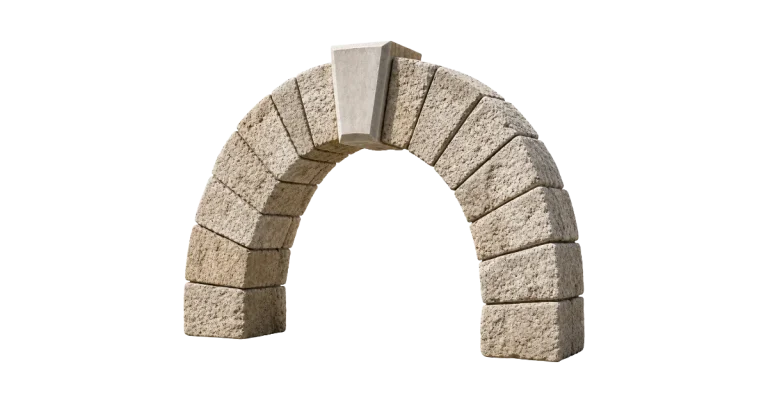
The right image is a thick steel bridge, built to resist stress without deforming. It holds under load and never becomes a better bridge because of the pressure. If it meets a load beyond its resistance, it snaps outright, precisely because it is too rigid.
The robustness of the living, after Olivier Hamant
The biologist Olivier Hamant, a researcher at the French national institute for agriculture and environment, proposes the opposite conception, drawn from living systems. He defines robustness as the capacity to maintain stability through diversity, redundancy and underperformance.
The right image becomes the suspension bridge. It holds because it sits in tension between opposing forces, because it moves under load instead of blocking it, and because its cables are redundant. Or the plant, which produces identical flowers despite the wind, by absorbing its variations rather than resisting them.
The argument looks paradoxical. The robustness of living systems is built against performance. Slowness, redundancy, heterogeneity and apparent inconsistency, everything a performance minded manager reads as waste, are what let the system hold in a fluctuating world.
BHP, a robust company in one sense and exposed in the other
Both definitions coexist in real organisations, and the same company can be robust in the industrial sense while being fragile in the biological one. Hyper specialised, optimised to the limit, with no internal diversity and no redundancy: it will resist the small known shocks and snap at the first unfamiliar one.
BHP holds tier one assets, proven industrial processes and a cost position that gives it structural strength against short term shocks. It has absorbed commodity price collapses that carried away lighter operators, and it keeps producing through cycles that stop other miners entirely.
That operational robustness has not protected it from concentration. A very large share of earnings depends on iron ore and on one customer economy, which is a single dependency dressed as a strength. The group holds. Reading it through the biology of robustness shows the exposure before an industrial reading reveals it.
The antifragile company, improving because of crises
Antifragility, a concept developed by the essayist and former trader Nassim Nicholas Taleb, introduces a genuinely different idea. An antifragile organisation does more than resist or rebound. It improves under disruption and becomes stronger because of shocks rather than despite them.
What Taleb contributes and what he leaves open
In this logic, errors, experiments and crises become sources of structural learning. The organisation that fails often and at small scale accumulates knowledge the cautious organisation never acquires. The logic is fertile and it carries a limit Taleb acknowledges himself.
Antifragility places chaos at the centre. Without disruption, no improvement. A company can learn very fast while staying structurally fragile on other dimensions, its governance, its identity or its cultural foundations. It depends on the shock to progress, which makes it dependent on a factor it does not control.
Inditex, antifragility that depends on the external signal
Global retail has absorbed cumulative turbulence: inflation, shifting purchase behaviour, aggressive competition from Asian platforms and rising unsold stock. Those disruptions hit every operator without distinction.
Inditex, the parent of Zara, uses that pressure systematically to sharpen its trend detection and shorten its production cycles. Its near real time flow of information from stores back to design lets it read the market faster than its competitors and improve at every disruption.
That is genuine antifragility, and it stays dependent on the external signal to fire properly. Without competitive pressure or market change, those mechanisms would not trigger with the same intensity. The organisation improves because of disruption, which separates it from resilience as much as from invulnerability.
The invincible company, reinventing ahead of the break
The invincible company rests on a distinct strategic capacity, which is renewing its business model before the market forces it. It does not depend on a single activity and it keeps several engines running, some funding the present and others exploring future markets.
Portfolio logic applied to the business model
That portfolio logic allows transformation ahead of obsolescence, by anticipation rather than under constraint. It assumes processes that regularly question the relevance of the current model, and mechanisms able to act on the conclusions of that questioning.
Aristocrat Leisure offers the clearest Australian demonstration. It bought Product Madness in 2012 and Big Fish in 2018 while its gaming machine business was still the cash engine, then acquired NeoGames in 2024 to build a regulated online arm, then sold Plarium and exited Big Fish once those assets no longer fitted. Each move was made from strength rather than under pressure.
The structural limit of invincibility
That strategic capacity does not protect against internal fragility. An organisation can hold a brilliant view of its market, a real capacity for reinvention and an enviable pipeline, while being undermined by a defective culture, insufficient governance or excessive concentration on a single bet.
The limit is not theoretical. It can be watched in real time, and the most spectacular example of recent years is also the one the management world was citing until very recently as the model of strategic anticipation.
Field note
Novo Nordisk, invincibility and its demonstrated limit
In June 2024 the Danish laboratory Novo Nordisk became the most valuable listed company in Europe, at roughly 640 billion US dollars, ahead of LVMH and ASML. It was a textbook case of strategic invincibility: more than twenty years of research into GLP-1 before Ozempic and Wegovy became a global therapeutic shift, and manufacturing capacity built well before demand exploded.
What followed took eighteen months. In December 2024 the CagriSema trial returned 22.7 per cent weight loss against the 25 per cent the company had projected, and the share price fell as much as 27 per cent in a session, wiping up to 125 billion dollars off its value. In May 2025 the chief executive left by mutual agreement with the board. The title of Europe’s most valuable company passed to SAP, and the group later guided to the first revenue decline in its modern history.
The capacity to anticipate was never in question. It was real and it paid. What gave way sat elsewhere: an extreme concentration on a single therapeutic class, and a back up pipeline that did not hold its promises.
Strategic invincibility protects against being late, never against concentration. An organisation can see correctly, invest early, win the market it created, and stay structurally exposed because it built neither redundancy nor an alternative during the years it could afford both. That gap is exactly the distance between invincibility and invulnerability.
The invulnerable company, an architecture designed to last
Set against these four approaches, the invulnerable company holds a distinct position, and the distinction is one of logic rather than degree. It does not sit higher on the same scale, it changes the reference point.
Four logics respond, the fifth precedes
The four preceding concepts share a common structure. Resilience responds after the shock, robustness during it, antifragility because of the shock and invincibility ahead of the strategic break. In each case, disruption remains the central reference point of the organisation.
The invulnerable company is defined by the soundness of its architecture, built upstream, independently of the nature or the timing of the shocks to come. It has installed in its ordinary structure what other organisations reserve for emergencies: regular questioning of the model, systematic detection of weak signals, responsiveness built before the need, internal dissent encouraged and redundancy deliberately carried.
Invulnerability is therefore a quality of design rather than a quality of response. That shift is set out in the full definition of the invulnerable company and breaks down into eight operating pillars.
The response side of that design is set out in structural responsiveness, which shows why the speed of a reaction says nothing about the solidity of the organisation producing it.
Sonic Healthcare, an architecture that predates the shock
Sonic Healthcare listed on the ASX in April 1987 with a single laboratory and became the third largest medical diagnostics company in the world. What carried it there was a structural choice that reads as inefficiency on any synergy spreadsheet.
The group runs what it calls a federated model, where each acquired practice keeps its own identity, its local leadership and its clinical autonomy, under the authority of pathologists rather than administrators. Every acquisition could have been integrated harder and cheaper. None of them was.
That structure was designed decades before the events that tested it, and it means the group has no single point of failure across eight countries. A qualification is worth adding to avoid the hagiographic reading. Diagnostics is a regulated, reimbursement dependent sector, and a policy change in one country still moves the whole group, which is why invulnerability describes a soundness rather than an immunity.
Move from the logic to the mechanisms
You have identified the logic you steer and you want to know what to build next? Discover the eight pillars of the invulnerable company, their dependencies on each other and the observable symptom each one leaves when it is missing.
Which logic are you actually steering?
These five logics do not exclude one another. An invulnerable company necessarily contains dimensions of robustness, antifragility and invincibility, and keeps resilience capacity for the situations where a shock lands anyway. They do not add up either, since invulnerability precedes them and organises them.
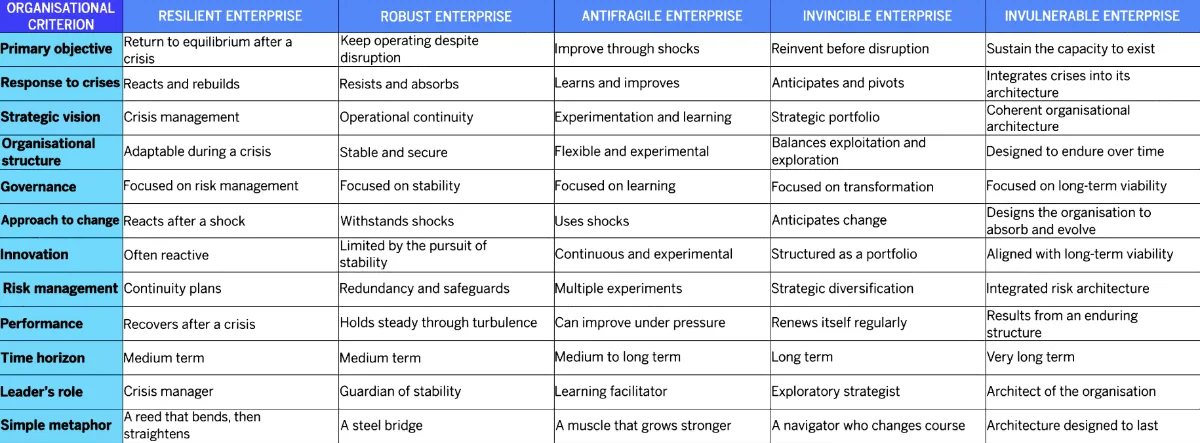
The summary table of the five logics
Each logic is recognised by three markers: what it aims at, its relationship to disruption and the limit it carries inside it. The table lets you place your organisation in a few minutes, and above all lets you check whether the logic you believe you steer matches the one your budgets fund.
| Logic | What it aims at | Relationship to disruption | Its main limit |
|---|---|---|---|
| Resilient | Bounce back after the shock | Reaction afterwards | Does not transform the structural weaknesses |
| Robust, industrial sense | Resist without bending | Resistance during | Snaps outright beyond its load threshold |
| Robust, living sense | Hold through diversity and redundancy | Continuous absorption | Requires giving up maximum optimisation |
| Antifragile | Improve because of crises | Learning through the shock | Depends on chaos to progress |
| Invincible | Reinvent ahead of obsolescence | Strategic anticipation | Protects against neither concentration nor internal fragility |
| Invulnerable | An architecture designed to last | Design upstream | Demands a rare long term discipline |
Four questions to identify the one you fund
The logic actually steered is read in the trade offs rather than in the language. These four questions can be handled in an hour of leadership team time and give a more reliable answer than any strategy document.
- Are your continuity investments sized to return to the previous state, or to operate in a different one? The first signals resilience, the second robustness.
- Is your redundancy budgeted explicitly, or does it survive only because nobody has removed it yet? An unbudgeted redundancy disappears at the next cost pressure.
- Did your most useful lessons of the past three years come from incidents you absorbed or from explorations you chose? The first signals antifragility, with its dependence on the shock.
- What share of your revenue comes from activities that did not exist five years ago, and has that diversification reduced your dependency or only widened your offer?
Several of these trade offs stay hidden behind arrangements that look protective from the inside. The nine false securities that make your company vulnerable run through the most common ones, from excess process to client concentration and sustained financial performance.
The Australian context adds a reason to treat these questions now. ASIC recorded 13,413 companies entering external administration in the eleven months to 31 May 2025, up 34.2 per cent on the same period a year earlier. The failures concentrate in organised sectors, construction above all, rather than in the smallest operators.
How I can help you choose your logic
The choice between these five logics is not academic. It determines what you measure, what you budget and what you protect when pressure rises. Three formats answer three different moments.
A keynote to clear the collective confusion
The keynote installs the vocabulary of the five logics and shows, on documented cases, what each one produces and what it leaves uncovered. It suits situations where several members of the leadership team use the same words for different realities, which is the most frequent case.
You can see what it covers on the page for the keynote on the invulnerable company.
A diagnostic to place your organisation
The diagnostic sets the logic your organisation says it steers against the one its trade offs actually fund. The gap between the two is usually the first lesson, and it tends to surprise the leaders most confident in their own reading.
You can prepare that session by taking the invulnerability diagnostic for your company on your own.
A workshop to arbitrate between robustness and efficiency
The workshop handles the most concrete conflict this comparison raises: which redundancy to keep, at what cost and on which critical points. It produces a dependency map and a budget decision rather than a discussion.
In person or remote, these engagements are designed so that you leave with decisions to make rather than ideas to explore. Book an engagement to talk it through.
Conclusion
In an unstable world, the dominant strategic question has become how to cope with chaos. It is a good question. It is probably no longer the best one.
The better question asks why your organisation needs chaos to reveal its faults. Resilient companies survive crises, robust companies resist disruption, antifragile companies learn from shocks and invincible companies reinvent themselves ahead of the breaks.
Invulnerable companies are designed so that these questions never determine their fate.
A robust company holds under load, and that is already a great deal. The question left open is whether your architecture was ready before the load arrived.
Frequently asked questions about the robust company and its neighbours
What is the difference between a robust company and a resilient one?
A robust company keeps operating during the disruption, without interruption. A resilient one stops, then returns to its previous state. The first invests in permanent safety margins, the second in a fast recovery capacity.
What does robustness mean in Olivier Hamant’s sense?
The biologist defines robustness as the capacity to maintain stability through diversity, redundancy and underperformance, on the model of living systems. That conception runs against engineering robustness, which rests on rigidity and on sized resistance margins.
Antifragile or robust, which logic should you choose?
Antifragility suits organisations whose errors are cheap and frequent, since it turns shocks into learning. Robustness suits situations where one serious failure stops everything. The criterion is the unit cost of a failure rather than cultural preference.
Are these five logics incompatible with each other?
No. An invulnerable organisation contains dimensions of robustness, antifragility and invincibility, and keeps resilience capacity. Invulnerability is not their sum, it precedes them and organises them by defining what is protected before any disruption.
How do I know which logic my organisation already steers?
Look at your trade offs rather than your language. Check whether your redundancy is budgeted explicitly, whether your lessons come from incidents absorbed or explorations chosen, and whether your continuity investments aim at the previous state or at operating in a different one.