You transform, you invest and you declare that you want to build for the long term. Your organisation stays structurally fragile all the same. The cause has nothing to do with a lack of will. It is a set of method errors that need naming before they cost too much.
Most organisations that fail to become invulnerable are not short of good intentions. They are short of clarity about what they actually do when they believe they are building their soundness.
The mistakes described here are not theoretical. They recur in leadership meetings, strategic plans and transformation seminars. They confuse the signal with the substance, the language with the architecture and the intention with the decision.
Structural fragility is never declared, it is built by accumulation. These seven structural mistakes are the most common traps on the road, and they share one feature, which is that they stay invisible for as long as the results remain acceptable.
| The trap | The mechanism | The reversal |
|---|---|---|
| Seven mistakes, one blind spotStructural fragility is built through seven recurring structural mistakes, from confusing performance with soundness to steering the whole thing as a time limited project. Each one looks reasonable at the moment it is made, and none produces a signal while the results still hold. | Short tools on a long problemAll these mistakes come from one logic, which is trying to build a long architecture with the instruments of short term optimisation. Stated values produce no behaviour, only mechanisms do, and that difference explains most transformation failures. | Swapping the goal and the meansStop treating performance as the goal and architecture as the means, and do the opposite. That reversal turns into protected budgets, leading indicators and repeated decisions, never into a statement of intent. |
The foundation mistake, confusing performance with soundness
This is the most widespread of the mistakes and the hardest to correct, precisely because it stays invisible in good times. An organisation that performs has a structural difficulty admitting that it is fragile.
The mechanism of the mistake
The indicators are good, the markets validate, the shareholders are satisfied. Why invest in foundations when the results seem to prove that the foundations hold? The logic looks airtight, and it rests on confusing two things with no direct link.
An organisation can consume its architectural, cultural, governance and strategic capital to produce immediate results. It performs right up to the moment the foundations give way, and by then it is too late to rebuild them without damage.
The consumption leaves no trace on the balance sheet. A governance shortcut, a culture that stops carrying bad news, a capability hollowed out to hit a number, none of these shows up in the results the quarter they happen. They show up years later, all at once, in a failure that looks sudden and was decades in the making.
That is what twenty years of research into organisational health has established. Financial results are lagging indicators, which measure what has already happened rather than what is in the process of weakening.
What this mistake reveals
If you measure only what your organisation produces and never the soundness of what produces it, you are managing a capital you do not know you are spending.
The test is simple. Take the three indicators you watch most closely in your leadership meeting each month and ask which of them measure a cause rather than an effect. If none measures a cause, you are steering a picture of the past.
I ran that test with the executive team of a profitable services business a few years ago, and the room fell quiet. Every one of their monthly indicators measured an outcome, revenue, margin, utilisation, win rate. Not one measured whether the conditions producing those outcomes were still intact, and the two years of record results had persuaded everyone there was nothing underneath to check.
The method mistake, treating invulnerability as a project
The organisational reflex in the face of a strategic issue is to create a project. A lead is appointed, milestones are set, a budget is allocated and a quarterly progress report is produced. This is how organisations know how to do things, and it is precisely why the approach fails here.
The mechanism of the mistake
Invulnerability is not a final state reached after eighteen months of transformation. It is a quality of architecture built through repeated decisions, progressively changing how the organisation governs, learns, decides and renews itself. It grows through cultivation rather than through a single act of installation.
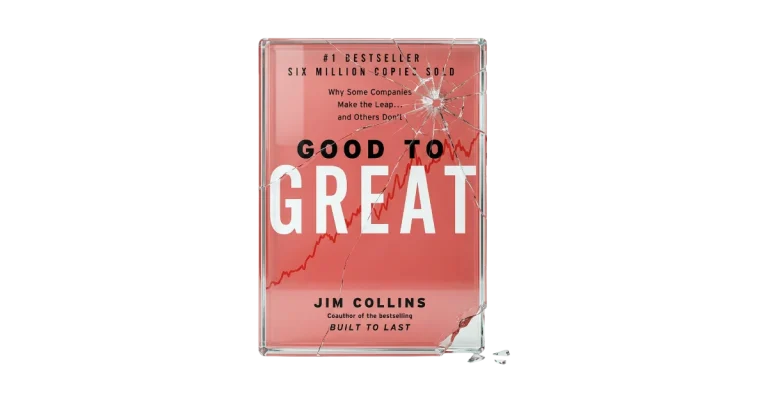
Jim Collins, in his work on the companies that move from good to great, describes this through the image of the flywheel. Soundness comes not from one spectacular decision but from constant pressure, in the same direction, over years. The symmetrical mistake is to pile up transformation programs and never let the flywheel gather speed.
Treating invulnerability as a project produces two equally destructive effects. The organisation believes it has succeeded when the project ends, while the real work has not begun. And by appointing a lead, it implicitly outsources the subject, which becomes someone else’s problem.
What this mistake reveals
If your invulnerability effort has a project manager, an end date and a ring fenced budget, you have created a signal of transformation rather than a transformation.
The invulnerable architecture is never the responsibility of one function. It is the product of decisions taken at every level, over time, and nobody can carry it in place of the leadership team.
The governance mistake, declaring values instead of building mechanisms
How many organisations display integrity, managerial courage or a culture of truth in their official values, and produce the opposite behaviour the moment those values collide with performance targets? The answer is most of them.
The mechanism of the mistake
This is not an anecdotal point. An analysis published in the Harvard Business Review covering more than five hundred large organisations shows that the gap between official values and real behaviour is the norm rather than the exception.
This is not hypocrisy but an architectural error. Values do not change behaviour, mechanisms do. An organisation that wants the truth to travel upward has to build processes that make that upward travel possible, protected and valued, independently of the individual courage of the people who practise it.
A culture of internal dissent, the reading of weak signals and long term governance are not states of mind a seminar installs. They are architectures: meetings where disagreement is structurally expected, indicators that measure what you want to protect and incentives that reward what you claim to value. The seminar changes the language for a fortnight, the mechanism changes the behaviour for good.
What this mistake reveals
List the five behaviours your official values are meant to produce. For each one, identify the concrete mechanism, meeting, indicator or incentive, that makes it inevitable.
If you find no mechanism, you have a declaration rather than an architecture. And a value that is not institutionalised is more toxic than no value at all, since it teaches the organisation that what is displayed does not count.
The Hayne Royal Commission put this in its sharpest form. In his 2019 final report, Commissioner Kenneth Hayne singled out one of the four major banks, National Australia Bank, and wrote that the entity contented itself with statements of purpose, vision or values that said little about the basic standards underneath. The chief executive and the chair resigned within days. The values were on the wall, and the mechanisms were not underneath them.
An invulnerable organisation is not an organisation whose leaders have good intentions. It is an organisation whose architecture produces the right behaviours, independently of the people who make it up.
The timing mistake, acting only under the pressure of a crisis
A crisis is an extraordinary revealer. It brings to light the weaknesses that growth years kept invisible, forces the decisions ordinary governance kept postponing and mobilises considerable resources in very little time. The problem is not that organisations act in a crisis, it is that they act only in a crisis.
The mechanism of the mistake
Building invulnerability demands exactly the opposite. Investing in foundations you do not yet need, taking decisions that are costly in the moment because they build future soundness, and accepting an apparent inefficiency in the form of redundancy and room to manoeuvre.
That logic is structurally hard to hold in a governance oriented towards short term performance. Why fund alternative scenarios when the main scenario works? Why keep capacity in reserve when it looks useless? Each of those questions has an obvious answer in the moment, and the obvious answer is what accumulates the fragility.
Structured anticipation is a technique rather than a posture. Gary Klein formalised the pre-mortem, which means imagining, before a decision is taken, that the project has already failed, then identifying the causes. It draws on research by Mitchell, Russo and Pennington showing that picturing an event as already having happened improves by 30 per cent the ability to identify its causes correctly.
What this mistake reveals
Take the important decisions of the past three years and work out the proportion triggered by a crisis. If it is more than half, your organisation reacts rather than builds.
Invulnerable organisations build their protections before they need them, because they know that the day they need them, it will be too late to build.
Field note
Masters, when the decision comes three years too late
In September 2011 Woolworths opened the first Masters store, a joint venture with the American retailer Lowe’s, to break the hardware market that Bunnings dominated. The pressure that would sink it was legible from the start: Bunnings held the best sites, and the American product calendar ran on Northern Hemisphere seasons that never matched an Australian summer.
What followed reads like a manual of timing mistakes. Losses accumulated year after year and the store network kept expanding while nobody settled the question the numbers were asking, which was whether a viable position against Bunnings existed at all. The decision to exit came only when the losses could no longer be hidden.
Woolworths announced its withdrawal from hardware in January 2016 and closed the last stores in December 2016, roughly five years after opening, having accumulated losses widely reported at more than 3 billion dollars across the venture. The exit drove the group’s first full year statutory loss since its listing.
Structural decisions taken under the pressure of results are not bad decisions, they are late ones. The questioning that produced the exit in 2016 would have produced the same answer in 2012, at a cost with no common measure. What was missing was neither clarity nor information, it was the mechanism that forces that questioning while nothing yet demands it.
The identity mistake, confusing tactical agility with strategic soundness
Agility has become the watchword of modern organisations. Moving fast, pivoting, iterating and testing is a legitimate answer to the acceleration of innovation cycles. Tactical agility does not produce strategic soundness all the same, and confusing the two has lasting effects.
The mechanism of the mistake
Rita McGrath, a professor at Columbia Business School, separates these two levels in her analysis of strategic inflection points. The companies that survive ruptures are not the ones that pivoted fastest, they are the ones with enough clarity about their deep identity to know which direction to pivot in.
An organisation that pivots constantly with no stable identity adapts to everything and anchors to nothing. It can be very responsive in the short term and structurally vulnerable in the long term, because it has not built the foundations that agility never builds.
Invulnerability is the base of agility rather than its opposite. An organisation can be both agile in its operations and sound in its architecture. Agility alone, with no architecture, produces organisations that move a great deal and hold very little.
The confusion is easy to make because agility is visible and soundness is not. A team that pivots quickly looks alive, decisive and modern. A team that has spent a year clarifying what it will never do looks slow by comparison, right up to the moment a rupture arrives and only one of the two knows which way to move.
Booktopia, movement without an anchor
Booktopia was the fast one. Founded in 2004, it grew into the largest Australian owned online bookseller, listed on the ASX in 2020 and rode the pandemic surge in online orders. Speed and iteration were never its problem.
What it never built was the structural soundness underneath the movement. When it invested heavily in a new fulfilment centre, the transition disrupted operations enough to drop half year revenue by around 22 per cent, at the same moment the post pandemic online market normalised and the founder had left after a board dispute.
The group entered voluntary administration in July 2024 and was later delisted. A business can be agile in every operational sense, move quickly and iterate constantly, and still hold very little when the one structural bet goes wrong at the wrong moment. Agility was never the missing piece.
The cultural mistake, rewarding alignment rather than truth
No leadership team declares that it values compliance. Most organisations nonetheless reward, implicitly, the people who say what leaders want to hear, and penalise those who raise objections or carry bad news.
The mechanism of the mistake
The result is predictable and documented. Leaders are often the last to hear about the problems everyone else can see. Information that is filtered, softened and delayed is the norm in hierarchical organisations.
The people involved are not short of courage. They have learned, through experience, that speaking up costs more than staying quiet. This is what Amy Edmondson, a professor at Harvard Business School, calls the absence of psychological safety, the shared belief that speaking up carries no negative consequences.
Building a culture of dissent is therefore an architectural decision rather than a matter of internal communication. Creating spaces where disagreement is expected, protecting the people who raise the alarm explicitly, and measuring the quality of the information that travels upward as much as the compliance with targets.
What this mistake reveals
Think of the last person who told you clearly that you were wrong on an important subject. What happened to that person in the months that followed?
The answer to that question is worth more than any value displayed on your walls, because the whole organisation watched it and drew its own conclusions.
The sequence mistake, wanting to change everything at once
This is the symmetrical mistake of the previous one. After reading a diagnostic of their fragility, some leaders try to transform the whole architecture at once, with a hundred and twenty day plan, a steering committee and a promise of visible results by year end.
The mechanism of the mistake
It is the right analysis and the wrong method. An invulnerable architecture is built neither by decree nor in a hurry. It is built in layers, starting with the foundations that condition everything else.
Trying to transform everything at once produces intense organisational agitation and superficial change: extra meetings, new indicators and culture seminars, with no real change in how the organisation decides, builds its redundancy or moves information upward.
John Kotter, in his study of more than a hundred transformation programs, named this trap decades ago. Skipping steps produces only an impression of speed, never a result that holds. Thirty years later, the same sequence mistakes recur with the same regularity.
What this mistake reveals
If you had to pick one pillar to work on seriously this year, with the resources and attention it demands, which would matter most to your organisation?
That is probably where to start, and the order matters. Identity first, without which no hard decision holds. Then long term governance, without which deep investment does not survive quarterly pressure. Only then the cultural and structural mechanisms.
The instinct to move on every front at once comes from a good place, which is urgency. It still produces the weakest result, because an organisation that changes twelve things badly ends up more tired and no more sound than one that changed two things properly. Depth on a single foundation beats breadth across all of them.
What these seven structural mistakes have in common
These seven mistakes do not signal bad faith in the leaders who make them. They are the natural product of organisations designed to optimise short term performance in relatively stable environments, and trying to build something else without changing the logic that governs them.
One reversal to make
Invulnerability demands that you stop treating performance as the goal and architecture as the means, and treat architecture as the goal and performance as the consequence.
That reversal is not decreed. It turns into governance mechanisms, indicators, incentives and repeated decisions that progressively change what the organisation values, protects and builds.
Structural fragility does not disappear with good intentions
It disappears with architectural decisions, taken over time, against the permanent pressure of the short term. That is the only thing separating an organisation that has understood from an organisation that has changed.
Among these seven mistakes, which do you recognise most clearly in your organisation, and what would be the first concrete decision to start correcting it?
Identify the pillar to start with
You recognise several of these mistakes and you want to know where to attack first? Read the eight pillars of the invulnerable company and their dependency table, which shows which pillar has to be built before the others.
Where to start if you recognise several
Most organisations recognise four or five of these seven mistakes. The reflex is then to tackle all of them, which reproduces the sequence mistake exactly. Two criteria let you choose.
Correction cost and urgency never coincide
These seven mistakes share neither the same correction cost nor the same delay before their effects become irreversible. Tackling them in the order they bother you means tackling the most visible ones, which are rarely the most structuring.
| Mistake | Correction effort | Delay before irreversible effect |
|---|---|---|
| Confusing performance with soundness | Low, three indicators to add in the leadership meeting | Long, several years |
| Treating the subject as a project | Low, one governance decision | Medium, one transformation cycle lost |
| Declaring values without mechanisms | Medium, revising the incentives | Long, but the credibility erodes continuously |
| Acting only under crisis pressure | Medium, protected budget and scenarios | Short, the window closes without warning |
| Confusing agility with soundness | High, deep identity work | Long, gradual drift |
| Rewarding alignment | High, slow to build and quick to destroy | Short, one visible episode is enough |
| Wanting to change everything at once | Low, giving up initiatives | Short, organisational exhaustion arrives fast |
Start with a low effort, short delay mistake
Crossing the two columns gives the answer. The mistakes with a low correction effort and a short delay are the ones that produce the best immediate return, and they create the credibility needed to launch the long projects.
Giving up simultaneous initiatives and protecting a soundness budget cost little and are decided in one meeting. Identity work and a culture of dissent take years. Starting with the second before handling the first is building while the house burns.
How I can help you correct these mistakes
These mistakes are rarely visible from the inside, because they are the normal product of ordinary operations. Three formats make them visible and then correct them.
A keynote to name what nobody names
The keynote makes these seven mistakes visible from documented and recent cases. It usually produces an uncomfortable and useful moment, the one where several members of the leadership team recognise the same mistake without ever having named it together.
You can see what it covers on the page for the keynote on the invulnerable company.
A workshop to settle the sequence
The workshop applies the two criteria from the table to your real situation and produces a decision: one mistake tackled this year, the others deliberately deferred. It is an exercise in giving up as much as in prioritising.
You can prepare it with the invulnerability diagnostic for your company, which gives a pillar by pillar map.
A program to install the first mechanism
The program supports the actual correction over three to six months, starting with the two mechanisms that make all the others possible: the soundness budget protected by a written rule, and the documented memory of architectural decisions.
In person or remote, these engagements are designed so that you leave with decisions to make rather than ideas to explore. Book an engagement to talk it through.
Conclusion
These seven structural mistakes share a feature that makes them dangerous. None looks like a mistake at the moment it is made. Creating a project, displaying values, acting when it is urgent, cultivating agility and seeking alignment are behaviours every serious organisation values.
That is exactly why structural fragility builds without anyone deciding it. It is the product of an accumulation of reasonable decisions taken with the wrong criteria, in an environment that rewards each of them separately.
The question to put to your leadership team this week fits in one line. Among these seven structural mistakes, which one is your organisation making with the best professional conscience in the world?
Frequently asked questions about structural fragility
How do you detect structural fragility when everything is going well?
By watching leading indicators rather than lagging ones. How long bad news takes to reach the top, the share of budget protected beyond three years, the proportion of decisions triggered by a crisis, and whether a recent refusal was driven by identity consistency.
Why do transformation programs fail so often?
Because they apply a project logic to an architecture problem. A project has an end date, a budget and a lead. An architecture is cultivated through repeated decisions and cannot be delegated to one function without losing its reason to exist.
Do you have to correct these seven structural mistakes at the same time?
No, and wanting to is the seventh mistake itself. Cross the correction effort against the delay before an irreversible effect, then tackle a low effort, short delay mistake first. The credibility you gain then funds the long projects.
What is a pre-mortem and what is it for?
It is an exercise that imagines, before deciding, that the project has already failed, then reconstructs the causes. Picturing an event as already having happened improves by around 30 per cent the ability to identify its reasons correctly.
Is a displayed value without a mechanism really harmful?
Yes, more so than no value at all. When a displayed value is contradicted by the behaviours that get rewarded, the organisation learns that what is declared does not count. That lesson then transfers to every other statement leadership makes.