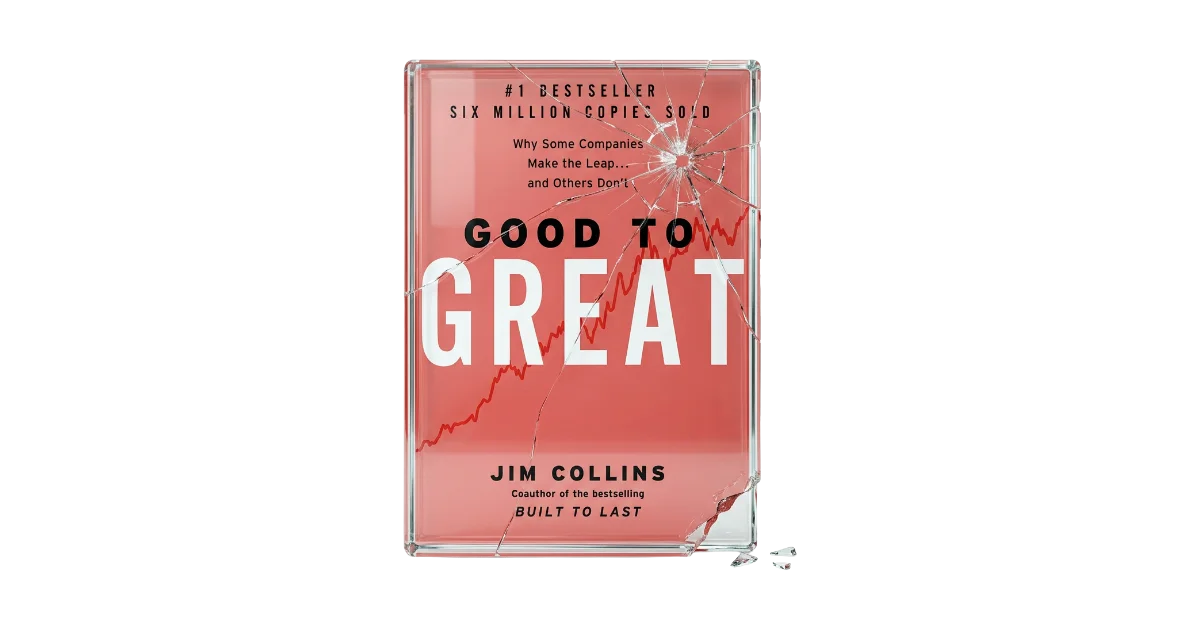
Good to Great is probably the management book handed around a board table more often than any other over the past twenty-five years. Jim Collins, the American researcher behind it, studied hundreds of listed companies to isolate eleven that had crossed from ordinary performance to exceptional results held over many years.
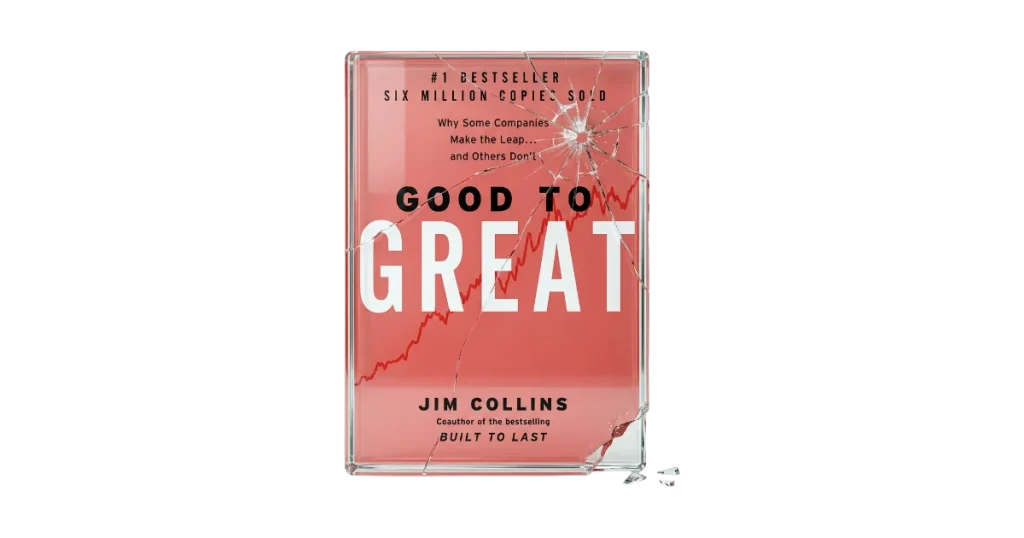
I read it like most leaders did, and I recommended it for a long time. Its research method is serious, its influence is deserved, and I still treat it as a founding work.
What changed is the world it described. What changed more is what we now know about the eleven companies Collins had crowned as great.
This article asks a question Collins could not pose in 2001. What in an organisation can be inspected today to tell whether it will hold tomorrow? That question sits at the heart of the invulnerable company, my term for an organisation whose architecture is built so that outside shocks never decide its fate. The answer to why great companies fail is never found by studying winners.
| The founding book | What the facts showed | The shift |
|---|---|---|
| A performance frameworkGood to Great identifies the practices shared by eleven American companies that durably outran their reference market. The framework explains a success already recorded, which is why it struggles to answer why great companies fail once conditions change their rules. | Greatness that did not holdSeveral of the named companies later filed for bankruptcy, were placed under public control or were absorbed by a rival. Strong results across one period did not prevent collapse when the environment rewrote the rules of the game. | From explaining to inspectingThe invulnerable company moves the question towards what can be observed inside an organisation before a crisis. Architecture is audited in the present, without waiting for a result to validate the method after the fact. |
What Good to Great actually measured
Good to Great rests on a five-year study of American listed companies. Collins’s team looked for firms whose share returns had durably beaten the market after a long ordinary run, then traced back to what those firms had in common. The execution is rigorous. Its reach depends entirely on what a past share result lets you conclude.
Eleven companies chosen for what they had already won
Collins names eleven companies as great: Abbott Laboratories, Circuit City, Fannie Mae, Gillette, Kimberly-Clark, Kroger, Nucor, Philip Morris, Pitney Bowes, Walgreens and Wells Fargo. He compares them with a control group in the same industries that never made the leap. The concepts that made the book famous come from that comparison.
Three of them still shape the vocabulary of leadership teams. The hedgehog concept, Collins’s idea of three overlapping circles, invites an organisation to find what it can be best in the world at, what drives its economics and what it is passionate about. Confronting the brutal facts demands a culture where bad news travels. The flywheel describes how consistent effort compounds until it produces momentum of its own.
These three ideas are sound. I still use them in workshops, under other names and in other settings. The concepts hold up fine. The problem lies in what the method lets you conclude from them.
A note for an Australian reader is worth adding here. The eleven are all American, all listed, and all observed from the mid-1960s to the mid-1990s. Their path does not transfer cleanly to the Australian economy, which leans heavily on private firms, family businesses and a workplace-relations and regulatory setting of its own.
What became of the Good to Great companies
The sequel is well known and rarely told in full. Circuit City, held up by Collins as a spectacular case of returns, filed for bankruptcy and then liquidated its stores. Fannie Mae was placed under federal conservatorship during the financial crisis. Gillette was absorbed by Procter and Gamble.
The rest of the group fared no better against time. A decade after publication, most of the remaining companies showed flat or negative performance, with a few exceptions such as Nucor. Wells Fargo later ran into a scandal over customer accounts opened without consent, penalised by the American regulator.
These trajectories do not disqualify the book. They disqualify one particular reading of it, the reading that assumes copying the practices of great companies protects you from their fate.
Collins’s own explanation and what it leaves open
Collins did not ignore these falls. He devoted a whole book to them, How the Mighty Fall, published in 2009, then a study of performance in chaotic conditions, Great by Choice, published in 2011. His thesis fits in a sentence: these companies declined because they abandoned the disciplines that had made them great, sliding from humility into arrogance.
The explanation is coherent and partly true. It carries an awkward property for anyone trying to decide today. It only becomes testable after the fall.
While a company performs, its confidence reads as conviction. The day it collapses, the same confidence becomes arrogance in hindsight. No leader can use that test to place themselves in real time, because the verdict depends on a result that has not yet landed.
I read it differently, and I hold to the reading because it produces decisions rather than commentary. Circuit City did not sink by forgetting its discipline. It sank by applying it, in a physical-retail trade whose rules were being rewritten elsewhere.
Why performance never guarantees survival
Two flaws separate a performance framework from a durability framework. The first sits in how the cases are chosen. The second sits in when the framework can be tested. Neither is a mistake by Collins. Both belong to the nature of the exercise itself.
A framework selected on its own result
Choosing companies because they won, then looking for what they share, always produces a list of practices. The method never tells you how many companies applied the same practices and failed, because those are not in the sample. The list describes the winners of a period without showing that the practices caused the win.
This limit has a name in research, survivorship bias, the error of studying only the cases that made it through while the failures stay invisible. It explains why recipes drawn from champions age as fast as the environment that crowned them.
The practical consequence is blunt for a leader. A framework built on past winners gives you no way to tell whether your organisation is becoming one of them or one of the invisible losers who followed the same principles.
Why great companies fail when the test comes late
The second flaw matters more. A performance framework is validated by a result, so after the test. An architecture is inspected on the evidence, so before the test. This is the deeper reason why great companies fail even while every scoreboard still reads well, since the scoreboard measures the old test rather than the new one.
The distinction sounds theoretical and it changes everything in a board room. Asking a team whether it is humble produces nothing you can use. Asking that same team how many decisions it revised last year after a signal came up from the front line produces a number, a date and a name.
This shift is the heart of what I work on with organisations. The quality of an architecture is measured on observable mechanisms, never on declared qualities.
When longevity protects nothing
Age offers no shield. Credit Suisse, founded in the nineteenth century, disappeared over a single weekend in March 2023, absorbed by UBS after 167 years. It held capital and liquidity that met regulatory requirements at the time. What gave way was the slowness to face its own errors, built up over a decade of restructurings.
The counter-example exists too, and it deserves a clear-eyed look. Ørsted, formerly DONG Energy, moved its business from fossil fuels to offshore wind until it became a global player in that field. The company then went through heavy losses tied to costs and interest rates, which proves my point exactly. A successful transformation improves a position. It hands out no permanent certificate of invulnerability.
The Australian picture confirms the trend at the scale of the whole economy. The corporate regulator has recorded more than 13,000 companies entering external administration in a single year, a rise of around a third on the year before. Fragility is not a speaker’s hypothesis. It reads straight off the public statistics.
What the invulnerable company changes in the question
An invulnerable company is an organisation whose architecture has been designed on purpose so that outside disruptions never decide its fate. The word names a property of structure, not a level of performance. That definition, which I developed as a working frame, forces three changes in how you examine an organisation.
Good to Great was the right instrument for a stable world, one where an advantage held its value for a decade and disciplined execution outweighed speed. Once that same leader enters the age of fragility, the period I describe in which shocks arrive often and from directions no one has mapped, the instrument has to change. What needs inspecting then is the architecture of the invulnerable company, the structure that decides whether the organisation stays standing when the ground moves.
From explaining after the fact to inspecting before the crisis
Good to Great answers why some companies outperformed. The invulnerable company answers a different question. What in this organisation will hold the day conditions change in nature? The first question is handled with performance data. The second is handled with evidence of mechanism.
A weak-signal reporting system either exists or it does not. It has produced traceable decisions or it has produced none. This is why I built the eight pillars of the invulnerable company as verifiable objects rather than as values.
Long-term governance shows up in how executives are paid. A reserve capacity shows up in a stock, a contract or a back-up procedure. Each pillar leaves a trace you can put your finger on, or it leaves nothing, and the absence is the finding.
Excellence as a lock-in mechanism
Here I part most sharply from the usual reading. Excellent companies do not lose their way by giving up their disciplines. They lose their way because those disciplines work too well. Fifteen years of optimising one trade leaves an organisation with the best processes, the best experts and the deepest reflexes of that trade.
Each of those assets becomes an exit cost the day the trade changes definition. Management scholars describe this as core rigidity, where a capability that distinguishes a firm at one moment turns into a source of inertia when the environment tips over.
This is exactly the object of my eighth pillar, the capacity to unlearn, and it is the pillar that high-performing organisations find hardest to build. The paradox states simply. The better an organisation is at its current trade, the more objective reasons it has to reject the signals warning that the trade is changing.
The age of fragility changes the nature of the test
Constancy used to be the winning bet. In that older world a competitive advantage kept its value long enough for disciplined execution to compound. Fragility reverses the maths, because an advantage can lose its worth in a single quarter when a technology, a supplier or a rule shifts underneath it.
These reversals also travel fast. They spread through supply chains, technology dependencies and regulatory moves that nobody had charted, which is what makes them so hard to price ahead of time.
In that context the question of greatness loses its practical value. The question that counts becomes the ability to stay in the game long enough for the next opportunity to appear. That shift also governs the organisational curiosity of weak signals, which is worth less for detection than for turning signals into decisions.
Field note
The best-equipped organisations are the ones that move least
The pattern comes back from engagement to engagement, and it usually takes the same shape. The organisations with the fullest resources, the tightest processes and the finest indicators are rarely the ones that reinvent themselves fastest. The leaner teams manage it more often, because they have changed how they decide, how they cooperate and how they trust one another.
In those excellent organisations the signals are there all the same. Operators have seen, managers have escalated, abnormal data has been produced, and nothing moves. The measurement apparatus works perfectly, and it measures yesterday’s world with a precision that makes doubt uncomfortable to voice in a meeting. I have watched organisations with every resource stay deeply still, while stripped-back teams transformed for real. The gap never came from the budget.
What blocks change is almost never material. The fear of losing a habit, the comfort of a reflex and the belief that a past result proves the method are enough on their own to freeze an otherwise well-run organisation.
Good to Great or invulnerable architecture, how to choose your reading frame
The two frames do not compete. They answer different situations. A leader torn between working on performance and working on resistance needs explicit criteria rather than an author’s preference. Here are the five criteria I use to separate them, so you can match a frame to your own situation rather than to a fashion.
Five criteria to compare the two frames
The table below sets each frame against the other, line by line, on what it observes, when it can be used and what it lets you decide. The most useful reading is to find the line that matches your current situation rather than to pick a whole column and defend it.
| Criterion | Performance frame | Invulnerable architecture |
|---|---|---|
| Object observed | The results achieved and the practices of winning companies | The mechanisms present in the organisation, whatever the result |
| When to use it | After a period of measurable performance | At any time, including before any disruption |
| Accepted proof | A financial trajectory compared with a control group | A device, a tested procedure or a traceable decision |
| Validity condition | An environment whose rules stay stable | An environment whose rules can change |
| Decision it allows | Copy practices that worked elsewhere | Fix a structural weakness identified in your own house |
When each frame actually serves
A performance frame still serves when the ground is stable and the problem is execution. An architecture reading takes over when the model itself is in question. A simple signal settles which one you need faster than any long diagnostic, and it turns on what your leadership team can name out loud.
A performance frame stays useful in three situations:
- your market is stable and your competitors are playing the same game as you
- your problem is weak execution rather than a contested model
- your leadership team needs a shared language before tackling harder questions
An architecture reading takes over in three other cases:
- your performance is good and your model rests on an assumption you have not re-examined in a long time
- your results hide a single dependency on a supplier, a customer, a technology or a regulation
- your organisation has already been surprised once and wants to understand why it saw nothing coming
A simple signal settles it quickly. If your leadership team can name the three assumptions your current model rests on, the performance reading still suffices. If it cannot, the architecture question comes first.
Five checks to run before the next disruption
These five checks run in half a day with a leadership team. They produce no score and replace no full diagnostic. They establish one thing only, whether your organisation holds evidence of its resilience or merely holds intentions about it.
The five inspection points
Each check asks for a fact, not an opinion. A dated decision, a named dependency, a tested fallback, a recorded disagreement and a pay horizon. Together they show whether the organisation can prove its resilience or can only assert it in a slide.
- Name a decision taken last year after a signal came up from a front-line colleague, with its date and its author.
- Name the dependency whose loss for a month would stop your business, then state the fallback you have tested in real conditions.
- Identify the practice your organisation masters best and whose value could vanish if the rules of the trade changed.
- Recall the last time a disagreement voiced in a leadership meeting changed a decision that had already been announced.
- Check what share of your leadership team’s variable pay depends on a horizon beyond three years.
What reading the results must forbid you
A general answer to any of these questions counts as no answer at all. Saying the culture encourages people to speak up proves nothing until a dated decision backs it. The most common temptation is to treat a good result as proof that the architecture holds, and it is the temptation that undid the companies in the book.
Every company Collins cited showed excellent results at the moment it was cited. The second temptation is to fix the most visible pillar rather than the weakest one. The strength of an architecture reads on its least-held point, and that point is rarely the one that appears in the strategy deck.
Move from reading to auditing your architecture
Want to know which of your pillars is the weakest before a disruption teaches you the hard way? Work through the eight pillars of the invulnerable company and find the one your organisation cannot back with a single piece of concrete evidence.
How I can help you build an invulnerable company
I work this question with leadership teams, executive committees and HR functions, in keynotes, workshops and longer engagements. My role is to make visible the gap between what an organisation believes it has built and what it can actually show when asked for proof.
A keynote to put the gap in front of your leadership team
The keynote puts your leaders in front of the real trajectories of companies that carried every mark of excellence before they gave way. It works as a way in when the conviction is not yet shared and the work needs to start quickly.
The format ends with the five checks from this article, run live. The discussion then turns on your own answers rather than on outside examples. The content sits on the page for my keynote on the invulnerable company.
An architecture audit workshop
The workshop takes over when you want a stocktake pillar by pillar. The work is to hunt for the evidence of each mechanism, then rank the gaps by their cost in a degraded situation. It suits organisations that prefer to decide on verifiable elements rather than on impressions.
It produces a roadmap ordered by pillar, with the points to treat first and the ones that can wait. The output is a working document, not a diagnosis to file away.
Ongoing support for managers
An architecture is built through managerial practice, not through a memo. I support organisations over several months to install the mechanisms that are missing, training the managers who will have to keep them alive after I leave.
This work joins my engagements on managerial transformation, since an organisation’s ability to correct itself depends first on what its managers are allowed to say and to decide.
Conclusion
Good to Great gave several generations of leaders a shared vocabulary and a few sound intuitions. Its flaw sits in the implicit promise, the one that lets you believe greatness recorded yesterday protects against tomorrow’s collapse.
The trajectories of its eleven companies settled the matter. No past performance is an insurance policy, and the discipline that produces excellence in one trade becomes the main resistance to change when that trade redefines itself.
A performance framework explains a result after the fact. An invulnerable architecture is inspected before the test.
Start with the simplest and most uncomfortable question. Which of your eight pillars rests on no evidence at all, and how long have you known it without touching it? Answering that honestly will teach you more about why great companies fail, and about your own real solidity, than every lesson in Good to Great.
Frequently asked questions about why great companies fail
What happened to the companies in Good to Great?
Circuit City filed for bankruptcy, Fannie Mae was placed under federal conservatorship and Gillette was absorbed by Procter and Gamble. A decade after publication, most of the remaining companies showed flat or negative performance, with a few exceptions such as Nucor.
Is Good to Great still worth reading?
The book stays useful for building a shared language on execution and strategic clarity inside a leadership team. It becomes insufficient the moment the business model itself is contested, since it analyses past results earned in a more stable environment than the one we work in now.
Why do great companies fail even when they are well run?
An organisation that excels at a trade owns the processes, careers and budgets of that trade. Those assets turn into exit costs when the rules change, which makes unlearning harder for excellent companies than for others. That is a central reason why great companies fail.
What is the difference between a high-performing company and an invulnerable company?
A high-performing company gets superior results under the current conditions of its market. An invulnerable company holds structural mechanisms that let it stay in the game when those conditions change in nature, whatever its performance level at the moment.
How do I tell whether my organisation is fragile?
Look for evidence rather than intentions. A dated decision changed after a front-line signal, a fallback actually tested in real conditions and a share of executive pay tied to the long term are verifiable clues, unlike stated values on a wall.