If your organisation had to give up a significant financial advantage tomorrow to stay true to what it is, would it know what to choose? And would the choice be the same regardless of who happened to be in the room?
When the answer varies with the person you ask, there is no institutional identity, only individual opinions about what the organisation ought to be. That confusion stays harmless while nothing is pressing, and it becomes a structural fragility the moment the pressure rises.
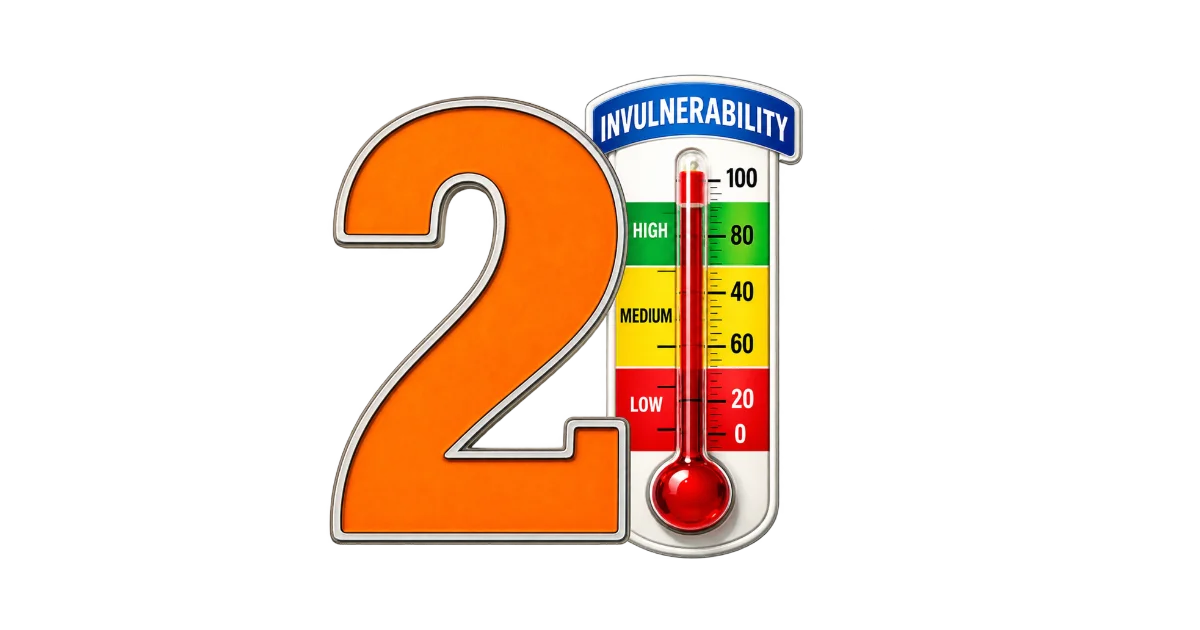
Organisational identity is the second of the eight pillars of the invulnerable company, and probably the most misunderstood. Most leaders think immediately of their purpose, their stated values and their culture as the annual report describes it. That is not what this is about.
| The misunderstanding | The test | The institutionalisation |
|---|---|---|
| Neither a purpose nor a brakeOrganisational identity is not a formula on the office wall, and it is not an obstacle to transformation. It is what an organisation refuses not to be when the hard decisions arrive, and that refusal is precisely what makes deep change possible without dissolution. | It is measured by refusalsA real identity imposes costly renunciations. It guides trade-offs when they collide with immediate performance, it travels beyond the executive team, and it produces decisions that different people would take identically. | The real test comes when the holder leavesAn identity that depends on the presence of a founder or a leader is still a personal vision. Whether it is written into decision mechanisms determines if it survives a succession, an acquisition or a change of shareholder. |
What an organisational identity actually is
Identity in the sense of this pillar is operational rather than communicational. It is measured by the consistency of hard decisions and never by the quality of the speeches, and an organisation can hold a perfectly formulated identity on its website while acting in the opposite direction every day.
The answer to a single question
The identity of an organisation answers a precise question. What would this organisation never sacrifice, even under extreme pressure? What cannot be bought, cannot be negotiated and cannot be reworded to suit the context?
That answer, and the depth at which it is embodied in everyday behaviour, is what defines the real identity. It is built by sedimentation rather than by formulation, through the accumulation of consistent decisions that confirm at every hard trade-off what the organisation truly is.
It is also built by what the organisation refuses: the markets it does not enter, the compromises it does not make, and the opportunities it declines because they do not resemble it.
What identity is not
A strong identity is not rigidity. The organisations most anchored in their identity are often the most capable of radical transformation, because they know what does not change and can therefore change everything else without existential anxiety.
An organisation with a blurred identity cannot transform without losing itself, having no way to know what it must preserve. It hesitates, prevaricates and produces half-transformations that satisfy nobody.
Identity is not a brand promise either, and it is not a privilege reserved for family businesses or luxury houses. Any organisation that has done the work of clarification and written it into its decision mechanisms holds this pillar, whatever its sector and its size.
The two ways to lose your identity
Two opposite trajectories lead to the same result. The first loses identity through progressive fragmentation. The second loses it by confusing the identity with the model that carried it at a given moment. Both end with an organisation that no longer knows what it is.
Sears, dissolution by an accumulation of plans
Sears was founded in 1892 and became at its peak the largest retailer in the world, present in every American town. It filed for bankruptcy in 2018. What is striking in that trajectory is not the violence of the collapse but its length.
The decline played out over three decades, during which the company piled up turnaround plans, strategy changes and reorganisations. Each new plan looked logical in isolation. Together they formed an incoherent accumulation that exhausted the teams without rebuilding what had been lost.
What had been lost was the identity. Sears rested on a precise promise: giving Americans in rural areas access to the same products as city dwellers, at fair prices and with a guarantee of quality. That promise guided the buying, the pricing, the catalogue and the customer relationship.
When demographics, then the big-box stores, then online commerce changed the context, the company never reclarified what it was in that new world. It kept optimising activities without a centre to organise them around.
Tupperware, identity confused with its sales channel
Tupperware illustrates the symmetrical trajectory. Where Sears lost its identity through fragmentation, Tupperware failed to evolve an identity that had become unsuited to its era.
The company had built an extremely strong identity around direct selling between women, the home party model invented in the 1950s. That identity was real, coherent and had generated decades of growth.
It became a prison. When ways of living changed, when women joined the workforce in large numbers and when online commerce transformed distribution, Tupperware could not separate its fundamental identity, the quality of the products and the trust in the brand, from its distribution model of a particular era. Every attempt to modernise the channel ran into the resistance of those who conflated the two.
What a strong identity makes possible, and its limit
The most documented positive case shows what an identity produces when it genuinely filters decisions. It also carries a limit that most analyses leave out, and that limit is precisely the test of this pillar.
Brunello Cucinelli, identity as a decision filter
Brunello Cucinelli was founded in 1978 in the village of Solomeo, in Umbria. The company closed its 2025 financial year at a record turnover of 1.407 billion euros, up 11.5 per cent at constant exchange rates, while several large luxury players were falling on the stock market.
What sets this house apart is neither its product positioning nor its craftsmanship, which others share. It is the coherence of its identity, founded on what its founder calls humanistic capitalism, the conviction that the quality of human work, the beauty of the artisans’ surroundings and economic profitability condition one another.
That identity translates into decisions that are costly in the short term. The workshops close at a fixed time at the end of the day. The company invests in restoring the village. It declines orders that would demand a pace incompatible with its standards, and it completed a plant expansion six months early, begun when nothing forced it.
The question this case leaves open
A reservation has to accompany this reading, and it sits at the heart of the pillar. This identity is entirely embodied by its founder, who still chairs the company and is approaching the end of his operational career. Around a third of the staff live and work in the village that carries the identity.
The succession is under way, and nobody knows today what becomes of that coherence when the person who embodies it leaves the table. Until that test has happened, the case demonstrates that a strong identity produces remarkable decisions. It does not yet demonstrate that the identity is institutionalised.
That distinction separates an identity that works from an identity that holds. It explains why the third stage of identity work, writing it into the mechanisms, is by far the most demanding.
Field note
Ben and Jerry’s, the strongest mechanism ever built, now in court
In 2000 the founders of Ben and Jerry’s sold their company to Unilever. Fearing that the social mission would be the first thing dropped, they negotiated an unusual merger agreement that wrote the mission into the governance and created an independent board charged with defending it, in perpetuity.
The mechanism held for twenty years, then it was tested. In 2024 the independent board sued Unilever, alleging it had been prevented from speaking publicly. In March 2025 the chief executive was removed. In September, one of the two co-founders left after forty-seven years, saying the independence that had underpinned the sale was gone.
In December 2025 Unilever spun its ice cream business into a separate entity, which removed the chair of the independent board and imposed term rules that pushed out two more members. The dispute is now before a United States federal court, and the group’s own foundation was permitted in March 2026 to join it.
A contractual mechanism did not prevent the conflict, it made the conflict possible. Without it, the identity would have been absorbed with no noise and no recourse. An identity written into mechanisms does not guarantee victory, it guarantees there is still someone to fight and something to fight with. That is already the difference between an identity and a declaration.
Measuring the gap between stated and real identity
The identity diagnostic is an exercise most leaders avoid, because it forces them to look at the gap between what the organisation says it is and what it does when the hard decisions arrive. That gap is exactly where the fragility lives.
Four tests to run with your executive team
These four tests can be run in one sitting and give a more reliable picture than any strategy document. Each is answered individually before being discussed collectively, since the divergences between the answers are often more revealing than the answers.
- Ask each member to write down, with no preparation, what the organisation would refuse to sacrifice even under extreme pressure. The convergence measures the real degree of institutionalisation.
- List the five hardest decisions of the last eighteen months and check whether your identity formulation would have predicted each of the choices actually made.
- Identify a significant commercial opportunity declined this year on consistency grounds. If you cannot find one, your identity has not yet cost anyone anything.
- Ask two or three people who joined less than a year ago what identity they inferred from the behaviour they observed, before they absorbed the official story.
What each gap reveals
The gaps are not equivalent and they are not corrected the same way. The table matches each symptom to the work it points to, which stops you treating a diffusion problem as a formulation problem.
| The symptom observed | What it reveals | The priority work |
|---|---|---|
| The executive answers diverge sharply | No institutional identity, only individual opinions | Collective formulation in terms of refusal |
| The answers converge but the decisions contradict them | A declarative identity with no operational translation | Introduce the identity criterion into the trade-off processes |
| No costly refusal to cite over twelve months | An identity that has never been tested | Identify the opportunities that should have been declined |
| The executive knows, the managers do not | A centralised identity, fragile as soon as decisions descend | Public explanation of past strategic refusals |
| New arrivals describe something else | A gap between stated identity and observed behaviour | Align the behaviour rather than rewrite the documents |
Locate this pillar among the other seven
Want to know whether identity is your weak point or whether the problem lies elsewhere? Take the invulnerability diagnostic for your company to get a map of the eight pillars before you commit to a major piece of work.
Institutionalising identity in three stages
Identity work follows a progression that cannot be shortened. Each stage assumes the previous one, and the third is the one most organisations never reach. The order matters more than the speed.
Formulate in terms of refusal rather than values
Formulating identity is not a communication exercise but a strategic clarification. It has to produce an operational compass usable in hard trade-offs, which no list of abstract values ever produces.
An acceptable formulation is a compromise nobody contests. A true formulation is the one each member of the executive team recognises in their daily decisions. The difference between the two is decisive, and it takes several work sessions rather than a single meeting. Reaching a true formulation depends on an executive team willing to contradict each other in the room, which is why the work stalls in organisations that have never built a culture of internal dissent.
Test it in decisions, not in documents
An identity that is formulated but untested stays decorative. The second stage confronts that formulation with the real decisions of the organisation: hires, partnerships declined, markets not addressed and products abandoned.
The gap revealed by that confrontation is valuable. It shows exactly where the construction work remains to be done, and it names the trade-off processes into which the identity criterion has to be introduced explicitly.
Write it into mechanisms rather than into people
The third stage is the most demanding. It makes the identity guide decisions independently of the people in post, which means writing it into the decision processes, the criteria for evaluating projects and the questions asked as a matter of routine in strategic trade-offs.
An identity that depends on the presence of the founder or the current leader is not institutionalised. It will disappear with them, as it disappeared in the organisations that changed leadership six times in ten years without ever formalising what they were.
The concrete mechanisms exist: identity criteria in the appraisal of investment projects, standard questions when recruiting leaders, indicators measuring identity consistency, and an onboarding process that transmits the reasoning rather than the past results. This is the same discipline that runs through long term governance and the mechanisms that protect it.
That last mechanism carries more weight than its administrative appearance suggests. I set out how to design it, stage by stage, in the onboarding process of an invulnerable company.
Which format to start with given your situation
The entry point depends on the stage your organisation is really at. Running a formulation seminar in an organisation that already has a shared formulation it does not apply is solving the wrong problem, and it costs the credibility you will need for the real work.
Three situations, three entry points
The first diagnostic test almost always settles it. If your executive answers diverge, you are at stage one. If they converge but the decisions contradict them, you are at stage two. If everything converges and the identity depends on one person, you are at stage three.
That last situation is the most common in successful companies, and the least often addressed. It only becomes visible at the moment of a succession, an acquisition or an investor coming in, which is to say too late to be corrected calmly.
The signal that should trigger the work
One event turns identity work from desirable into urgent. Any prospect of a change of holder, a founder departing, a family handover, a capital raising or a merger, converts an embodied identity into a dilution risk on a known timetable.
In that case the order reverses. Writing the identity into the mechanisms becomes the priority over refining the formulation, because the timetable no longer belongs to the organisation.
How I can help you work on this pillar
Identity work often produces the most uncomfortable moment of an architectural effort, because it makes visible a gap everyone sensed without naming. Three formats correspond to the three stages, and I run them the same way whether the room is in Sydney or on a screen.
An identity clarification seminar
The seminar produces, in one structured working day, a collective formulation of what your organisation refuses not to be, tested against real past decisions, with the gaps identified. This is strategic work rather than a team building exercise, and it produces a compass you can use immediately.
A keynote on identity as a competitive advantage
The keynote is for organisations that want to put this question beyond the executive team alone. It draws on recent, documented cases, runs for two hours, and prompts the conversations organisations avoid because they seem too abstract.
The content sits on the page for the keynote on the invulnerable company.
An institutionalisation program
The program is for organisations that already have an identity formulation and find that it does not yet guide decisions. Three to six months to write the identity into the concrete mechanisms of decision, project appraisal and recruitment.
If you want to talk through what this would look like inside your organisation, book a conversation with me directly.
Conclusion
Crises do not create confusion in organisations, they reveal the confusion that was already there. An organisation that does not know what it fundamentally is takes contradictory decisions while conditions are calm, and catastrophic ones in a crisis, for want of a compass to arbitrate between options that all look plausible.
Patagonia transferred its ownership to a structure dedicated to fighting climate change without anyone inside being surprised. LEGO abandoned half of its activities without losing the thread. Those decisions look opposite and they have the same source, an identity clear enough to make obvious what had to be done. Giving up an activity while it still performs takes a mechanism of its own, and that is the subject of building a culture that can unlearn.
An organisational identity does not protect you from disruption. It gives you the capacity to move through it without losing the sense of what you are building.
The final test of an organisational identity happens neither during a crisis nor during a transformation. It happens the day the person who embodied it is no longer there.
Frequently asked questions about organisational identity
What is the difference between organisational identity and purpose?
Purpose states an ambition, organisational identity states a limit. It answers what the organisation refuses not to be, which produces concrete refusals. A purpose that imposes no renunciation stays an intention rather than an identity.
Does a strong identity prevent transformation?
The opposite. An organisation that knows what does not change can change everything else without existential anxiety. Those with a blurred identity produce half-transformations, because they do not know what they must preserve.
How do we know if our identity is real or declarative?
Name a significant commercial opportunity declined in the last twelve months on consistency grounds. If you cannot find one, your identity has never cost anyone anything and has therefore never been tested.
Does a legal agreement protect identity after an acquisition?
It does not guarantee it, it makes the defence possible. A contractual mechanism gives you a recourse and a legitimate counterparty, where a mere statement of values disappears without a sound. Design it as a conflict tool, not as insurance.
What do you do when the identity rests entirely on the founder?
Reverse the order of the work. Writing the identity into the decision mechanisms becomes the priority over refining the formulation, because the timetable is set by the succession rather than by the organisation.