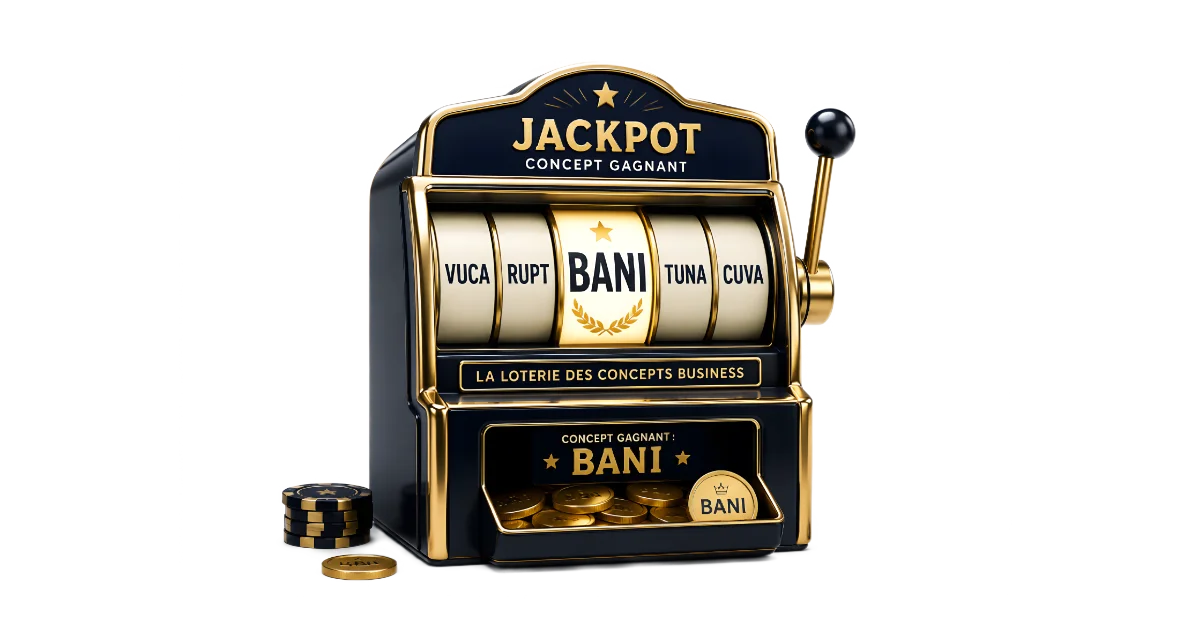
Why do some business concepts go viral while sharper ideas die in the archives of the people who coined them? A model that looks almost simplistic spreads through boardrooms and business media, and a more rigorous rival, no better and no worse, is never picked up at all.
The winners are rarely the best thought out. Quiet quitting swept the world while act your wage, which describes the same behaviour with more precision, stayed in a few niche corners. The freed company filled conference halls in its day while holacracy, the more rigorous method, stayed confidential. Among the many acronyms coined to describe an unstable world, one caught on while a dozen equally defensible ones vanished.
This is a lottery rather than a meritocracy. Four forces decide the draw, and none of them is the quality of the idea: emotional timing, phonetics, a commercial relay, and the authority of whoever carries the concept. These four variables decide whether a word slips into a leadership team conversation or dies quietly on a blog.
Getting this mechanic wrong costs you twice.
You adopt the concept of the moment because everyone repeats it, without checking whether it matches what you see on the ground.
or …
You ignore a real signal because it has not yet found its viral packaging, and your competitors name the trend six months ahead of you.
| The puzzle | What actually decides | The Chaminade angle |
|---|---|---|
| The questionWhy business concepts go viral while equally interesting rivals vanish is the puzzle this article answers. Quiet quitting outruns the sharper act your wage, and among a crowd of uncertainty acronyms only one ever catches on. | The four forcesAdoption turns on four things: a timing that meets a shared pain, a name that sits easily in the mouth, a commercial relay of consultants and speakers who need something new to sell, and the moral authority of a visionary over the technical authority of a researcher. | The second lotteryMerit does not decide, and virality is not the only prize. A concept can lose the popularity lottery and still win a second one, the lottery of the lever, by entering the law and the way work is measured. |
The crowded family of uncertainty acronyms
Before you can see why BANI won, you have to measure the field it beat. The family of acronyms that claim to describe an unstable world has more members than a royal household, and most of them never left the paper that introduced them.
VUCA, the military grandfather turned business star
VUCA stands for volatile, uncertain, complex and ambiguous. It came out of the US Army War College in the late 1980s to describe the post Cold War world, drawing on the leadership work of Warren Bennis and Burt Nanus. After 2001, consultants adopted it wholesale.
A generation later it is still taught in every business school, the default label for sounding sharp about global complexity. Its strength was never precision. It arrived when the world stopped sitting still and the military needed language for that, and it stuck because it was first. I have looked at the head to head between the two acronyms elsewhere, in VUCA or BANI.
The cohort of forgotten challengers
Around VUCA, a swarm of acronyms tried to take the throne and failed. Each was defensible on paper. None found the combination of timing, sound and relay that turns a term into a mode. The graveyard is instructive.
- TUNA, for turbulent, uncertain, novel and ambiguous, from an Oxford executive education programme in 2016.
- RUPT, for rapid, unpredictable, paradoxical and tangled, from the Center for Creative Leadership.
- CUVA, a simple permutation that never travelled.
- VUCAD, which adds a D for diversity or disruption depending on the author, and carries one letter too many.
- VUCA Prime, the positive flip proposed by Bob Johansen in 2007 as vision, understanding, clarity and adaptability.
BANI, the challenger that took the prize
BANI stands for brittle, anxious, non-linear and incomprehensible. The futurist Jamais Cascio set it out in his 2020 essay Facing the Age of Chaos, though he had been watching the signals for years before. Within a few years it appeared in more decks than the other acronyms combined.
BANI reached Australia too. The Australian HR Institute, the country’s peak HR body, framed a recent state conference around BANI conditions, where ethical risk, cultural fragility, regulatory pressure and AI driven disruption collide. That is adoption at the level of the conference circuit, not the statute book, a distinction I come back to below.
The hidden equation of why business concepts go viral
Why business concepts go viral comes down to four forces working together, and none of them is analytical quality. A concept spreads when it meets a shared pain, when it sits easily in the mouth, when sellers of novelty carry it, and when a visionary rather than a researcher signs it.
Emotional timing, or how a shared pain lights the fuse
A concept spreads because it meets a pain that is already present but not yet named, and correctness has surprisingly little to do with it. BANI was built before 2020 and landed as the whole planet felt, in its body, the fragility and anxiety the acronym described.
The pandemic revealed the need for BANI to a mainstream audience rather than creating it. The word anxious carries a different public charge in a health crisis than it did two years earlier, even though the thing itself already existed. RUPT, published in the same period, speaks of paradox and tangled complexity, which sounds intelligent and moves no one.
Phonetics and mouthfeel as a distribution weapon
BANI can be said out loud. It lands like a name. RUPT stays angular, TUNA is a fish, CUVA means nothing, VUCAD has a syllable too many. The concepts that survive share a physical property: they sit easily in the mouth.
This sounds trivial and decides everything. The clearest proof I know is Australian. Atlassian, the Sydney software company, ran internal innovation days it first called FedEx Days, because teams had to deliver something overnight. When a trademark problem forced a rename, the company chose ShipIt Day and said openly that it captured the same spirit in the same number of syllables. The sound was engineered rather than stumbled upon, and the practice spread worldwide through Daniel Pink’s book Drive.
The consultant relay and the hunger for novelty
Consultants, trainers and speakers live on an economy of novelty. A firm that sold leading in a VUCA world for a decade needs a fresh label to sell the same content to the same clients. BANI, arriving at the right moment, became that product.
Richard Pascale mapped this in his 1990 book Managing on the Edge, showing how each generation of consultants reframes the previous concepts to justify its own existence. This is a programmed obsolescence of concepts, a theme I develop in my keynote on professional obsolescence. In Australia the same engine runs, and the conference and learning circuit needs new concepts each season, which is why a body like the Australian HR Institute reaches for BANI rather than a decade old frame. I track where that circuit is heading in my analysis of conference trends and where events are heading.
Why business concepts go viral on moral authority over technical rigour
Business concepts go viral on the authority of a visionary more often than the rigour of a researcher. Cascio is an anthropologist and futurist with the aura of a poetic seer. The researchers behind RUPT have solid bibliographies. Between 2020 and today, the business audience prefers the seer.
BANI speaks of human fragility and anxiety, two words that resonate with the wellbeing conversation. RUPT speaks of leaders facing paradoxical relationships, which assumes an initiated reader. One names what people feel, the other explains how executives should react.
When this analysis first went out, Cascio wrote to me directly. He told me he had not built BANI to feed business journals or consultant decks, but because he needed better language for what he was seeing, and it turned out he was not alone in that need. He also confirmed something that sharpens my own thesis, that he worked the sound of the acronym on purpose so it would carry cleanly when he first presented it. The mechanic of virality can run on top of an act that was entirely sincere.
Field note
The leadership team that put BANI on every slide
A while ago I ran a strategy offsite for the executive team of an Australian services firm that had just rebuilt its whole internal story around BANI. Every deck opened with the four letters, and the language of brittleness and anxiety was everywhere.
When I asked what any manager was supposed to do differently on the Monday, the room went quiet. BANI named the anxiety in the building with real accuracy, and it handed no one a lever. The team had bought a feeling and mistaken it for a plan. We spent the afternoon replacing the acronym with three measurable commitments on workload, decision rights and psychological safety.
The test for any concept is simple. A frame that only names what you feel will comfort a leadership team and change nothing, so ask what it lets you measure and act on before you print it on a slide.
Australian cases that prove the rule
The BANI story is not an isolated case. Recent Australian and global examples follow the same mechanic, and one of them flips it. The sharper term loses the popularity contest, and the winner is the one that catches fire, until you meet a concept that won a completely different game.
Quiet quitting versus act your wage, formula beats precision
In 2022 two terms described the same behaviour. Act your wage was the more precise, since it means calibrating effort to pay rather than leaving. Quiet quitting went viral instead, because the phrase is paradoxical, it hints at a silent betrayal that worries employers, and it landed at the peak of post pandemic burnout.
The winning concept is the most flammable one, and accuracy barely enters into it. Australian workplaces ran the same debate, with the same result, and act your wage stayed in the footnotes while quiet quitting reached the board.
Psychosocial safety climate, the concept that won without going viral
Psychosocial safety climate, or PSC, is the shared perception of how seriously an organisation protects the psychological health of its people. It was defined by Professor Maureen Dollard and colleagues at the University of South Australia and set out in a 2010 model with Arnold Bakker. It is genuinely Australian, and it is unpronounceable.
By every rule in this article, PSC should have died like RUPT. Three technical words, no image, no emotional hook, no pandemic window. It won anyway, through a different door. PSC and the wider psychosocial risk agenda now sit under Australian work health and safety regulation, which has moved the country to the front of the field on psychosocial hazards. The concept that names a feeling won the stage. The concept that imposes a duty won the law.
The right to disconnect, a concept Australia amplified but did not coin
The right to disconnect lets staff refuse to monitor work contact outside hours without penalty. The idea is French and European in origin. Australia did not invent it, and Australia gave it teeth, writing it into the Fair Work Act and turning it into a global talking point.
This is the pattern worth naming. Australia is a net importer of viral business concepts, and VUCA, BANI and quiet quitting all arrived from elsewhere. The country’s own contributions tend to win by other routes, either a practice exported quietly like ShipIt, or a frame that colonises the statute book like psychosocial safety. For an Australian reader that is a more useful story than hunting for a homegrown BANI that does not exist.
How to judge a business concept before you adopt it
Before you build a programme on the concept of the season, weigh it against your own criteria rather than its share of voice. The question is not whether a term is popular. The question is whether it gives your managers a lever, rests on evidence, and will still be useful after the next cycle.
The four signals that separate a fad from a durable frame
Four signals tell a passing fad from a frame worth adopting. Run any new concept through them before it reaches your slides, and most of the noise falls away on its own.
- Lever over label. Does it tell your managers what to do differently, or only give them a word for how they feel?
- Carrier and motive. Who pushes it, a seller of novelty who needs a new product, or a body that has to write a rule?
- Evidence over resonance. Is there measurement behind it, or only the fact that it sounds true?
- Survival. Does it outlast the news cycle that launched it, or vanish with it?
BANI, VUCA or psychosocial safety, which serves which decision
Each concept is a product aimed at a different decision. VUCA suits leaders who must act under uncertainty, BANI suits those addressing anxiety and wellbeing, and psychosocial safety suits organisations facing a compliance duty. Matching the concept to the decision matters more than picking the newest one.
| Concept | What it gives you | Best used for | Weak spot |
|---|---|---|---|
| VUCA | An operational grid for volatility and ambiguity | Acting and deciding under uncertainty | Feels dated, offers no emotional read |
| BANI | A shared language for fragility and anxiety | Naming a felt crisis, opening a wellbeing conversation | Describes a feeling, hands you no lever |
| Psychosocial safety climate | A measurable duty of care | Compliance, risk and workload design | Unmemorable, needs specialist framing |
Tell the signal from the noise
Want a repeatable way to sort a durable trend from a passing fad? Use my five levels of trends to place any new concept before you invest a dollar or a training day in it.
What the concept lottery reveals about the market for ideas
It is tempting to dismiss all this as surface, and to say real managers should focus on their teams rather than acronyms. That misses the lesson. The concepts a market adopts reveal how it sees itself, and choosing one is a strategic act.
Concepts reveal our gaze more than the world
The acronyms we adopt say more about us than about the world they claim to describe. Putting anxious inside BANI marks a shift. We stopped describing the economic context and started describing the psychological state of the manager living through it. That shift belongs to a wider frame I call the age of fragility, whose fourth characteristic I set out in extreme paradoxes and the fragility of our experience.
That subjective turn is revealing and worth questioning. A Western centred frame that leads with anxiety and the incomprehensible may not read the same from Jakarta, Mumbai or Sao Paulo. The world does not experience one uniform chaos, and a concept that assumes it does tells you where it was written. The accelerating rotation of these labels is exactly what I track in my map of management fads.
Choosing a concept is a strategic act, not an analytical one
When you build training on BANI rather than VUCA, you are choosing a commercial posture as much as an analytical grid. BANI speaks to HR leaders addressing anxiety. VUCA speaks to strategy teams deciding under uncertainty. Psychosocial safety speaks to the work health and safety function.
Each concept is positioned on a segment, and the rotation between them is the raw material of the consulting and speaking market. The pace of replacement has accelerated from a decade to a couple of years, which is a feature rather than a fault. Without it there would be nothing new to sell.
How I can help you decode business concepts before they become fads
My work as a speaker and trend analyst is to separate the signal from the noise. Instead of selling you the concept of the moment, I give you a way to read the market yourself, so you adopt what fits your organisation rather than the latest post in your feed.
The trend decoding keynote
My keynotes do more than present the newest acronym. They hand your leaders a grid to judge the maturity of a trend, tell a passing fad from a structural signal, and pick the concepts that fit your culture. The approach draws on fifteen years of watching trends across Australia, France and the United States. If you are weighing names for that slot, my guide on how to choose a keynote speaker sets out the criteria worth using.
The concept audit for your organisation
Many organisations run on a jumble of borrowed concepts, with some agile here, a dose of the freed company there, quiet quitting to fight and BANI to understand. I audit the concepts already circulating in your internal story, surface their contradictions, and propose one coherent narrative your people can actually follow. The work runs across a few sessions with your leadership team and your HR function.
Bespoke managerial design workshops
Once you understand the lottery, you have two options, to import concepts or to build your own. My managerial design workshops help leadership teams formalise their own frame, with the vocabulary, tools and measures that fit them. It is harder than adopting an acronym, and it produces a durable advantage.
Conclusion: read the lottery before you buy the next concept
The way one concept catches on while equally interesting rivals only pass through is never an accident. It is the product of a precise equation, made of emotional timing, a memorable sound, a strong commercial relay, and moral authority over technical rigour. Understanding why business concepts go viral protects you from two traps, treating the next acronym in your feed as gospel, and assuming that popularity tracks quality. It does not. BANI is neither better nor worse than its rivals, it simply won the lottery, and reading why business concepts go viral is what lets you spot the next winning number before everyone else.
Frequently asked questions about why business concepts go viral
Is BANI actually used in Australia?
Yes, though mostly at the conference and consulting level rather than in legislation. The Australian HR Institute has framed events around BANI conditions, while government and mainstream business coverage still lean on VUCA. In Australia, BANI reads as a speaker’s framing more than an institutional standard.
What decides why business concepts go viral?
Four forces working together decide it: a timing that meets a shared pain, a name that is easy to say, a commercial relay of consultants who need something new to sell, and the authority of a visionary over a researcher. Analytical quality is rarely one of them.
Is a viral concept better than a less known one?
Not necessarily. Virality tracks emotional resonance and packaging, not accuracy. Psychosocial safety climate, an Australian concept most people cannot pronounce, shapes national regulation while catchier terms fade, which shows that popularity and usefulness are different prizes.
How do I stop chasing every new management fad?
Judge each concept against your own criteria before adopting it. Ask whether it gives managers a lever, who benefits from promoting it, whether evidence backs it, and whether it will outlast the news cycle. Most fads fail at least one of those tests.