Why circles to talk about managerial transformation, management innovation. A circle has no beginning and no fixed hierarchy, and it forces you to think in terms of a journey rather than an organisational chart. Managerial transformation cannot be decreed from the top down. It is built step by step, by connecting notions too often presented to us in isolation, at the mercy of passing fads.

For twenty-five years, I have watched the same words parade through management conferences and books: empowerment, trust, freedom, collaboration, accountability and curiosity. Each one arrives as the miracle solution of the year, then gives way to the next. The terms themselves are all sound. The problem lies in the way they get stacked up without anyone ever showing how they connect or in what order to activate them.
The operational manager ends up with a seductive vocabulary and no instructions for use. This is precisely what these circles set out to correct: giving a readable direction to a managerial transformation that would otherwise look like a collection of good intentions. The table below lays out that direction at a glance, before the article walks through it circle by circle.
We have been talking about this for a long time, and talking is no longer enough. The operational manager must move beyond a supervisory role and take an active part in this managerial transformation, to help team members face the procession of constraints, worries, hopes and self-questioning that comes with it. That is before even mentioning the 7 management crises they must resolve in parallel.
Management is inheriting new responsibilities. They now come from the technological, social and economic environment rather than from the trade or from company leadership. So what can be done to guide managers in the right direction, if such a direction exists, to make sense of a world that has become unreadable, and to contribute to the company’s transformations while supporting their teams? The answer takes the form of a journey rather than a recipe.
| The inherited reflex | What it really produces | The circle that transforms |
|---|---|---|
| Command and controlManagerial transformation begins with naming the reflexes inherited from the industrial era: keeping up the pace, planning, checking compliance and segmenting work. Those reflexes reassured yesterday, yet they ignore today’s needs for autonomy and accountability and the place of emotion at work. | Mass disengagementOnly a small minority of employees worldwide report being engaged at work, and most of the variation in a team’s engagement traces back to its manager. Disengagement signals an outdated managerial operating system rather than a failure of individual motivation. | The 6 circles, in orderBenjamin Chaminade’s managerial transformation chains six circles, from trust to creativity, each one making the next possible. Innovation cannot be decreed; it arrives as the result of the journey. Giving a direction rather than a method, and starting by repairing trust, transforms practices durably. |
Understanding your inheritance before starting your managerial transformation
Before building, you need to know what you are standing on. This first step consists of questioning managerial fundamentals and confronting managers and executives with the contradictions of practices largely inherited from the world before. It looks obvious, and yet I see it skipped in almost every engagement where I am asked to move fast.
At this stage, it is also useful to step back and look at the map of management fads 2000 to 2026 that have swept through organisations over the past twenty-five years, to distinguish those that left a lasting mark from those that simply consumed energy.
The four roles inherited from industrial management
Most of our supervisory reflexes answered a precise problem, such as assessing performance, correcting behaviour or managing lateness, but they have become sources of problems themselves: frustration, disappointment and infantilisation. They ignore the needs for autonomy and accountability and the place of emotion in the workplace. The manager’s role has moved beyond commanding, planning, controlling and segmenting.
- Command: in a production logic, the head of operations keeps up the pace, pushes to lift volume, restates the rules and enforces discipline, on the hierarchical model of the army.
- Plan: nothing must surprise production or prevent quotas from being met. Following Deming’s PDCA wheel, you plan before you do, then check and adjust.
- Control: the quest for zero defects is pursued through minute control of compliance levels, entrusted to whoever holds a higher qualification or has risen through the ranks and been rewarded for results.
- Segment: the division of labour prevents cross-functional collaboration and reinforces the boss’s influence, with everyone staying at their station so as not to disturb the organisation.
To hold these four roles, the boss must lead by example and prove rigorous and accountable for their own actions and their team’s. No room is left for authenticity, emotion or autonomy. This model produced compliance and never produced engagement.
Why these inherited reflexes block managerial transformation
The trouble with these reflexes lies in the world they answer to, a world that no longer exists, rather than in any malice. Keeping up the pace and controlling compliance made sense in a mass production logic. Today, those same practices generate frustration, disappointment and infantilisation, because they ignore the needs for autonomy and the place of emotion at work.
The result is measurable. When only 20% of employees worldwide report being engaged at work according to Gallup, and even Australia and New Zealand, among the strongest regions on record, still leaves more than three quarters of team members disengaged, the problem reveals an outdated managerial operating system rather than a failure of individual motivation. Identifying these inherited reflexes is the precondition for any managerial transformation, because you only replace well what you have first named.
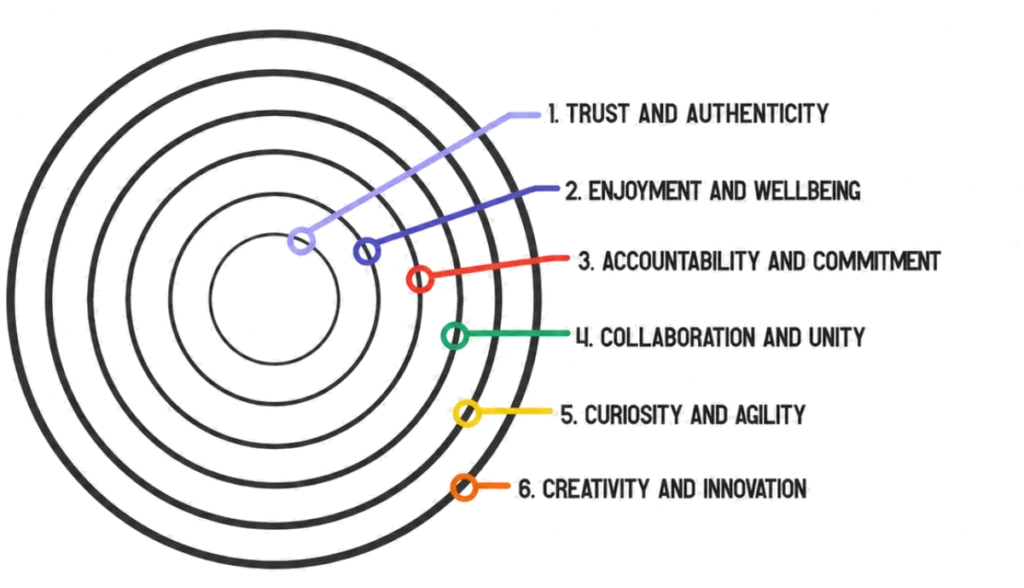
The 6 circles of managerial transformation
Here we are at the heart of the matter. This second step is markedly more demanding. It involves guiding managers step by step towards updating some of their practices, a movement popularised under the name of management innovation. This managerial transformation gives a direction rather than a method, and helps anyone with supervisory responsibilities to progress.
It never forgets that we now live in a world of AND, where contradictory realities coexist. Unemployment and talent shortages cohabit. A team member can be delighted with their work experience and actively looking for another job. We want work-life balance and fascinating work. We expect meaning without always knowing which one. We want to be autonomous and reassured about our future by our leaders.
These circles offer a journey that chains together, step by step, the managerial notions presented to us year after year as trends: empowerment in 1998, trust in 2010, freedom in 2013, collaboration in 2016, accountability in 2017 and curiosity in 2019. These 6 circles of managerial transformation follow one another in a precise order: trust first, as the foundation, ending with innovation, which is only its result.
Trust, the starting point of managerial transformation
Trust is the cornerstone of any managerial transformation. Without it, none of the following steps can thrive. At the managerial level, it is built on several concrete pillars, observable in daily work.
- Reliance: the ability to count on someone dependable who keeps their promises.
- Professional credibility: the manager knows what they are doing and demonstrates both competence and the capacity to decide.
- Self-discipline: applying to yourself what you ask of others.
- Empathy: understanding the other person’s point of view.
- Authenticity: staying consistent with yourself without playing a role.
Wellbeing, the balance between appetites and skills
Wellbeing is the search for the best possible balance between what a team member wants to do, their appetites, and what they can do, their skills, rather than a pursuit of happiness. It brings into play working conditions, the pleasure taken in holding the job, the right to make mistakes and the mutual support within the team.
- Humility: accepting that you do not know everything and are not omniscient.
- Empathy: understanding the real situation of your team members.
- Friendly relationships: fostering a healthy working climate between colleagues.
Engagement, the voluntary decision to invest over time
Engagement is one of the great HR issues of the moment, and for good reason. It is the informed and voluntary decision to commit your mind and your efforts to a company, a project or a job over time. When you know that 70% of the variance in a team’s engagement depends directly on its manager, you understand that this circle plays out first in the leader’s posture. Engagement rests on several levers.
- Activation: refusing to put obstacles in team members’ way.
- Transparency: sharing key information to strengthen involvement.
- Reciprocity and fairness: guaranteeing fair, consistent treatment.
- Accountability: letting each person take ownership of their job, their workspace, their training and their mistakes.
Field note
Repairing trust before decreeing engagement
During an engagement with an industrial company of around three hundred people, leadership had called me in for what they described as an engagement problem. Internal surveys were in the red, turnover was climbing, and the reflex response had been to launch a grand purpose program complete with values workshops.
Two days in the field told a different story. Frontline managers, themselves exhausted and never trained, could no longer keep their promises for lack of room to move. The company was trying to build a circle of engagement on a foundation of trust that did not exist. Team members were withdrawing from a managerial chain that no longer protected them, well before withdrawing from the work itself.
We took everything back in the order of the circles, starting by restoring managers’ credibility and right to make mistakes before talking about meaning. The lesson is simple and I repeat it in every workshop: engagement cannot be decreed, it becomes possible once trust is repaired first. Skipping that step guarantees the failure of the next plan.
Collaboration, co-building rather than working side by side
Alongside engagement, collaboration is the central issue of this managerial update. Collaborating in a group sometimes requires rebuilding the bond to share a common vision and common ideas, to put the collective interest first and to let everyone have their say. It rests on respect for others, complementarity and the pooling of contributions, whether ideas or skills.
- Rebuild the bond: restore trust between teams.
- Encourage interactivity: allow everyone to speak up.
- Promote pooling: draw on each person’s skills.
Curiosity, the managerial antidote to automation
A newcomer on the managerial scene, curiosity is becoming a vital subject in a world of work under threat from automation. It is the desire to live new experiences, acquire new knowledge and explore new territories. It is linked to agility, which connects distant ideas while supporting the company’s continuous adaptation to a changing environment.
- Agility: connecting different ideas and adapting your reasoning.
- Openness: actively seeking new perspectives outside.
- Exploration: moving past your certainties to understand an ambiguous situation.
Creativity, the outcome of the journey and the source of innovation
Flowing directly from curiosity and agility, creativity is the ferment of innovation. It is the act of producing new ideas within an imposed frame and along a given direction. This mental process moves through several phases, which themselves lean on the previous circles.
- Inspiration: widening your field of vision, linked to curiosity.
- Inception: crossing ideas and experiences, linked to collaboration.
- Ideation: structuring and modelling your ideas.
By thinking through each piece of this puzzle, you will ask yourself the right questions to lead your managerial transformation with your team at your side rather than against you.
How I can help you master your managerial transformation
Supporting a managerial transformation cannot be done from a stage. I design programs that start from your real practices and from the order of the circles, to avoid the trap of a values plan resting on absent trust.
A keynote and workshops, circle after circle
To make concrete progress, I offer an interactive keynote and dedicated workshops that take your managers through the circles one by one, from a trust diagnostic to management innovation. Each session starts from cases lived in your teams rather than from theoretical models.
A diagnostic to map your practices
Before you build a roadmap, it helps to know where you currently stand. I use the managerial transformation diagnostic to score each circle with your managers and surface the ones that are holding the rest back.
Map where your management gets stuck
Want to go further and pinpoint exactly where your leadership chain is blocking? Explore the complete 6 circles of managerial transformation tool to map your practices and build your roadmap, step by step.
Conclusion
A successful managerial transformation puts the buzzwords back in the right order instead of collecting them. Trust first, then wellbeing, engagement, collaboration, curiosity and finally creativity, from which innovation is born. Each circle makes the next one possible, and none of them holds if the previous one is neglected.
At a time when only 20% of employees worldwide report being engaged, the real question has shifted from whether to transform your management to which circle to start with. And the answer, invariably, remains trust: that is where any managerial transformation is won or lost.
Frequently asked questions about managerial transformation
What is the difference between managerial transformation and management innovation?
Managerial transformation describes the overall journey that evolves supervisory practices, while management innovation is its end point. Innovation arrives as the result of a path that begins with restoring trust, and no organisation can decree it as a starting point.
How long does a managerial transformation take?
No standard duration exists, because a managerial transformation follows the rhythm of the teams and the depth of the practices to be changed. Experience shows it pays to think in terms of a continuous journey rather than a dated project, as each circle needs consolidating before moving to the next.
Why start with trust rather than engagement?
Engagement rests entirely on prior trust between the manager and the team. Trying to stimulate engagement without that foundation amounts to asking team members to invest themselves in a managerial chain that does not keep its promises, which produces the opposite effect.
What role does the frontline manager play in managerial transformation?
The frontline manager is the pivot of any managerial transformation, since according to Gallup about 70% of the variance in a team’s engagement depends on them. No strategic plan compensates for frontline leaders who are poorly trained or stripped of room to move.