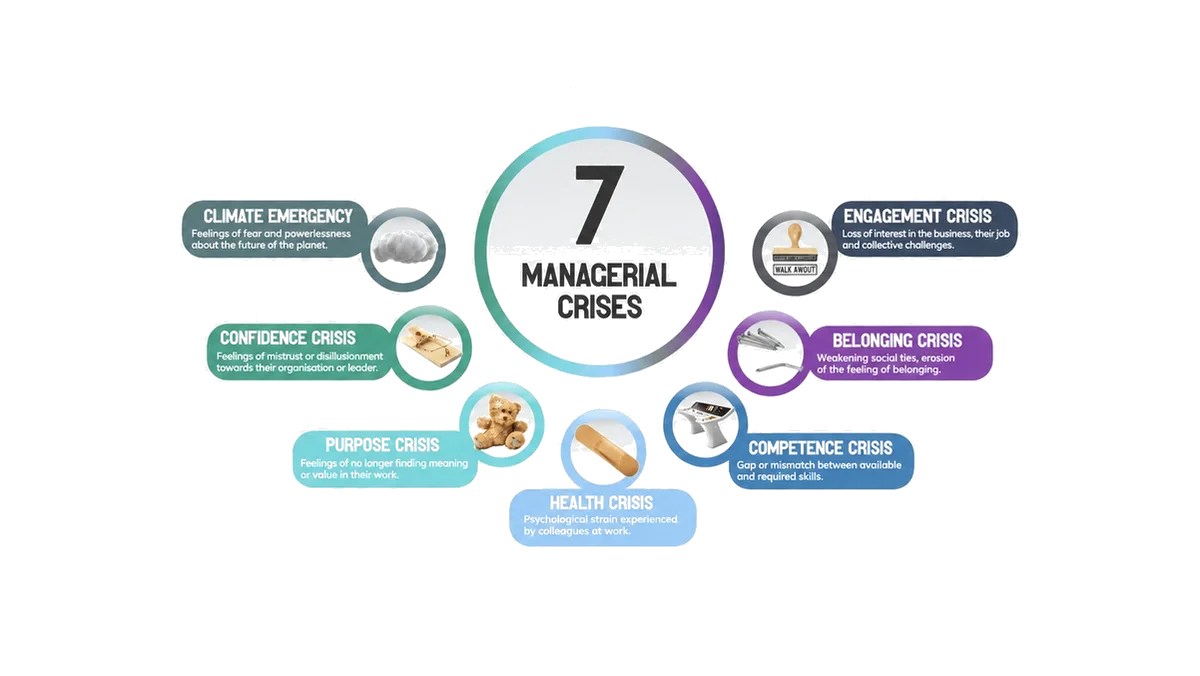
These management crises gather several crises that managers and executives must answer. These management crises are anything but new! And yet I have still seen no training, no workshop and no keynote designed to prepare managers to bring constructed, structured answers to them.
And these crises did not spring out of nowhere! You already know every one of them. But here is the thing: you have probably never connected them to one another, you have no time to respond to them, or you treat them as events beyond your reach.
That is exactly what I thought too, until, while preparing a keynote, I realised that all these crises are connected and sit at the foundation of the fragility I have spent years putting words and figures on, starting with my work decoding the VUCA acronym.
That work led me onto the path of sustainability and regeneration, the unavoidable conclusion for any company that wants to stay attractive to its candidates and its customers. Especially since they are sometimes the same people.
To change from the usual grand ecological framings about the state of the planet, the climate losing its bearings, the economy drifting and resources running thin, I suggest a more micro approach, wired directly into management.
I suggest you ask what this fragility means at your level, as a human being hooked on sugar, screens and a monthly salary. Because yes, the world is fragile, we have understood that much, and the story does not stop there!
This fragility also concerns our individual lives, our companies, our careers, our jobs, our marriages and our skills.
| One chain, seven links | What it produces | The way through |
|---|---|---|
| Causally connectedThe 7 management crises form a single causal chain: climate, trust, meaning, psychological health, skills, social connection and engagement. Each crisis feeds the next, which explains why treating them one at a time keeps failing. | Disengagement as final bossDisengagement arrives last, at the end of the sequence. Organisations that respond with isolated programs treat the symptom while the chain keeps producing anxiety, mistrust, exhaustion and skill gaps upstream. | A holistic, regenerative responseBenjamin Chaminade reads these crises as one system rooted in the age of fragility, his own frame that absorbs VUCA. Taken in causal order, with a holistic and regenerative approach, the chain becomes a transformation roadmap rather than a list of threats. |
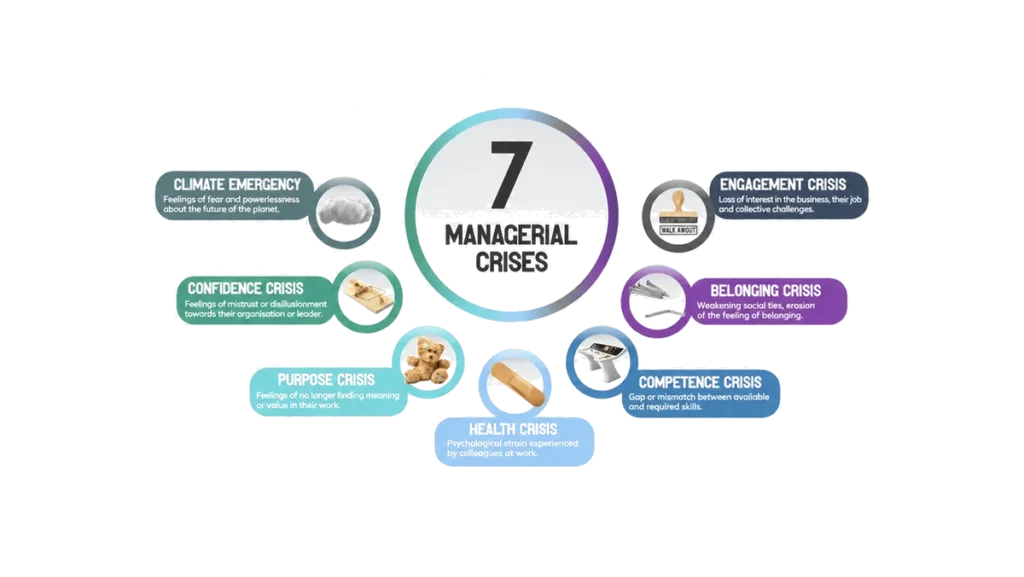
So here are the 7 management crises, presented in an order of causality, each detailed in as many other articles on this blog that treat every crisis and shortage in depth, one after the other. To respond to them, you will then want to visit the article that offers answers to the management crises.
- Climate and environmental crisis
→ It creates a context of uncertainty and anxiety that can lead to the… - Trust crisis
→ The lack of trust in institutions and companies to handle this challenge can lead to a… - Meaning crisis
→ The loss of bearings and the questioning of whether actions still matter against environmental challenges can bring on a… - Psychological health crisis
→ The stress and anxiety tied to these changes and to the search for meaning can affect mental health, which can trigger a… - Skills crisis
→ Rapid change and new demands can open a gap between the skills available and the skills needed, which can deepen the… - Social connection crisis (reliance)
→ The difficulty of adapting and finding one’s place in this new context can strain social relationships, leading finally to the… - Engagement crisis
→ The accumulation of all these factors can end in a general loss of motivation and involvement. The final boss of the level, if you like.
This chain shows how all these crises are interconnected and mutually reinforcing. It also underlines the importance of a holistic* approach for companies, which must take all of these challenges into account in their transformation strategy and their leadership.
* Holistic management? Yes, it exists. Is it the management of tomorrow? To be continued.

The climate emergency, first link in the chain
Everything starts with the context. The climate crisis acts like a sky clouding over when you had planned a quiet walk. The wind picks up, and the way everything else organises itself changes. Teams feel it right down to their informal conversations, even when the subject is never named.
The scientific record leaves no room for doubt. The IPCC’s sixth assessment report confirms that global warming has already passed 1.1 degrees Celsius above the pre-industrial era, and that the effects are accelerating. For an organisation, this reality has moved well past regulatory compliance. It touches fundamental questions: the company’s responsibility towards its environment, its role in the transition, the adaptation of its business model and its capacity to innovate without destroying.
Why climate is a management subject and no longer just an ESG one
Climate too often gets filed in the ESG drawer, far from daily management. That framing has become an error. Climate disruption has become a management subject because it changes what team members expect from their work and their leadership. A growing share of staff judge their employer on its environmental consistency, and that consistency has become a criterion of attractiveness on par with salary. The candidate and the customer are often the same person, which makes inconsistency doubly costly.
At the manager’s level, climate translates into concrete decisions: should this trip go ahead, how to arbitrate between a fast solution and a sober one, how to answer a team member who questions the ecological point of their assignment. These micro trade-offs, repeated a thousand times, draw an organisation’s real environmental credibility far more than the annual sustainability report does.

Towards sustainable management?
The management of tomorrow will need to be resolutely turned towards sustainability and regeneration, combining economic performance with environmental responsibility. In practice, this involves several concrete shifts I observe in organisations that take the subject seriously:
- Integrating environmental criteria into decision making at every level, and no longer only at the top.
- Carbon reduction targets that commit operational teams, and no longer only the sustainability department.
- Building environmental skills internally, to stop depending entirely on external providers.
- Encouraging eco-innovation and circular economy thinking in everyday processes.
- Transparency about real performance, including when it disappoints.
Field note
Where environmental ambition actually lives
I ran a workshop on this very terrain with the teams at Suez. The engagement had a particularity: nobody in the room needed convincing that the subject mattered. The environmental ambition was written, funded and publicly committed.
The blockage sat somewhere else entirely. The question that filled the workshop was how to translate that ambition into managerial decisions tenable in daily work: which trip to cancel, which deadline to trade against a lower-impact option, what to answer a team member challenging the point of a project. The strategy was clear; the ordinary trade-off was where it wobbled.
The lesson has followed me into every engagement since: an organisation’s environmental credibility gets decided in the ordinary arbitration, never in the speech. A manager equipped to make one sober trade-off per week does more for that credibility than another commitment slide.
Rethinking business models and management practices
Management does not carry this alone. Faced with the climate and environmental crisis, companies must deeply rethink their business models and their practices to align with the imperatives of sustainability.
This can include:
- Adopting clean technologies and renewable energy sources. See my workshop with Suez on this subject.
- Redesigning supply chains to reduce their environmental impact.
- Developing eco-designed, low-carbon products and services.
- Entering partnerships to accelerate the ecological transition.
- Setting up carbon offset and ecosystem restoration programs.
The evidence is plain: the companies that manage to respond effectively to the climate and environmental crisis will do more than clear a hurdle. They will position themselves as leaders in a world where sustainability has become an economic and societal imperative.
Eco-responsible management, one of the practices of regenerative management, has stopped being an option and become a necessity for building organisations that stay resilient, innovative and high performing over the long term.
By making sustainability a strategic priority, these companies will do more than survive. They will create a durable competitive advantage while actively contributing to the preservation of our planet and the construction of a greener, fairer future. They will become key players in the ecological transition, able to reconcile economic prosperity with respect for the environment, in a world facing unprecedented environmental challenges.
The trust crisis, when the guide hesitates at the crossing
When the context loses its bearings, team members watch institutions and leadership the way hikers watch a guide hesitating at an intersection. If the guide inspires no confidence, nobody wants to move forward. People start doubting intentions, decisions, sometimes even the stated priorities.
This disappearance of trust never happens in one block. It is multiple: lack of confidence in oneself, in the future, in institutions, in the employer’s word. It feeds on an unstable economy, on labour market mutations, on widening inequality and on the rapid devaluation of certain skills in the face of automation and artificial intelligence. The team member who watches a slice of their trade absorbed by a tool asks more than whether they will keep their job. They ask whether they can still trust a leadership team that told them nothing.

Why trust has become the rarest resource
Trust has become a rare and precious resource in the world of work. Rare because it is slow to build and quick to destroy. Precious because nothing works without it: neither delegation, nor initiative, nor the flow of information. A team that distrusts its hierarchy filters what it says, keeps information to itself, and protects itself instead of cooperating. The cost of that defiance appears on no balance sheet, and it gets paid in slowness, in information hoarding and in quiet departures.
This crisis touches every level and every relationship, internal and external alike. It raises very concrete questions about transparency, integrity, and above all the consistency between words and acts. An executive can deliver the finest speech on trust: if a single decision contradicts it, the decision is what people will remember.
Towards trust-based management
Trust-based management has already filled books and keynotes, and I invite you to seek them out. The consensus is clear: a culture built on constructing and maintaining trust rests on several demanding conditions.
- Transparent, honest communication, above all in hard moments, which are precisely the ones where silence tempts.
- Readable decision processes, where the criteria get explained and no longer just the outcome.
- Real feedback and listening mechanisms at every level, well beyond a suggestion box that never answers.
- A culture of accountability and autonomy, which requires accepting a share of error.
- Strict consistency between the stated values and the daily acts.
Let me add a point that often gets forgotten. The trust to rebuild goes beyond the teams’ trust in leadership. It includes team members’ confidence in themselves, damaged by restructures, by tools that devalue them, and by a feeling of obsolescence. A manager who helps a team member recover confidence in their own capacities is working a lever that few transformation plans take seriously.
Turn a defiant team into one that dares again
Want to go further on this point? Discover my method for transforming a distrustful team into a collective that takes initiative again, through my workshops on the invulnerable company.
Companies that overcome the trust crisis solve far more than an internal problem. They position themselves in a world where integrity and transparency have become competitive assets. Trust-based management is the path to building a durable relationship with your teams and a healthier economic ecosystem.
The meaning crisis
Once trust is cracked, meaning starts peeling away like a badly glued label on a thermos. Efforts feel mechanical. Team members ask themselves why they get up in the morning for projects that no longer resonate.
Survey after survey shows that a large share of workers feel disconnected from their work and short of meaning in what they do. The trend crosses borders, sectors and generations, and Australia offers no exemption from it.
The search for meaning at work has become a central concern for many team members and organisations. This problem runs far deeper than simple job satisfaction. It touches fundamental questions about the company’s reason for being, the societal impact of its activities, the alignment between personal and organisational values, and each person’s capacity to contribute to something bigger than themselves.
What the recent figures say about the loss of meaning at work
The data is blunt. According to the most recent State of the Global Workplace report from Gallup, only 20% of employees worldwide report being engaged in their work. Australia and New Zealand rank among the strongest regions on record, and even here fewer than one in four team members reports genuine engagement. The figure says less about any national laziness than about a deep divorce between what team members expect from work and what organisations offer them.
The quest for meaning has become central, and it reaches far beyond simple professional satisfaction. It touches the company’s reason for being, the societal impact of its activities, the alignment between personal values and organisational values, and the possibility for each person to contribute to something bigger than their position description.

Towards management that produces meaning instead of decreeing it
The management of tomorrow will need to create and spread meaning, combining economic performance with real contribution. And creating meaning resists decree by annual seminar. It gets built over time.
- An authentic reason for being, formulated and above all embodied in daily decisions.
- Visible alignment between that reason for being and concrete trade-offs, without which it becomes a slogan.
- Encouraging individual and collective reflection on the real impact of the work.
- Setting up projects with strong social or environmental value, open to those who want them.
- Making meaning a criterion of recognition, alongside and beyond measured performance.
Meaning is also a matter of personalisation. Rethinking the team member experience means accepting that what carries meaning for one person leaves another indifferent. Uniform journeys produce uniform disengagement. Organisations that make meaning a strategic priority offer their teams an environment where the work is worth doing well, and gain a durable advantage along the way.
The psychological health crisis
Loss of meaning plus external pressure makes a formidable mix. Fatigue settles in. Irritations become habits. The gaze clouds over, the way it does when you walk too long without a break and without knowing where you are going.
Australian organisations face a durable deterioration of psychological health, accentuated since the pandemic and never truly reabsorbed since. The phenomenon touches every age bracket and every category of worker, which forbids reducing it to a generational fragility.
What the latest Australian data reveals about psychological injury
The numbers are alarming and they keep heading the wrong way. According to Safe Work Australia’s most recent national statistics, serious workers’ compensation claims for mental health conditions have risen by 161% over the past decade, the largest growth of any injury category, and now account for 12% of all serious claims. More telling still, a worker with a psychological injury loses a median of 35.7 weeks of work, almost five times longer than for other serious claims. The leading causes sit squarely on management’s desk: workplace bullying and harassment, and work pressure.
Australian regulators have moved too. Managing psychosocial hazards is now an explicit work health and safety duty for employers, backed by codes of practice across jurisdictions. The subject has left the taboo zone, and yet the passage from awareness to action remains largely undone inside organisations. Recognising the problem does little, on its own, to treat it.

Towards management resting on psychological safety?
The management of tomorrow will need to promote psychological health by integrating it into strategy, and no longer by outsourcing it to a peripheral program.
- Clear psychosocial risk prevention policies, known and applied.
- Training managers to spot weak signals, without turning them into improvised therapists.
- Integrating psychological wellbeing into the company’s real strategic objectives.
- Spaces for dialogue and listening where speaking up exposes no one.
- A culture that values balance and the respect of limits, starting with the example set by executives.
Rethinking the organisation of work
Faced with the psychological health crisis, companies must rethink their organisation of work to create an environment conducive to mental wellbeing.
This can include:
- Adopting flexible work models (remote work, adjusted hours)
- Setting up stress management and mindfulness programs
- Designing workspaces that support wellbeing and collaboration
- Encouraging breaks and the right to disconnect
- Investing in psychological support resources (coaching, therapy, support lines)
Management built on the quest for safety has become a necessity for building a long-term relationship with team members, notably those some people call fragile. That means a climate of high psychological safety, an environment where you can say you are struggling, that you got it wrong or that you do not know, without it turning against you. This climate halves the feeling of loneliness at work, and it costs nothing beyond managerial courage.
The skills crisis
Under prolonged stress, people learn more slowly. Errors slip in everywhere. Trades keep evolving and teams feel they are chasing a train that accelerates every time they near the platform.
The challenge predates today’s headlines and spares no developed economy. Australia still faces a persistent skills shortage that reaches across many sectors and threatens the competitiveness of its organisations.
The phenomenon shows up as a talent shortage and a widening gap between the skills available and the needs of the labour market. According to Jobs and Skills Australia’s most recent Occupation Shortage List, 29% of assessed occupations remain in national shortage, and the gaps concentrate exactly where they hurt most: nearly half of trade occupations and two in five professional occupations, led by health, education and construction.

Towards appetite-based management
The management of tomorrow will need to be resolutely turned towards identifying and valuing appetites BEFORE developing skills!
In no particular order:
- Setting up systems for identifying individual appetites and their complementarity at the collective level.
- Adopting more flexible and personalised talent management models, even “hyper-personalised” ones.
- Encouraging internal mobility that uses appetites as its foundation and no longer only experience.
- Ending irregular, incoherent training in favour of learning journeys built over several years.
Rethinking the human resources approach
Faced with the skills shortage, companies must rethink their human resources approach to create an ecosystem that supports the identification and management of appetites and talents.
This can include:
- Adopting innovative recruitment strategies (such as skills-based hiring instead of qualification-based hiring)
- Setting up mentoring and coaching programs
- Investing in advanced learning technologies (virtual reality, artificial intelligence)
- Creating a work environment that stimulates learning and experimentation
- Developing communities of practice and internal expertise networks
By turning the skills shortage into an opportunity for transformation, these companies will do more than survive. They will create a durable competitive advantage while contributing to the positive evolution of the labour market and of society as a whole.
The social connection crisis
When everyone is fighting to stay upright, bonds loosen. Conversations turn functional. Teams fragment into little islands. It feels a bit like walking in a group and realising everyone took a different trail without warning.
Beyond the economic and environmental crises, Australia also faces a more insidious one: the deterioration of the social bond, meaning the capacity to create and maintain meaningful social connection.
The national indicators point the same way. Data compiled by the Australian Institute of Health and Welfare shows the share of adults volunteering fell from 36% before the pandemic to 28% by late 2024, and formal volunteering has still not recovered its pre-pandemic level. Loneliness follows the same curve, with roughly one in six Australians reporting they often feel lonely in any given year.

Towards management centred on the social bond
The management of tomorrow will need to be resolutely turned towards creating and maintaining social connection, combining economic performance with collective wellbeing.
This involves:
- Team rituals that encourage informal interaction.
- Participative and inclusive management practices.
- Encouraging team building and cohesion initiatives.
- Creating spaces, physical and virtual, conducive to exchange.
- Making social connection an indicator of company performance.
Rethinking the organisation of work
Faced with the deterioration of the social bond, companies must rethink their organisation of work to create an environment favourable to interaction and cohesion.
This can include:
- Adopting hybrid work models that balance physical presence and flexibility
- Setting up collaborative tools that support remote exchange
- Designing workspaces that encourage informal encounters
- Developing mentoring and sponsorship programs
- Organising regular events and activities that bring people together
By making social cohesion a priority, these companies will do more than survive. They will create a durable competitive advantage while contributing to the flourishing of their team members and to the creation of a more connected, more supportive society.
The engagement crisis
This one touches the energy invested in work. You recognise it by that slightly limp thing in the room, as if everyone were walking in power-saving mode, sometimes without even noticing.
The engagement crisis shows up as a loss of interest and motivation towards traditional institutions, professional roles and collective causes. The phenomenon touches many domains and carries significant consequences for society and the world of work.
The last of the 7 management crises, and the most multidimensional
The engagement crisis expresses itself at several levels:
- a growing disinterest in politics,
- a rejection of managerial responsibilities, and
- a widespread disengagement of team members.
This crisis is fed by various factors, notably political polarisation, disinformation, the evolving aspirations of younger generations and a lack of recognition at work.
Towards experience-centred management
The management of tomorrow will need to be resolutely turned towards stimulating engagement, combining economic performance with the flourishing of team members.
This involves:
- Redefining the work experience as a life experience
- Adopting participative, empowering management practices
- Setting up systems that recognise and value individual and collective contributions
- Encouraging personal and professional development
- Making engagement a key performance indicator of the company
Rethinking the team member experience
Faced with the engagement crisis, companies must rethink the whole team member experience to create an environment conducive to involvement and motivation.
This can include:
- Personalising career paths according to individual aspirations
- Setting up workplace wellbeing programs
- Adopting flexible work models that allow a better work-life balance
- Developing opportunities to contribute to projects with social or environmental impact
- Encouraging initiative and intrapreneurship
By making engagement a strategic priority, these companies will create a durable competitive advantage while contributing to the flourishing of their team members and to the creation of a society where work is a source of meaning and personal accomplishment.
A call to action for your managerial transformation
The seven management crises we have explored, climate, trust, meaning, psychological health, skills, social connection and engagement, can look overwhelming at first glance. In reality, they represent an unprecedented opportunity to rethink and deeply transform our management practices and our organisations.
These interconnected challenges invite us to adopt a holistic approach to leadership, where every action taken to resolve one crisis has positive repercussions on the others. By facing these challenges head-on, you have the chance to create companies that are more resilient, more human and more effective.
The management of tomorrow will be resolutely turned towards sustainability, trust, meaning, wellbeing, continuous learning, social cohesion and deep engagement. It is a management that recognises how all these aspects interconnect, and that seeks to create value well beyond the company, for society and the planet as a whole.
The leaders who embrace this vision will have the opportunity to:
- Inspire and mobilise their teams around a mission that carries meaning
- Cultivate a fulfilling, psychologically safe work environment
- Develop future-ready skills and unlock their team’s potential
- Strengthen social bonds and build close-knit work communities
- Stimulate the innovation and agility needed to thrive in a changing world
- Contribute actively to solving the great challenges of our era
By taking on these challenges, you will do far more than overcome crises. You will answer what your team members expect of you in this increasingly fragile world. You have the opportunity here to build a company that acts as a positive force in the world, that generates prosperity while preserving the planet, and that gives work meaning while supporting individual flourishing.
The path will demand effort, and it is necessary and deeply rewarding. Every step in this direction brings us closer to a world of work that is more sustainable, fairer and more fulfilling. It is a journey that asks for courage, creativity and perseverance, and it carries within it the promise of a better future for everyone.
So, without getting too lyrical, or maybe just a little, these management crises invite you to become the architects of this positive change, on the basis of a managerial revolution that will establish the world of work of tomorrow.
If you want a frame for that work, my article on managerial transformation sets out the circles a transformation has to move through instead of stacking buzzwords, and the managerial transformation diagnostic helps you work out which of these crises is already costing you the most.
So, when do you start? Let’s talk!
Frequently asked questions about the 7 management crises
What are the 7 management crises?
The 7 management crises are the climate, trust, meaning, psychological health, skills, social connection and engagement crises. Benjamin Chaminade presents them as a causal chain rather than a list, with each crisis feeding the next and disengagement arriving last as the cumulative result.
Are these management crises specific to Australia?
The crises are global, and the Australian data confirms each one locally. Safe Work Australia records a decade-long surge in psychological injury claims, Jobs and Skills Australia reports persistent occupation shortages, and Gallup places engagement at a minority of the workforce even in this region.
Which management crisis should leaders tackle first?
Start where the chain starts, with the context and with trust, rather than where it hurts most visibly. Engagement sits at the end of the sequence, so programs that target it directly treat a symptom. Repairing trust upstream is what makes every later response possible.
What is the difference between the management crises and crisis management?
Crisis management is the discipline of handling sudden emergencies such as accidents or reputational shocks. The 7 management crises are slow, structural shifts in the world of work that demand a durable transformation of management practices, well beyond an emergency response plan.